
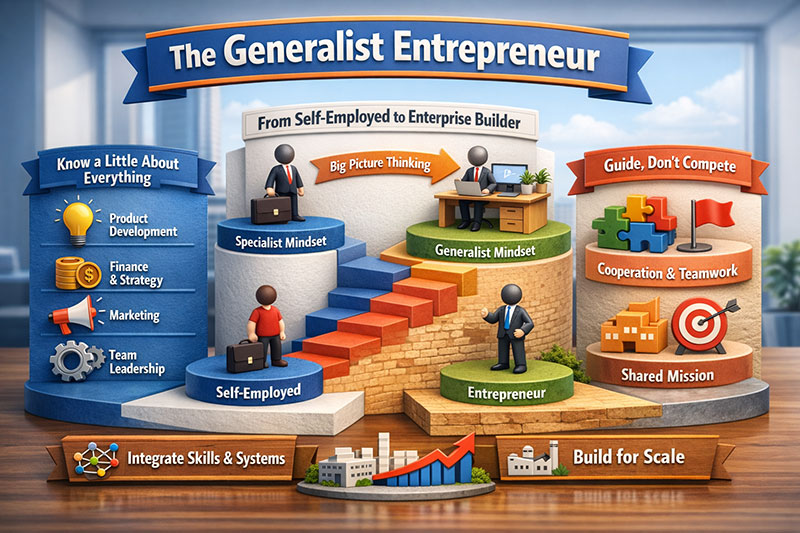
One of the most striking differences between entrepreneurs and self-employed persons is not so much a function of drive and motivation, but rather one of focus. While the self-employed individual leverages an ability, the entrepreneur builds a system. This explains why entrepreneurs are generalists, persons who have a general knowledge of many things but not specialists in any one area. Studies of entrepreneurship through historical analysis have shown that size is not a function of having all the answers, but rather of having the right questions and of integrating many different persons for a given purpose.
In starting a business, all functions meet at the entrepreneur’s desk: design, finance, personnel, marketing, service, regulation, and corporate culture. All functions meeting at one point make over-specialization not worth the risk. Management expert Peter Drucker famously wrote: “The entrepreneur always searches for change, responds to it, and exploits it as an opportunity” (Drucker, 1985). The exploitation of opportunity requires awareness of how technology, people, markets, and capital relate to each other, not just expertise in one area. Entrepreneurs with knowledge in finance can spot potential dangers from a distance; those with knowledge in human behaviour can prevent cultural decline; those with knowledge in strategy can turn before others.
The history of business in India has a parallel in parable form. In ‘The Panchatantra’, “The Four Friends” is a parable about a crow, a deer, a mouse, and a tortoise, each of whom has a different skill set. However, it is only together that they can ensure survival. This is a lesson for entrepreneurs, who must be able to think broadly if they are to be able to manage specialists. An entrepreneur who cannot “speak the language” of finance, technology, and operations is not empowered but dependent.
The generalist approach also changes the perspective on competition among entrepreneurs. In an organizational environment, an employee mind-set encourages internal rivalry, and people compete for recognition, promotion, or access to power. Although this type of competition can motivate people and boost their performance, it can also damage trust and knowledge sharing among them. Entrepreneurs, however, need to establish cooperative environments. In modern organizational studies, it has been revealed that high-performance companies prioritize psychological safety and shared goals rather than zero-sum competition (Edmondson, 2018).
From an Indian philosophy point of view, cooperation in place of competition has always had strong foundations. This has been aptly described by Mahatma Gandhi in these few words: “The best way to find yourself is to lose yourself in the service of others” (Gandhi, 1958). When it comes to businesses, there is more to leadership in India in place of competing with other members of the organization and working for collective excellence.
In the global context, the same applies to leadership theories today. Jim Collins, in his study on “the enduring companies,” introduces “Level 5 leaders,” who combine a sense of humility with a sense of will, focusing their ambitions on the organization and not on the self (Collins, 2001). These leaders are the conductors of an orchestra, in which they neither play on every instrument, but they have a good idea about how to combine everything. Ultimately, entrepreneurship is not the function of knowledge of all things or the highest level of specialization in a particular field. Rather, it is the function of integration.
The entrepreneur brings together people, concepts, capital, and values. With the knowledge of the basic concepts of how a company operates in terms of people and mission, the entrepreneur is able to see from the necessary perspective in order to cooperate instead of compete, in order to lead instead of control, in order to build enterprises that will endure long after the entrepreneur’s personal achievements have been forgotten.
Dr. Prahlada N.B
MBBS (JJMMC), MS (PGIMER, Chandigarh).
MBA in Healthcare & Hospital Management (BITS, Pilani),
Postgraduate Certificate in Technology Leadership and Innovation (MIT, USA)
Executive Programme in Strategic Management (IIM, Lucknow)
Senior Management Programme in Healthcare Management (IIM, Kozhikode)
Advanced Certificate in AI for Digital Health and Imaging Program (IISc, Bengaluru).
Senior Professor and former Head,
Department of ENT-Head & Neck Surgery, Skull Base Surgery, Cochlear Implant Surgery.
Basaveshwara Medical College & Hospital, Chitradurga, Karnataka, India.
My Vision: I don’t want to be a genius. I want to be a person with a bundle of experience.
My Mission: Help others achieve their life’s objectives in my presence or absence!
My Values: Creating value for others.
References:
- Drucker PF. Innovation and Entrepreneurship. New York: Harper & Row; 1985.
- Collins J. Good to Great: Why Some Companies Make the Leap… and Others Don’t. New York: HarperBusiness; 2001.
- Edmondson AC. The Fearless Organization: Creating Psychological Safety in the Workplace for Learning, Innovation, and Growth. Hoboken, NJ: Wiley; 2018.
- Gandhi MK. The Collected Works of Mahatma Gandhi, Vol. 36. New Delhi: Publications Division, Government of India; 1958.
























Leave a reply