
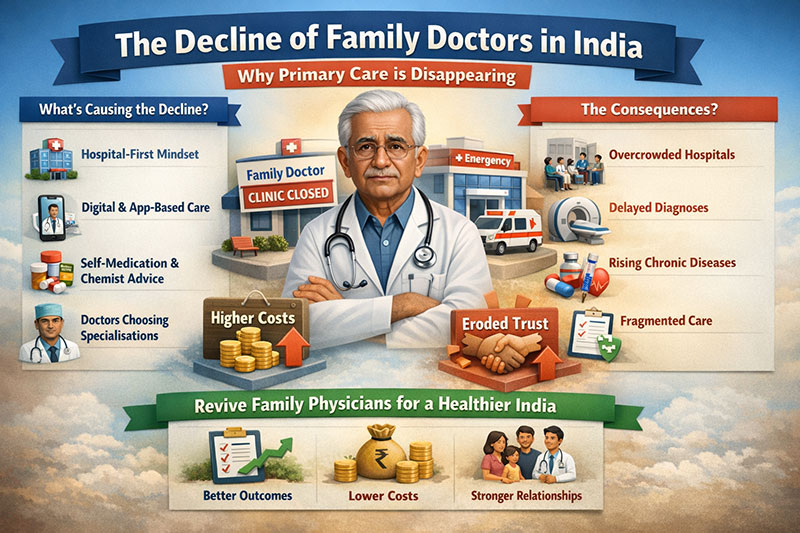
For several decades, the family physician was the unsung guardian of the health of the Indian nation. From small towns to cities, the vaidya or the family physician was acquainted with the families through the years. They knew not only the symptoms of the ailments of their patients but also the social nuances of their lifestyle—their diet, their working pressures, their economic constraints, and their family dynamics. This unseen fabric of the Indian healthcare system is now unravelling, and the damage is far more profound than we think.
There is a perceptible shift in the way the delivery of health care is organized in India, and this is towards a “hospital-first” mentality. Being sick is now synonymous with visiting a hospital, undergoing diagnostic and specialist consultations, even in cases that could have been handled at the primary level of care. World evidence clearly indicates that a strong focus on primary care is the most cost-effective way to achieve outcomes, and this is a message that the World Health Organization has reinforced again and again, indicating that a strong focus on primary health care is the most efficient and equitable way to achieve universal health coverage.
The digital health revolution has inadvertently fuelled this problem. Online doctor visits are all about speed and convenience, and they come with a price—the loss of a relationship that spans a lifetime. Healthcare delivery becomes a transaction—problem, pill, and star rating. “The answer to improved healthcare isn’t more technology, it’s improved relationships,” writes American surgeon and author Atul Gawande.
Self-medication, as well as advice from pharmacists, further diminishes the doctor-patient relationship. Antibiotics, steroids, and analgesics are often taken without consultation, thus concealing symptoms. The concept of a family physician is that of a gatekeeper, someone who understands when not to pursue, when to observe, and when to refer. This is not easily possible with episodic care.
Another structural problem is aspirational in nature. Young doctors are increasingly turning to specialization because of its reputation, security of remuneration, and institutional support. Community practice is viewed as non-professionally challenging and economically unviable. Nevertheless, countries like the UK, Canada, and Australia have strategically promoted general practice because they understand that while specialists cure diseases, family physicians safeguard health systems.
The economic implication for India is substantial. This is because poor primary healthcare translates into congested hospitals, unnecessary tests, increased patient expenses, and delayed diagnosis. Conditions such as diabetes, hypertension, asthma, and mental illnesses get exacerbated with the absence of constant monitoring. This translates into a situation where the patient perceives the healthcare system as disjointed.
Indian philosophy has always prized continuity and care. Mahatma Gandhi has reminded us that “It is health that is real wealth, not pieces of gold and silver.” Family physicians have always stood for this approach by emphasizing preventive care and overall health rather than just care during episodes of illness. The need to revive this mindset is neither a nostalgic nor a romantic approach; rather, it is a need based on strategy.
What can be done? Firstly, policy needs to shift the status of family medicine from being a less prestigious, less desirable option for a career into a respected, rewarding, and viable option for a career. Technology should be used to enhance family physicians, rather than replacing them. More importantly, it’s time for society to learn the value of having a personal doctor who knows you, not just your reports. The fact is that strong primary care means better health outcomes, lower costs, and greater trust. The reality is that if India wants a healthier tomorrow, it must address the need for the family physician to be at the forefront. The consequence could be realizing too late that in the pursuit of rapid scale and pace, we have sacrificed the human element in healthcare.
Dr. Prahlada N.B
MBBS (JJMMC), MS (PGIMER, Chandigarh).
MBA in Healthcare & Hospital Management (BITS, Pilani),
Postgraduate Certificate in Technology Leadership and Innovation (MIT, USA)
Executive Programme in Strategic Management (IIM, Lucknow)
Senior Management Programme in Healthcare Management (IIM, Kozhikode)
Advanced Certificate in AI for Digital Health and Imaging Program (IISc, Bengaluru).
Senior Professor and former Head,
Department of ENT-Head & Neck Surgery, Skull Base Surgery, Cochlear Implant Surgery.
Basaveshwara Medical College & Hospital, Chitradurga, Karnataka, India.
My Vision: I don’t want to be a genius. I want to be a person with a bundle of experience.
My Mission: Help others achieve their life’s objectives in my presence or absence!
My Values: Creating value for others.
Leave a reply






















Leave a reply