
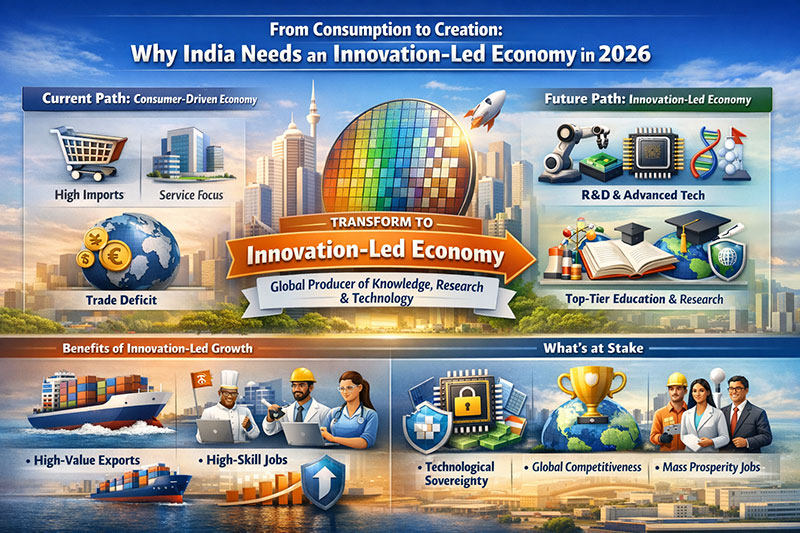
As India enters the year 2026, it does so with very enviable economic momentum. With high GDP growth, increasing domestic demand, and increased infrastructure spending, India has been one of the fastest-growing large economies in the world. However, this success now presents a strategic crossroads. With economic growth fuelled by consumption and service, although important in the short to medium term, it does not necessarily equate to long-term national wealth, technological autonomy, or global power. The question that India must now answer for itself is whether it wants to continue to be a large market for ideas, technologies, and intellectual property created elsewhere in the world or whether it wants to change itself into a global producer of knowledge, research, and innovation.
A consumption-driven model of the economy has the advantage of fast growth because it leverages the demographic and income advantage. Nevertheless, such an economy has inherent limitations because the growth in consumer spending is accompanied by the influx of quality technologies and intellectual property. On the other hand, an innovation-driven economy has the compound growth advantage because the economies that develop original research and intellectual property have the capacity to export not only physical goods but also “invisible” value in the form of software and know-how. Such exports have the capacity to generate higher margins and drive the prosperity of the economy.
Technologically, “the global economy is being restructured around a new set of strategic capabilities.” Artificial intelligence, semiconductors, biotechnology, climate tech, cyber security, advanced materials, and digital manufacturing have ceased to be “niche sectors,” and have instead become “foundational layers of national power.” Nations that have these layers “drive markets, standards, and even geopolitical outcomes.” However, “if India remains a consumer of these sectors, it will continue to pay a technology rent.” On the other hand, being a producer, no matter how non-dominant, “changes India’s bargaining power and resilience.”
The role of semiconductors is a case in point. Chip technology is at the forefront of military, telecommunication, healthcare, the automotive sector, and artificial intelligence computing. India’s recent focus on developing the country’s own semiconductor and advanced electronic technology is, therefore, not just a matter of industrial policy, it is a necessity. Such a focus, even if it is only partially successful, can significantly increase the security of the supply chain, help develop a talent ecosystem of the highest quality, and insulate the country against disruptions in the global environment. A similar case can be made in the area of health technology, where the country’s scale and disease diversity can provide a unique foundation for innovation, provided the research environment is well governed and supported through a strong translational ecosystem.
The international ranking of Indian innovation has been improving over the past few years, but the next step, from efficient and frugal innovation to frontier research, will be much more challenging. High-quality research investment, greater university-industry collaboration, a strong doctoral and postdoctoral pipeline, and mechanisms at the institutional level for translating lab-to-product success at a globally competitive level will be needed. Schemes such as the “Anusandhan National Research Foundation” indicate awareness of the imperatives but will depend on implementation, delivery, and national missions being kept in sight.
The employment aspect makes this transition even more pressing. Jobs can be created on a massive scale through consumption-driven growth; however, these are often low-productivity and low-wage jobs. Knowledge-driven economies create more valuable employment opportunities across the board, from research scientists to engineers, advanced manufacturing technicians, and specialized services providers. Such employment opportunities increase productivity per employee and are the foundation for a strong middle-class society. A country with India’s size can neither create mass prosperity by itself nor through wage growth led by productivity innovation.
However, there is also the sovereignty element that should not be overlooked. Strategic autonomy in the twenty-first century means not only energy security and defence security but also security of science, technology, and data. Export controls, technology blockades, and research collaboration restrictions are emerging as instruments of statecraft. An economy that is capable of knowledge production will always have the ability to adapt, substitute, or innovate within the same. But an economy that is mainly reliant on foreign intellectual property will always be on the brink of vulnerability.
Becoming a knowledge-producing country does not necessarily mean that the country needs to forego the model of growth through consumption. It simply means that the engine of economic growth needs to be upgraded so that the domestic demand is supplemented by globally competitive innovation. This would require an increased and better-structured investment in innovation, more incentives for private innovation, and an innovation reward system that honours achievements rather than activities. There would also be a need for an efficient innovation-to-market process.
The benefits of this transition are great. From an economic point of view, it allows for more valuable exports and more robust growth that is less tied to domestic consumption patterns. From a technological point of view, it allows for reduced strategic vulnerability and faster development of advanced tools that are better suited to Indian needs. From a societal point of view, it provides high-quality jobs, enhances research careers, and slows down brain drain by providing world-class opportunities in India. Nevertheless, there are also some risks involved in this transition. These challenges, however, can be managed through effective policy design. Mission-crafted funding with milestones, incentives attuned to outcomes, innovation clusters spread over geography, and skill pipelines can help ensure that the gains from a knowledge economy are shared by all. An enabling regulatory environment and cooperation among ministries can help smooth the way, while learning from the world and building capabilities within the country can help speed up the process while maintaining freedom.
The current phase of growth in India presents a moment of opportunity. With growth already on such a strong footing, it is a country that is able to invest purposefully in the next stage of growth. The choice facing this country in 2026 is not between consumption and innovation, but between being a consumer of growth or a producer of ideas, innovation, or solutions. While it is a more difficult, more gradual, more complex path, it is also a path to lasting prosperity.
Dr. Prahlada N.B
MBBS (JJMMC), MS (PGIMER, Chandigarh).
MBA in Healthcare & Hospital Management (BITS, Pilani),
Postgraduate Certificate in Technology Leadership and Innovation (MIT, USA)
Executive Programme in Strategic Management (IIM, Lucknow)
Senior Management Programme in Healthcare Management (IIM, Kozhikode)
Advanced Certificate in AI for Digital Health and Imaging Program (IISc, Bengaluru).
Senior Professor and former Head,
Department of ENT-Head & Neck Surgery, Skull Base Surgery, Cochlear Implant Surgery.
Basaveshwara Medical College & Hospital, Chitradurga, Karnataka, India.
My Vision: I don’t want to be a genius. I want to be a person with a bundle of experience.
My Mission: Help others achieve their life’s objectives in my presence or absence!
My Values: Creating value for others.
Leave a reply



























Leave a reply