
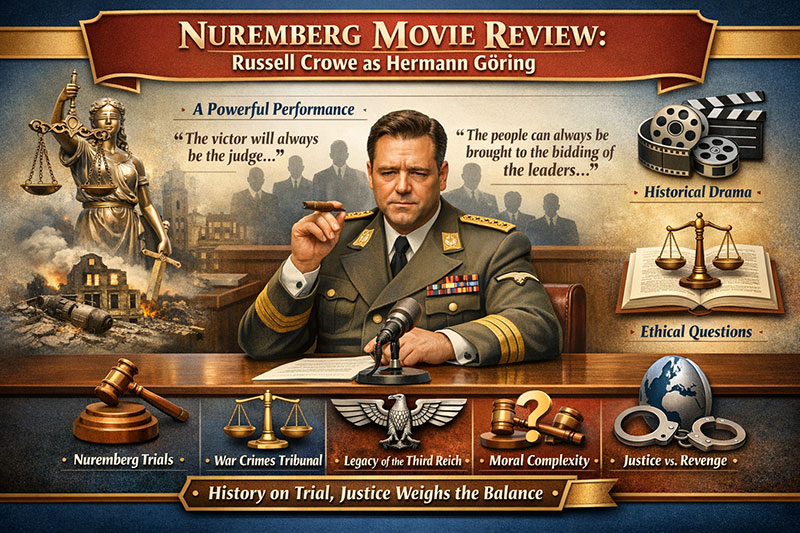
The movie “Nuremberg” (2025) is far from a courtroom drama; it is a reflection on power, moral bankruptcy, and the tentative emergence of international justice in the aftermath of disaster. Based on the historical Nuremberg Trials of 1945-46, Nuremberg recreates the judicial and psychological struggle to bring to justice the perpetrators of the Third Reich while posing an underlying question: “How does civilization treat men who once established the very machinery of modern states?”
But at the center of this production is Russell Crowe, whose performance as Hermann Göring has been cited as one of the greatest in the courtroom drama genre. Crowe does not depict Göring as the ranting, raving villain, but as the urbane, clever, and confident man who feels that history may yet exonerate him, even in the confines of his cell. This particular reading of the character corresponds with the historical accounts of an American prison psychiatrist named Douglas Kelley, whose interviews with Göring revealed him to be a man with a narcissistic personality and tremendous charm.
Historical context proves to be very important. Göring was no minor functionary in the Nazi party; he was Hitler’s successor for most of the Nazi regime’s existence, the founder of the Gestapo, the mastermind behind the Four Year Plan, and one of the most important figures in the economic and military mobilization of Nazi Germany. The movie correctly portrays the concern that prosecutors had that Göring could hijack the trial and turn the courtroom into a political forum. The quote from Göring’s real-life interrogation— “The victor will always be the judge and the vanquished the accused”—expresses his attitude towards the trial.
Crowe is strongest during his word play sequences, especially those pertaining to psychological interviews. Harman Göring veers wildly between bombastic showboating and calculated openness, sometimes using language as a tool. “The people can always be brought to the bidding of the leaders… all you have to do is tell them they are being attacked,” is one of the most chilling moments, a nod to Göring’s notorious description of mass persuasion. The film uses such lines not as historical curiosities, but as warnings—reminders that authoritarianism thrives not only on cruelty, but on fear expertly framed as patriotism.
More importantly, Nuremberg resists the urge to break down the proceedings into a simplistic good vs. evil dichotomy. Instead, it recognises the legal innovativeness—but also contentiousness—of prosecuting crimes of humanity and “victors’ justice.” Nevertheless, it eventually reaffirms the imperatives of the proceedings. The courtroom thus serves as a metaphorical connector of barbarism and law, implying that even novel crimes have to be responded to with reason rather than with vengeance.
The strength of Crowe’s portrayal of Göring is that he is clearly human: vain, intelligent, and manipulative, and this challenges the audience to accept Hannah Arendt’s observation about the “banality of evil.” His subsequent suicide, also accurate, indicates that his defiance is ultimately a failure, since he gets away from the gallows but not from history’s disapproval.
In sum, “Nuremberg” is a success as historical drama and as philosophical exploration, and it is Crowe’s performance as Hermann Göring that lends the film its weight. In resisting simplification and instead offering complexity, Crowe forces the viewer to confront the truth that the most dangerous actors in history are frequently neither monstrous nor marginal, but rather persuasive and central.
Dr. Prahlada N.B
MBBS (JJMMC), MS (PGIMER, Chandigarh).
MBA in Healthcare & Hospital Management (BITS, Pilani),
Postgraduate Certificate in Technology Leadership and Innovation (MIT, USA)
Executive Programme in Strategic Management (IIM, Lucknow)
Senior Management Programme in Healthcare Management (IIM, Kozhikode)
Advanced Certificate in AI for Digital Health and Imaging Program (IISc, Bengaluru).
Senior Professor and former Head,
Department of ENT-Head & Neck Surgery, Skull Base Surgery, Cochlear Implant Surgery.
Basaveshwara Medical College & Hospital, Chitradurga, Karnataka, India.
My Vision: I don’t want to be a genius. I want to be a person with a bundle of experience.
My Mission: Help others achieve their life’s objectives in my presence or absence!
My Values: Creating value for others.
Leave a reply


























Leave a reply