India’s ambition to emerge as a global medical tourism powerhouse receives its most concrete policy backing yet in Union Budget 2026–27, which deliberately positions Medical Value Tourism within the larger vision of “Viksit Bharat”. Rather than treating healthcare travel as a peripheral activity, the Budget integrates medical tourism into its services-sector renewal, care-economy expansion, infrastructure push, and ease-of-doing-business reforms
At the heart of the Budget is a shift from rhetoric to execution. As the document itself frames India’s growth philosophy: “Action over ambivalence, reform over rhetoric, people over populism.” This framing is especially relevant to medical tourism, a sector that depends simultaneously on clinical excellence, regulatory clarity, skilled manpower, and patient-friendly ecosystems.
Dedicated Medical Tourism Hubs: From Intent to Infrastructure
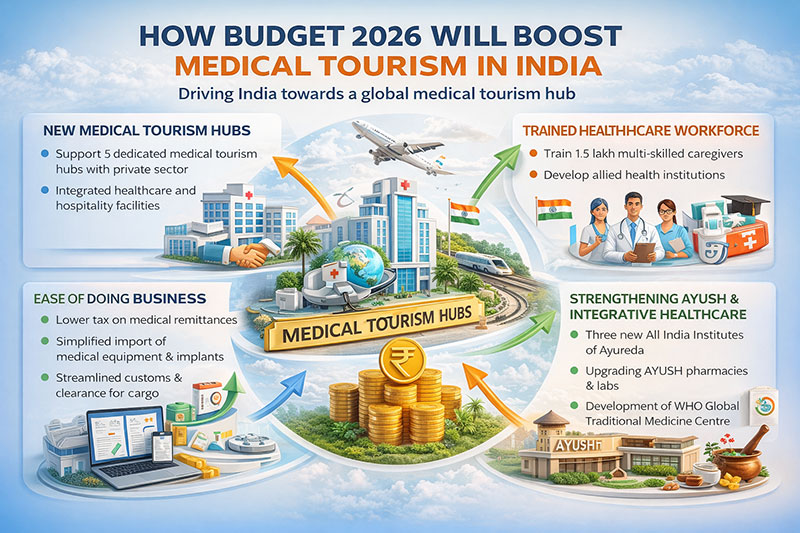
One of the most direct interventions is the proposal to support States in establishing five Medical Value Tourism hubs in partnership with the private sector.
This is a decisive move away from fragmented hospital-led efforts toward cluster-based destination healthcare. These hubs are expected to integrate tertiary hospitals, diagnostics, rehabilitation centres, hospitality, translators, and travel facilitation under a single regional brand.
For example, a cardiac-orthopaedic hub in South India or an oncology-transplant hub in Western India can now be developed with structured state support, aligning public infrastructure with private clinical capacity. This model mirrors global best practices seen in destinations such as South Korea and Thailand, where medical tourism thrives on ecosystem depth rather than isolated excellence.
Human Capital: Caregivers as the Silent Enablers
Medical tourists judge not only outcomes, but experience. Recognising this, Budget 2026 places strong emphasis on building a care ecosystem, including the training of 1.5 lakh multi-skilled caregivers and the upgrading of Allied Health Professional (AHP) institutions across ten disciplines
This is crucial. India’s cost advantage in medical tourism has always been clinical; Budget 2026 now addresses the service gap. Skilled nurses, physiotherapists, dialysis technicians, transplant coordinators, and geriatric carers are the backbone of long-stay international patients. The Budget’s people-centric approach reflects its stated commitment to “building people’s capacity and making them strong partners in India’s path to prosperity.”
AYUSH and Integrative Care: India’s Differentiator
Another strategic lever is the strengthening of India’s traditional medicine ecosystem. The Budget announces three new All India Institutes of Ayurveda, upgrades to AYUSH pharmacies and drug-testing laboratories, and further development of the WHO Global Traditional Medicine Centre
This is internationally significant. The World Health Organization has repeatedly emphasised the need for evidence-based integration of traditional medicine into national health systems, and India is uniquely positioned to lead this space. For medical tourists seeking post-operative rehabilitation, chronic pain management, metabolic care, or wellness-oriented recovery, integrative AYUSH-based services offer a value proposition few countries can match.
Cost, Compliance, and Convenience: Making India Easier to Choose
Budget 2026 also quietly removes several friction points that have historically discouraged international patients. The reduction of Tax Collected at Source (TCS) on overseas tour packages and medical remittances under the Liberalised Remittance Scheme to 2% directly lowers financial barriers for inbound and outbound health-related travel
Further, the push for single, interconnected digital windows for cargo and service clearances, extended validity of advance rulings, and trust-based customs systems contributes to smoother import of medical equipment, implants, and consumables—an often overlooked but critical enabler of complex procedures such as transplants and robotic surgeries.
Infrastructure and Tier-II/Tier-III Cities: The Next Medical Destinations
Medical tourism does not flourish in isolation from urban infrastructure. Budget 2026’s massive public capital expenditure, focus on Tier-II and Tier-III cities, high-speed rail corridors, improved airports, and city economic regions indirectly but powerfully support healthcare travel
As tertiary hospitals increasingly emerge in cities like Indore, Coimbatore, Kochi, Nagpur, and Bhubaneswar, the Budget’s infrastructure vision ensures that medical tourists are no longer restricted to overcrowded metros. This decentralisation aligns perfectly with India’s stated aim to ensure “every region and sector has access to opportunities for meaningful participation.”
A Global Signal
While Budget 2026 is domestically focused, it sends a clear signal to the world: India is serious about becoming a trusted, scalable, and patient-centric global healthcare destination. By embedding medical tourism within services-sector reform, workforce development, AYUSH integration, and ease-of-living measures, the Budget moves the sector from aspiration to execution.
In doing so, it echoes the Budget’s own guiding belief: to transform aspiration into achievement, and potential into performance—a philosophy that may well define the next decade of India’s medical tourism story.
Dr. Prahlada N.B
MBBS (JJMMC), MS (PGIMER, Chandigarh).
MBA in Healthcare & Hospital Management (BITS, Pilani),
Postgraduate Certificate in Technology Leadership and Innovation (MIT, USA)
Executive Programme in Strategic Management (IIM, Lucknow)
Senior Management Programme in Healthcare Management (IIM, Kozhikode)
Advanced Certificate in AI for Digital Health and Imaging Program (IISc, Bengaluru).
Senior Professor and former Head,
Department of ENT-Head & Neck Surgery, Skull Base Surgery, Cochlear Implant Surgery.
Basaveshwara Medical College & Hospital, Chitradurga, Karnataka, India.
My Vision: I don’t want to be a genius. I want to be a person with a bundle of experience.
My Mission: Help others achieve their life’s objectives in my presence or absence!
My Values: Creating value for others.
Leave a reply



















India Health Tour serves a range of treatments that is trusted by patients all across the world. We are a globally recognized institution that provides treatments related to cosmetics, gynecology, weight loss, fertility related treatments, cardiac treatments, orthopedics, oncology and so on.
Reply