
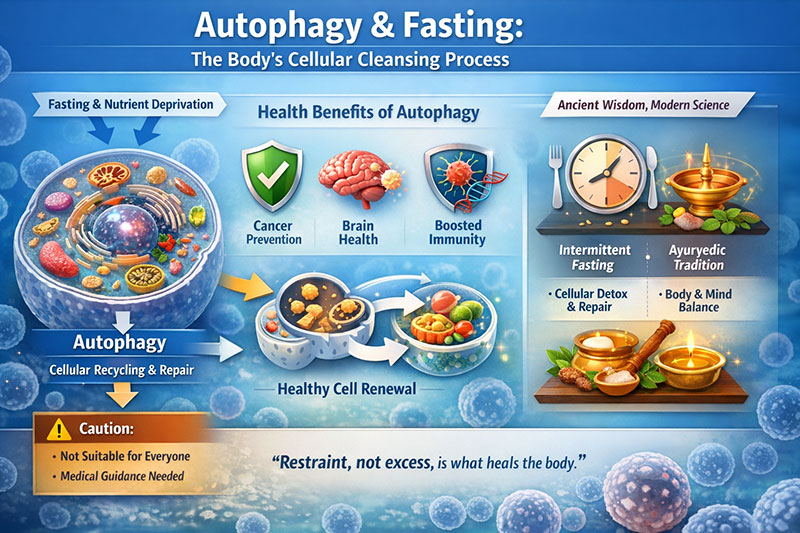
Autophagy, which comes from the Greek words “auto” (self) and “phagy” (eating), is one of the most basic ways that humans stay alive. Cells use this mechanism to find damaged, broken, or extra parts and recycle them to keep the cell’s structure intact. Autophagy is no longer just a fringe idea about health; it is now seen as a key part of staying well, avoiding sickness, and living a long life.
Yoshinori Ohsumi won the 2016 Nobel Prize in Physiology or Medicine for explaining how autophagy works at the molecular level. This brought the importance of autophagy into the mainstream of medicine. Ohsumi said in his Nobel talk that “autophagy is necessary for cellular homeostasis and adaptation to starvation.” This new information changed how doctors and scientists think about fasting, metabolic stress, and how well the body can fight off disease.
How Autophagy Functions
Autophagy is always going on at a low level, doing regular housekeeping for cells. But when you fast, cut back on calories, or don’t get enough nutrients, it is very significantly elevated. When there isn’t enough fuel from outside the cell, it turns inward. It breaks down damaged mitochondria, misfolded proteins, and pathogens that are inside the cell and transforms them into amino acids and fatty acids that can be used.
This adaptive reaction is evolutionarily conserved, seen in everything from yeast to humans, which shows how important it is for life. Autophagy functions as a quality-control mechanism, inhibiting the buildup of cellular waste that may induce inflammation, genetic instability, and tissue degeneration.
Preventing disease and its effects on treatment
One of the most interesting things about autophagy is how it helps keep diseases from happening.
Cancer: Autophagy stops tumours from starting by getting rid of damaged organelles and lowering oxidative stress. Autophagy that doesn’t work right causes genetic instability, which is a well-known sign of cancer. However, once cancer has set in, certain tumours use autophagy to stay alive, which makes it a double-edged sword and a focus of active cancer research.
Neurodegenerative diseases:
Alzheimer’s, Parkinson’s, and Huntington’s disease are all diseases that have harmful protein aggregates. Autophagy helps get rid of amyloid-β and tau proteins, which slows down damage to neurons. Mizushima and Levine notably called autophagy “a major intracellular degradation system essential for neuronal survival.”
Infections and the immune system:
Autophagy directly contributes to innate immunity by digesting intracellular bacteria and viruses, a process known as xenophagy. It also improves the presentation of antigens, which connects the innate and adaptive immune systems. This is especially important for people with long-term illnesses or weak immune systems.
The Indian Viewpoint: Old Knowledge Meets New Biology
Interestingly, the idea of autophagy fits in well with traditional Indian health ideas. Historically, practices like upavāsa(therapeutic fasting) in Ayurveda and Jain traditions were promoted not just for spiritual discipline but also for physical purification.
Contemporary Indian clinicians are progressively acknowledging fasting-induced metabolic shift as clinically significant. Dr. Prabhat Jha, a leading Indian public health expert, has observed that “lifestyle-linked metabolic disorders are now India’s greatest health burden; interventions that restore metabolic balance are no longer optional.” Autophagy explains how intermittent fasting and eating fewer calories can help with obesity, type 2 diabetes, and fatty liver disease, which are all quite common in India.
Examples from the Clinic
In metabolic syndrome, a long-term excess of nutrients stops autophagy, which causes insulin resistance and inflammation in cells. Clinical research indicates that intermittent fasting regimes enhance insulin sensitivity and lipid profiles, partially via the activation of autophagy.
In individuals at risk for neurodegenerative diseases, caloric restriction has been linked to enhanced cognitive indicators and diminished neuroinflammation in experimental and preliminary clinical investigations.
Controlled nutrition modulation is being researched to improve immune responses and recovery, even in surgical and critical care settings.
A Word of Caution
Autophagy is good, but fasting too much or without rules is not always safe. Children, pregnant women, frail elderly adults, and those with eating disorders or chronic illnesses necessitate meticulous medical oversight. Autophagy is a treatment, not something everyone should do.
As Levine and Kroemer correctly put it, “Autophagy is neither good nor bad—it is context-dependent.”
Advice to Keep in Mind
Autophagy is a big change in how we think about preventive and regenerative medicine. It connects molecular biology, metabolism, immunology, and even cultural health practices. For doctors, it gives them a way to explain to patients how to change their lifestyles. For politicians, it makes it even more important to deal with overeating and not being active. And for people, it teaches us that sometimes, holding back is what cures the body, not going overboard.
Dr. Prahlada N.B
MBBS (JJMMC), MS (PGIMER, Chandigarh).
MBA in Healthcare & Hospital Management (BITS, Pilani),
Postgraduate Certificate in Technology Leadership and Innovation (MIT, USA)
Executive Programme in Strategic Management (IIM, Lucknow)
Senior Management Programme in Healthcare Management (IIM, Kozhikode)
Advanced Certificate in AI for Digital Health and Imaging Program (IISc, Bengaluru).
Senior Professor and former Head,
Department of ENT-Head & Neck Surgery, Skull Base Surgery, Cochlear Implant Surgery.
Basaveshwara Medical College & Hospital, Chitradurga, Karnataka, India.
My Vision: I don’t want to be a genius. I want to be a person with a bundle of experience.
My Mission: Help others achieve their life’s objectives in my presence or absence!
My Values: Creating value for others.
Leave a reply


























Leave a reply