
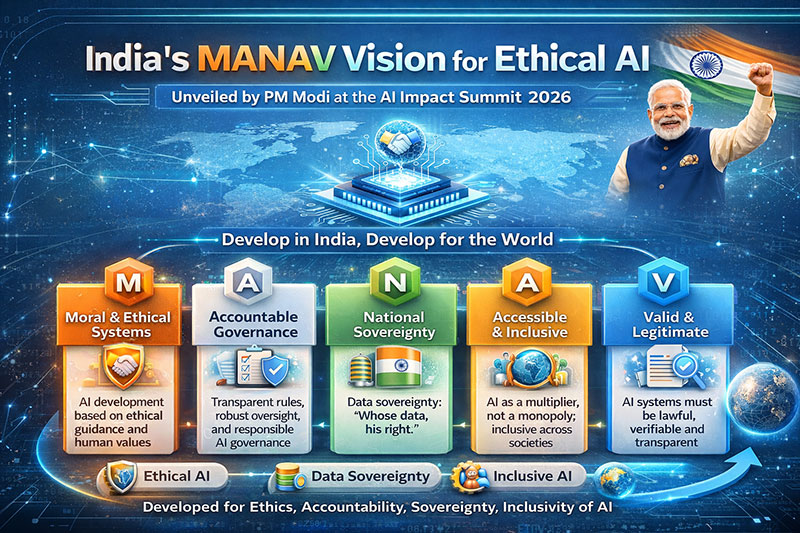
At the 2026 in New Delhi, Prime Minister Narendra Modi articulated India’s “MANAV” vision for artificial intelligence—a human-first doctrine that places ethics, accountability, inclusivity, and data sovereignty at the heart of technological advancement. The address marked more than a policy announcement; it signalled India’s ambition to shape the moral architecture of the AI age.
The MANAV framework—Moral and ethical systems, Accountable governance, National sovereignty, Accessible and inclusive deployment, and Valid and legitimate implementation—offers a structured response to one of the most pressing questions of our time: how should humanity govern intelligence it has created? Rather than framing AI as a race for dominance, the summit emphasized AI as a global common good.
The reporting of this landmark development by The Economic Times deserves appreciation for its clarity and analytical depth. The article succinctly captured the core philosophy behind the MANAV doctrine while placing it within a global technological context. In an era where AI discussions are often polarized between utopian optimism and dystopian alarmism, the coverage maintained balance and intellectual sobriety. Responsible journalism of this nature strengthens public understanding at a time when technological literacy is as important as digital access.
From Competitive AI to Responsible AI
The summit’s central theme was clear: AI must be “powerful but principled”. This aligns with global regulatory movements such as the European Union’s AI Act and evolving governance conversations in the United States and Asia. However, India’s framing introduces a distinctive dimension—linking AI governance with democratic values, demographic diversity, and developmental equity.
India’s call to “design in India, develop for the world” reflects strategic confidence. With one of the youngest populations globally and immense linguistic and socioeconomic diversity, India presents one of the most complex testing grounds for AI systems. An AI model capable of functioning effectively across India’s scale and plurality can likely scale globally. This is not merely technological ambition; it is a positioning statement that India seeks to be both innovator and rule-setter.
Internationally, technology leaders have echoed similar concerns about responsible development. Microsoft CEO Satya Nadella has noted that trust will determine AI’s long-term legitimacy. Stanford’s Fei-Fei Li has emphasized the idea of “augmented intelligence,” highlighting that AI should enhance human decision-making rather than replace it. The MANAV doctrine resonates strongly with these global sentiments.
Ethics Embedded in Architecture
One of the summit’s most consequential proposals involved embedding trust mechanisms directly into AI systems—through authenticity labelling, watermarking, and clear-source standards to counter deepfakes and fabricated content. As generative AI increasingly produces text, images, and video indistinguishable from human output, the risk of misinformation escalates.
Deepfakes have already influenced elections, financial markets, and social harmony worldwide. The emphasis on authenticity labels represents a proactive strategy to build trust into the digital ecosystem from inception. Rather than reacting to crises, this approach advocates preventive governance.
For technology companies, this means adopting “trust-by-design” frameworks—algorithmic audits, bias testing, explainability layers, and compliance architectures that anticipate global regulation. For governments, it calls for independent oversight authorities and internationally harmonized standards.
Data Sovereignty and Inclusive Growth
The MANAV vision’s emphasis on national sovereignty—“whose data, his right” —highlights a growing geopolitical reality. Data has become the raw material of the AI economy. Nations that lack robust governance risk becoming mere suppliers of digital resources without strategic leverage.
India’s experience with digital public infrastructure—Aadhaar, UPI, and other scalable platforms—demonstrates how technology can operate at population scale while retaining policy oversight. Extending this philosophy into AI governance could empower startups, researchers, and innovators to build solutions grounded in local needs.
The accessibility principle within MANAV also addresses the risk of monopolization. Globally, AI capability is concentrated among a handful of corporations. Without inclusive frameworks, the digital divide may widen. India’s emphasis that AI should be a “multiplier, not a monopoly” reinforces the importance of open ecosystems, academic-industry collaboration, and public compute infrastructure.
Human Agency in an AI Age
Perhaps the most compelling metaphor offered at the summit compared AI to GPS: it may suggest routes, but humans choose the destination. This analogy reframes AI as advisory rather than authoritative. It underscores that the future of AI is not predetermined but shaped by collective decisions made today.
In healthcare, AI supports diagnosis but does not replace clinical judgment. In education, it personalizes learning but cannot substitute mentorship. In governance, predictive analytics inform but do not define policy values. The emphasis remains on co-creation—humans and intelligent systems collaborating rather than competing.
A Moment of Global Transition
The 2026 was described as a historic transition point. Unlike previous technological revolutions that unfolded over decades, AI’s evolution is occurring in real time. This compresses both opportunity and risk.
India’s MANAV vision offers a structured response to this compressed timeline. It blends innovation with ethical restraint, ambition with accountability. Whether this framework translates into enforceable policy and scalable systems will depend on sustained institutional commitment.
The thoughtful reporting by The Economic Times ensures that this vision reaches policymakers, entrepreneurs, academics, and citizens with clarity and context. At a time when AI narratives can easily become sensationalized, responsible journalism plays a vital role in guiding informed discourse.
The decisions made now—by governments, corporations, and societies—will determine whether AI becomes a force of concentration or collaboration, disruption or dignity. The MANAV doctrine signals India’s intent to shape that trajectory not only for itself but for the world.
.Dr. Prahlada N.B
MBBS (JJMMC), MS (PGIMER, Chandigarh).
MBA in Healthcare & Hospital Management (BITS, Pilani),
Postgraduate Certificate in Technology Leadership and Innovation (MIT, USA)
Executive Programme in Strategic Management (IIM, Lucknow)
Senior Management Programme in Healthcare Management (IIM, Kozhikode)
Advanced Certificate in AI for Digital Health and Imaging Program (IISc, Bengaluru).
Senior Professor and former Head,
Department of ENT-Head & Neck Surgery, Skull Base Surgery, Cochlear Implant Surgery.
Basaveshwara Medical College & Hospital, Chitradurga, Karnataka, India.
My Vision: I don’t want to be a genius. I want to be a person with a bundle of experience.
My Mission: Help others achieve their life’s objectives in my presence or absence!
Leave a reply




























Leave a reply