
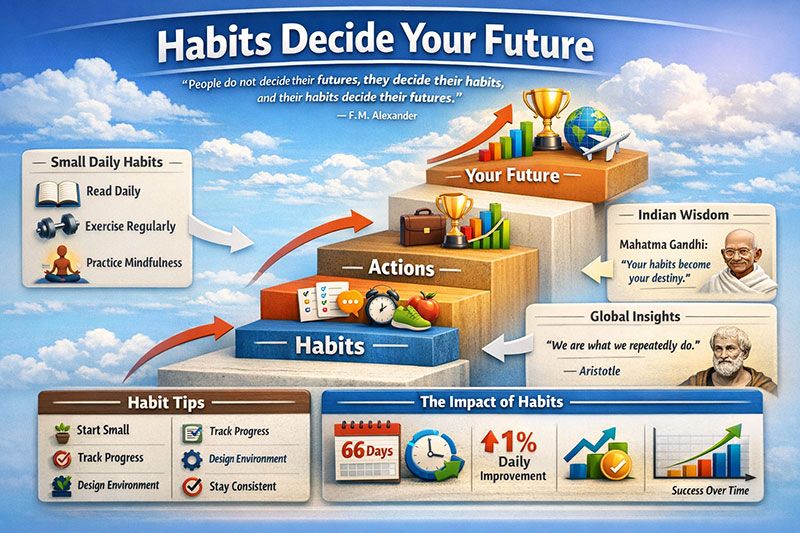
“People don’t choose their futures; they choose their habits, and their habits choose their futures.” — Frederick Matthias Alexander.
F. M. Alexander’s deep thought reminds us that fate is not often a big deal. It is a gradual buildup of acts that happen over and over. Many of us want amazing futures, but not many of us stop to think about the daily practices that are making them happen.
We often think that one big choice will change our lives. But history, science, and personal experience show us that little, persistent actions can lead to amazing results.
The Science of Habits and Fate
Modern behavioural science backs up what Alexander said. James Clear’s book Atomic Habits says that “every action you take is a vote for the kind of person you want to be.” Neuroscientific research indicates that repetitive actions reinforce neural connections, rendering habits automatic over time. According to a study from University College London (Lally et al., 2010), it takes an average of 66 days for a new habit to become automatic.
So, habits are not just random choices. They are investments in the brain.
You are not just doing a task when you choose to read every day, work out consistently, be thankful, or improve a skill. You are also establishing your identity. On the other hand, procrastination, negativity, and neglect build up just as strongly.
The Indian View: Dharma as Discipline
Indian philosophy has long understood how powerful disciplined repetition can be for change. The Bhagavad Gita says that doing things on a regular basis that are in line with your goals (karma yoga) improves your character and your future.
Mahatma Gandhi famously said, “Your beliefs turn into your thoughts, your thoughts turn into your words, your words turn into your actions, your actions turn into your habits, your habits turn into your values, and your values turn into your destiny.”
This development is basically exactly like what Alexander said.
Think about the life of A. P. J. Abdul Kalam. He was born into a poor family, yet he developed a strong work ethic, a desire to learn, and a strict study routine. His past didn’t decide his destiny; it was made through everyday learning and hard work. Those behaviours made him India’s “Missile Man” and thereafter its President.
Even yoga and pranayama don’t change anything in one session, according to ancient Indian practice. The daily discipline, or habit, is what gives you clarity, strength, and resilience.
The Compound Effect from an International Point of View
The same idea is heard all across the world.
Aristotle said, “We are what we do over and over.” So, excellence isn’t something you do, it’s something you do all the time.
Elite athletes are great examples. Michael Phelps didn’t just decide to win 23 Olympic gold medals on a whim. His fate was shaped by his daily 4 a.m. swim sessions, constant training cycles, and strict recovery routines.
Benjamin Franklin also created a personal system for daily self-reflection that kept account of virtues including humility, temperance, and hard work. His habits of doing things in a certain way defined not only who he was but also how he changed the course of world history.
The world celebrates results. It hardly ever sees the routine.
Evidence from Performance Psychology
Psychologists examining high achievers generally recognize “deliberate practice” as a significant predictor of exceptional performance. Anders Ericsson’s research demonstrated that proficiency in various domains, including music and medicine, relies more on systematic, repetitive practice than on inherent skill.
This is in line with habit theory, which says that repetition is what makes something great.
The problem, though, is habits that we don’t even know we have. A sedentary lifestyle, too much time spent in front of a screen, long-term stress, and not getting enough sleep are all habits. The World Health Organization says that not getting enough exercise is a major cause of illness around the world. Small things that you don’t do every day add up to big problems in the future.
Habits are neutral; they make any direction we select stronger.
The Daily Vote That Can’t Be Seen
Every morning, there are silent choices to make:
Read or scroll?
Should you work out or put it off?
Think or act?
Learn or stay at ease?
Each option is small. But over time, those little choices become who you are.
A young student who reads 20 pages per day finishes about 30 to 40 books a year. 300 to 400 books over ten years is a big change for your mind.
A professional who gets better by 1% every day will see their skills expand exponentially. James Clear says that if you get 1% better every day, you’ll be almost 37 times better in a year.
Habits don’t yell. They spoke in low tones. But they always shape.
The Leadership Dimension
For leaders, especially in healthcare, academia, business, or government, culture is a way of life.
Institutional greatness comes from an organization that makes timeliness, ethical behaviour, documentation, learning, and accountability habits. On the other hand, tiny mistakes that are allowed to happen every day turn into big problems.
Habit ecosystems are what make great institutions great.
Making habits that change your life.
Start small; small habits last.
Don’t say, “I want to run.” Link to your identity. Say, “I’m going to be a runner.”
Keep track of progress—measuring helps keep things steady.
Design Environment: The environment has a bigger effect on behavior than willpower.
Be patient; habits take longer to show results.
Keep in mind that visible accomplishment is often the result of dedication that isn’t evident.
The Last Reflection
Alexander’s remark encourages taking responsibility. We can’t control everything that happens, but we can control how often we do things.
Futures aren’t written down in big, dramatic ways. They are carved into daily routines.
“Take up one idea,” advised Swami Vivekananda. Make that one concept your life; think about it, dream about it, and live by it.
That’s the best form of habit.
Pick one behaviour today that fits with your highest vision. Keep it safe. Say it again. Make it better.
Because you won’t be making decisions about your future tomorrow.
You are making the choice today, in a slow, steady way, one habit at a time.
Dr. Prahlada N.B
MBBS (JJMMC), MS (PGIMER, Chandigarh).
MBA in Healthcare & Hospital Management (BITS, Pilani),
Postgraduate Certificate in Technology Leadership and Innovation (MIT, USA)
Executive Programme in Strategic Management (IIM, Lucknow)
Senior Management Programme in Healthcare Management (IIM, Kozhikode)
Advanced Certificate in AI for Digital Health and Imaging Program (IISc, Bengaluru).
Senior Professor and former Head,
Department of ENT-Head & Neck Surgery, Skull Base Surgery, Cochlear Implant Surgery.
Basaveshwara Medical College & Hospital, Chitradurga, Karnataka, India.
My Vision: I don’t want to be a genius. I want to be a person with a bundle of experience.
My Mission: Help others achieve their life’s objectives in my presence or absence!
Leave a reply






















Leave a reply