
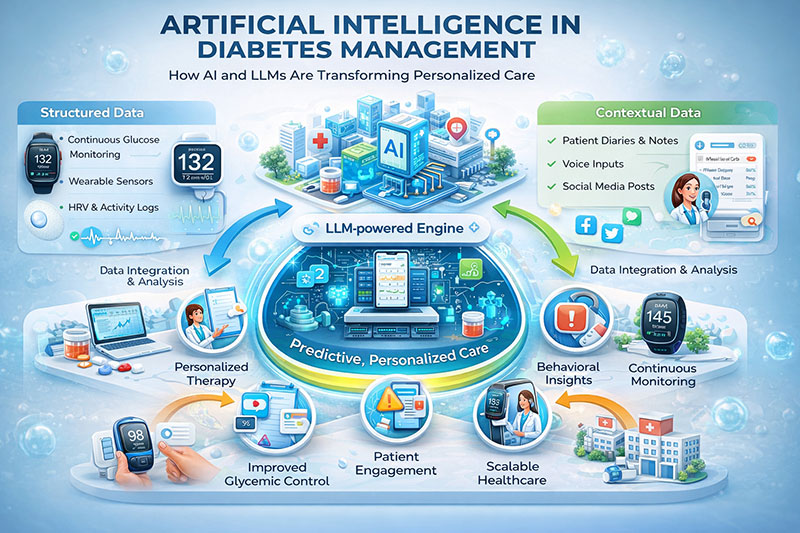
Diabetes mellitus is one of the most pressing health issues of the twenty-first century. Diabetes affects hundreds of millions of people worldwide and is accompanied by serious complications such as renal failure, cardiovascular disease, neuropathy, blindness, and amputations. Urbanization, sedentary lifestyles, and dietary habits are some of the factors that have accelerated the growth of this disease, particularly in countries such as India, which now faces one of the highest disease burdens worldwide. This is where the urgent need for innovative solutions arises, taking the disease management paradigm beyond traditional clinical approaches. Artificial intelligence, specifically large language models, is now emerging as a powerful paradigm shift that has the potential to transform the traditional, reactive approach to diabetes management into a more proactive and personalized approach to health care.
Traditionally, the management of diabetes has relied on intermittent blood glucose monitoring, consultations with clinicians, and maintaining lifestyle diaries. Although these tools provide useful clinical information, they are often based on incomplete and fragmented clinical data. For example, intermittent blood glucose monitoring using finger prick methods may not provide useful clinical information, as it may not be able to detect glycaemic fluctuations throughout the day. Continuous glucose monitoring has now improved this situation somewhat, providing useful clinical information through real-time glucose trends and alerts. However, even continuous glucose monitoring may not be able to provide useful clinical information on factors such as emotional stress, sleep, exercise, and dietary habits, which play an important role in glucose dynamics.
This gap in understanding the patient’s condition can be filled by the emerging concept of artificial intelligence. AI models have the capability to interpret diverse data streams, which include both structured physiological data and unstructured contextual information. These data streams include wearable sensor data, patient diaries, contextual information, voice recordings, or even behavioural narratives from digital health platforms. The ability of AI models to analyze diverse data streams simultaneously will help create a holistic understanding of the patient’s metabolic condition and lifestyle influences. The AI model essentially becomes an “intelligent interpreter” of diverse health data, converting chaotic information into meaningful clinical recommendations.
Contextual data integration becomes a critical component of diabetes care, given the fact that various contextual factors often contribute to changes in blood glucose levels. Factors like stress, irregular sleep patterns, skipped meals, heavy exercise, or eating late at night often have a considerable effect on blood glucose levels. Wearable devices like smartwatches or fitness trackers have the ability to measure various physiological data streams. These include heart rate variability, activity levels, or sleep patterns. The integration of CGM data with wearable sensor data and the ability of AI models to interpret this data will create a better understanding of the effects of behavioural influences on the patient’s metabolic condition.
Research has indicated the emerging potential of multimodal AI models in this regard. AI models integrating CGM data, wearable sensor data, and patient narratives have indicated a high level of accuracy in glucose level prediction and stress-related metabolic responses. These models have the ability to identify patterns in diverse data streams, which conventional monitoring tools often fail to do. For instance, narratives of anxiety before examinations or fatigue after exercise often lead to episodes of hypoglycaemia or hyperglycaemia. The AI model will be able to recognize these patterns and send anticipatory messages to the patients, thus reducing the risk of clinical errors and the cognitive burden of patients dealing with complex treatment regimens.
The implications of this have far-reaching consequences for nations like India, which is witnessing an ever-growing prevalence of diabetes. With digital health platforms enabled by AI, it is possible that expert advice can reach these underserved populations, enabling patients to receive personalized advice through mobile applications or monitoring systems. In these scenarios, it is clear that AI does not replace the physician but acts as an aid in decision-making that can improve the efficiency of healthcare delivery.
While it is clear that artificial intelligence is poised to play an increasingly important role in healthcare delivery for patients with diabetes, it is equally important that the incorporation of this emerging field is accompanied by an equally important consideration of its ethical implications. As has been pointed out by many experts in the field, there is an ever-present threat that an incomplete dataset can result in bias in an AI program, which can have serious consequences for healthcare delivery. Experts have suggested that it would be best to incorporate a “human-in-the-loop” approach wherein healthcare professionals validate AI-driven insights before they can be considered for patient care decisions. This would enable us to incorporate emerging technologies without replacing the expertise of healthcare professionals.
In the future, it is likely that the role of artificial intelligence will continue to expand in the management of diabetes care. Biosensors, non-invasive monitoring devices, and multi-omics data, including genetic information, will enable us to incorporate precision medicine through an intelligent platform that can aid healthcare professionals in patient care decisions. In fact, it is likely that future generations of artificial intelligence will enable us to predict patient outcomes, determine optimal therapies for patients, and even enable us to identify new pathways that can aid us in developing novel drugs for diabetes management.
The present analysis finds inspiration in the insightful research conducted by Adina Chotbaeva and colleagues, whose comprehensive review of the LLM-based methods for the management of diabetes mellitus showcases the revolutionary capabilities of multimodal artificial intelligence in the field of medicine. It is noteworthy to appreciate the contributions of The International Journal of Intelligent Control and Systems, which has been at the forefront of promoting the concept of interdisciplinary research in the field of artificial intelligence and medicine. The publication of such research has been significantly beneficial to the advancement of the field of intelligent medical systems.
The convergence of artificial intelligence, health wearables, and personalized medicine has the potential to revolutionize the management of chronic health conditions such as diabetes mellitus. It has the potential to transform the management of diabetes mellitus from a reactive approach to a predictive approach, enabling patients to manage their health and prevent complications from the disease. It has the potential to improve the health and lives of millions of people suffering from the disease and to ease the pressure on the health systems of the world.
References:
Dr. Prahlada N.B
MBBS (JJMMC), MS (PGIMER, Chandigarh).
MBA in Healthcare & Hospital Management (BITS, Pilani),
Postgraduate Certificate in Technology Leadership and Innovation (MIT, USA)
Executive Programme in Strategic Management (IIM, Lucknow)
Senior Management Programme in Healthcare Management (IIM, Kozhikode)
Advanced Certificate in AI for Digital Health and Imaging Program (IISc, Bengaluru).
Senior Professor and former Head,
Department of ENT-Head & Neck Surgery, Skull Base Surgery, Cochlear Implant Surgery.
Basaveshwara Medical College & Hospital, Chitradurga, Karnataka, India.
My Vision: I don’t want to be a genius. I want to be a person with a bundle of experience.
My Mission: Help others achieve their life’s objectives in my presence or absence!
Leave a reply




























Leave a reply