
Artificial intelligence is evolving from an auxiliary computer tool into an integral part of the cognitive infrastructure of medicine. Modern medical students rely on generative AI to explain complicated notions, to summarize literature, to make a list of differential diagnoses, to create examination tasks, and to examine clinical cases. The primary question here is not whether one should use AI but whether AI helps future physicians to think or just makes the process easier for them.
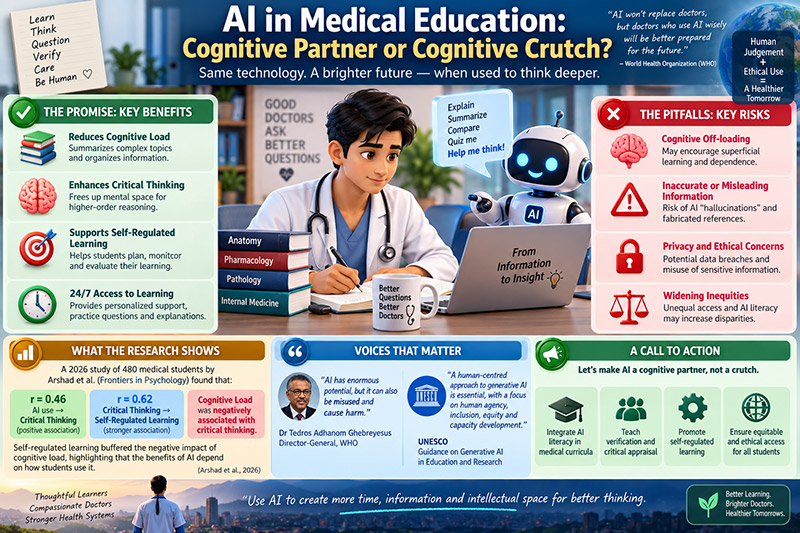
One way to answer this question is offered in the 2026 Frontiers in Psychology article “From AI use to critical thinking among medical students: a moderated mediation perspective on cognitive load and self-regulated learning” written by Arooj Arshad, Ayoob Lone, Loveena Arickswamy, Komal Hassan, Abdullah Abdulaziz Alnaim, and Mohammed Farhan AlFarhan. In their study on 480 undergraduate medical students, the authors provide a more complex picture than a black-and-white stance on AI.
First of all, the more often the students used AI, the higher were the levels of critical thinking and self-regulation in their learning. Namely, the correlation coefficient between the variables of AI use and critical thinking reached r = 0.46; between critical thinking and self-regulated learning – r = 0.62. At the same time, cognitive load had a negative correlation with critical thinking. Further, the results of mediation analysis proved that decreases in cognitive load were one of the factors explaining the association between AI use and critical thinking.
Such relevance is significant for medicine since, for instance, a student faced with a lot of material about acid-base disorders can ask AI to structure it into mechanisms, clinical manifestations, and differentiating cases. Instead of wasting precious working memory space to find and organize the information, the student will be able to spend more cognitive resources on such questions as: why does this patient have metabolic acidosis? How could this diagnosis be questioned? What could change the management? Thus, AI becomes a form of cognitive scaffolding instead of intellectual outsourcing.
It should be noted that there is one important caveat. As Arshad et al. show, self-regulated learning acts as a buffer: the higher students’ ability to plan, monitor, and evaluate their own learning is, the weaker the negative relationship between cognitive load and critical thinking becomes. In other words, one may get some benefit not only because of having an AI but because of knowing how, when, and why to use it.
There is one drawback possible, however. As Arshad and colleagues found out, cognitive offloading happens. If a student asks the AI system for the diagnosis before interpreting the information independently, this system bypasses the exact reasoning skills which medical education intends to cultivate. The authors point out that AI encourages superficial learning, dependency, and low-level analysis if a student uses generated answers instead of his or her brain. Risks in the field of healthcare are especially high: the generation of hallucinations, fabrications, automation bias, privacy breaches, and overconfidence in the wrong clinical reasoning.
Such principle is especially relevant for India, where big groups of students, irregular faculty availability, multi-lingual requirements, and inequality in the availability of educational materials make AI tutoring a revolutionary change. A medical student in an under-resourced institution could theoretically have round-the-clock access to explanations, simulated viva examinations, and adaptive revision. However, inequitable access to the Internet, uneven AI literacy, and insufficient validation of AI outputs can create educational disparity at the same time. In addition, UNESCO supports a human-centered approach to generative AI with an emphasis on human agency, inclusion, equity, and capacity development.
The same approach should be applied to clinical practice. AI can structure the record, notice drug interactions, analyze images, and suggest diagnostic options but it cannot take responsibility instead of the physician. According to WHO, AI is a valuable instrument in diagnostics, treatment, research, and management of the health system but ethics, human rights, accountability, and equity cannot be neglected. WHO Director-General Dr. Tedros Adhanom Ghebreyesus warned that AI has enormous potential but can also be misused.
Crucially, the Arshad study does not prove a causal relationship between AI use and critical thinking. The study was cross-sectional, based on self-report measures, convenience sampling, and performed on medical students of government institutions of Lahore, Pakistan. The authors warn against the causal interpretation and broad generalizations. Longitudinal, randomized, and performance-based studies are required, especially among Indian medical colleges.
Thus, the proper response here should be neither prohibition of AI nor abdication of education to it. The medical curriculum should teach AI literacy, verification, metacognition, and self-regulation of learning. Moreover, as Arshad et al. suggest, the educational value of AI depends not only on the technology but on students’ ability to self-regulate and control cognitive load.
Perhaps the most helpful principle in the AI era in medicine can be formulated concisely:
Do not use AI to avoid thinking. Use AI to make more time, information, and cognitive space for better thinking.
Physician of the future will probably not compete with AI by memorizing more facts than the machine. The advantage of the clinician in this case will be in asking better questions, challenging seemingly convincing answers, synthesizing evidence with context, making ethical judgments, and knowing the person behind the numbers. AI should become a cognitive partner of the medical student – not a substitute for cognition.
Senior Professor and former Head,
Department of ENT-Head & Neck Surgery, Skull Base Surgery, Cochlear Implant Surgery.
Basaveshwara Medical College & Hospital, Chitradurga, Karnataka, India.
My Vision: I don’t want to be a genius. I want to be a person with a bundle of experience.
My Mission: Help others achieve their life’s objectives in my presence or absence!
My Values: Creating value for others.
References:
Arshad A, Lone A, Arickswamy L, Hassan K, Alnaim AA, AlFarhan MF. From AI use to critical thinking among medical students: a moderated mediation perspective on cognitive load and self-regulated learning. Frontiers in Psychology.2026;17:1883053. DOI: 10.3389/fpsyg.2026.1883053.
Kasneci E, et al. ChatGPT for good? On opportunities and challenges of large language models for education. Learning and Individual Differences. 2023;103:102274.
UNESCO. Guidance for Generative AI in Education and Research. 2023, updated 2026.
World Health Organization. Ethics and Governance of Artificial Intelligence for Health. WHO, 2021.
World Health Organization. Ethics and Governance of Artificial Intelligence for Health: Guidance on Large Multi-Modal Models. WHO, 2025.
Leave a reply



























Leave a reply