
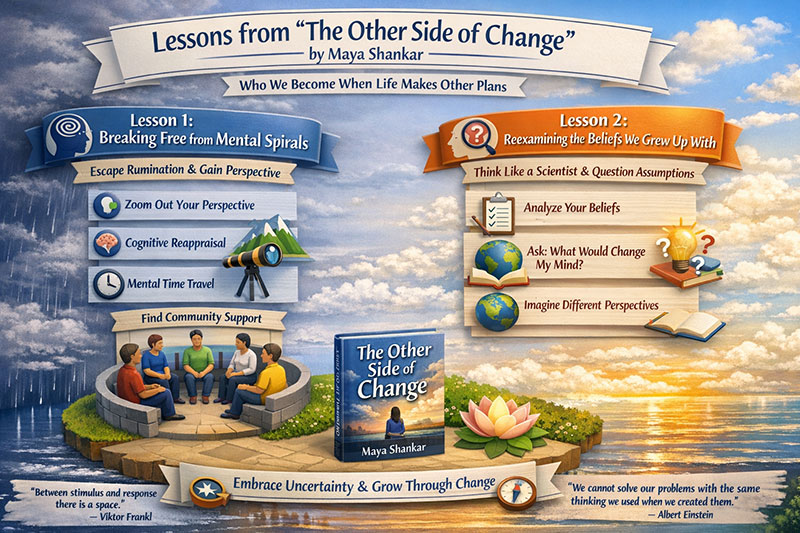
Change doesn’t often seek for permission. It interrupts, disturbs, and often rewrites the script we worked so hard to develop. Maya Shankar’s book The Other Side of Change is a poignant, research-based look at who we become when life doesn’t go as planned. She combines cognitive research with great storytelling to show us that change is not just disruptive, but also transforming.
She says, “Even when our stories don’t look like ours, we can learn from them.” The book is both a story and a how-to guide. It’s a good companion for anyone who is unsure of what to do, is thinking about a past crisis, or is afraid of what lies ahead.
These two deep lessons can change how we deal with life’s surprises.
Lesson 1: Getting Out of Mental Spirals
When something big happens, like losing a job, getting sick, or losing a loved one, our minds can start to spin. Negative thoughts keep coming back. We think about talks we’ve had, see the worst possible future, or worry about what we should have done better. Shankar calls this “rumination,” which is a mental trap that makes us think we’re fixing a problem when we’re really making things worse.
“When we ruminate, we keep thinking the same bad thoughts over and over again, and we get stuck in a loop.”
From an Indian point of view, we witness this behaviour a lot in high-pressure academic and work contexts. A student who fails a competitive exam may think of it as a lasting judgment on who they are. A person who started a business in Bengaluru might replay investor rejections to show how bad they are. But the same tendency can be seen around the world: executives in Silicon Valley, athletes in Europe, and artists in Japan are all at risk of falling into the same cognitive spiral.
Shankar talks about a freeing idea called “psychological distancing,” which means being able to “zoom out.”
When you zoom out, there is space between you and your thoughts. It gives you a different point of view. We could question, “How would I help a friend in this situation?” instead of “Why did this happen to me?” That one small change breaks the cycle.
There are scientific techniques to do this:
Cognitive reappraisal is changing the way you think about an experience to change how it makes you feel.
Imagining how today’s problem will look five years from now is a form of mental time travel.
Experiences of awe are when we come across something big (like nature, art, or service) that makes our worries seem smaller.
The Bhagavad Gita in India talks about seeing your ideas without getting attached to them. This is like psychological distance in a spiritual way. In Man’s Search for Meaning, psychologist Viktor Frankl said something similar: “There is a space between stimulus and response.” That gap is where freedom is.
Shankar also talks on how loneliness and rumination are related. Being alone makes spirals worse; being with others makes them better. Sharing tales with others can help break mental loops, whether it’s at a satsang in our city, a professional mastermind circle in London, or a peer-support group in New York.
We don’t need to have everything figured out all the time if we accept the “gray areas” in life. And with that, ruminating starts to let go.
As she says, becoming used to living with uncertainty takes away the fuel that keeps mental spirals going.
Lesson 2: Looking at the beliefs we had as kids again
Change doesn’t just change things; it also makes you wonder who you are. Our views about success, family, morality, work, and self-worth are all part of who we are as people. When things change in our lives, we have to go back and look at those internal tales.
Shankar wants us to become more conscious of our own thoughts, which is called metacognition.
“Think about looking at your ideas from a scientist’s point of view.”
This is advice that will change everything. We don’t argue our opinions as facts; instead, we consider them as guesses. We want to know:
How did I come to this belief?
What ideas back it up?
What proof would make me change my mind?
Many professionals in India believe that having a lot of prestige means being safe, including doctors, engineers, and civil servants. But thousands more people are increasingly redefining success through starting their own businesses, doing creative activities, or coming up with new ways to help people. Similar changes in beliefs are happening around the world, such as going from loyalty to a company to having a portfolio career, and from strict gender norms to flexible identities.
Think about what it might be like to be born in a different decade or society. Would you still believe the same things? If you lived in rural Rajasthan instead of big Mumbai, or in Scandinavia instead of South Asia, would your ideas change?
These kinds of thinking experiments help you think more flexibly.
Albert Einstein once observed, “We can’t fix our problems with the same way of thinking that got us into them.” It is not weak to change your convictions; it is growth.
Shankar’s work makes us remember that identity isn’t something that can be set in stone. It is a manuscript that is being revised.
Becoming Who We Are Meant to Be
Life does not stop when things change. That’s life.
The ability to deal with change may be our greatest strength in a world where technology is changing, politics are unclear, jobs are unstable, and personal lives are unpredictable.
The Indian startup ecosystem is strong because founders change their minds. Global leaders stay in power because they change. Families get better when they change old stories.
Shankar’s book doesn’t say that it will make suffering go away. Instead, it gives you insight in the middle of confusion and a sense of purpose following hard times. It says that when life has different plans, we are not just getting through change; we are becoming through it.
The most important thing to remember is that how we react to change affects our character more than the change itself.
The book is for anyone who is going through a lot of change, as she says. And really, that’s all of us.
When we step back from our cycles and question the beliefs we’ve always had, we start to see uncertainty as a teacher instead of an enemy.
The sailor is not defined by the storm. The navigation does.
On the other side of change, we might not only find strength, but also a smarter, bigger version of ourselves.
Dr. Prahlada N.B
MBBS (JJMMC), MS (PGIMER, Chandigarh).
MBA in Healthcare & Hospital Management (BITS, Pilani),
Postgraduate Certificate in Technology Leadership and Innovation (MIT, USA)
Executive Programme in Strategic Management (IIM, Lucknow)
Senior Management Programme in Healthcare Management (IIM, Kozhikode)
Advanced Certificate in AI for Digital Health and Imaging Program (IISc, Bengaluru).
Senior Professor and former Head,
Department of ENT-Head & Neck Surgery, Skull Base Surgery, Cochlear Implant Surgery.
Basaveshwara Medical College & Hospital, Chitradurga, Karnataka, India.
My Vision: I don’t want to be a genius. I want to be a person with a bundle of experience.
My Mission: Help others achieve their life’s objectives in my presence or absence!
Leave a reply
























Leave a reply