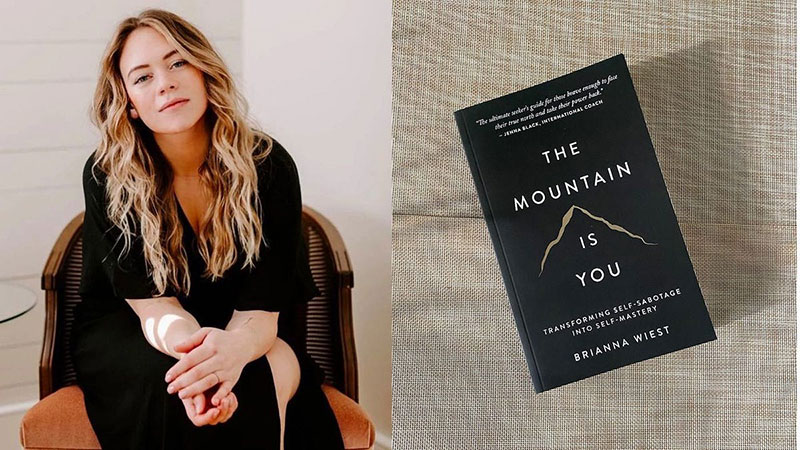
A book I read at the dusk of 2025—one that could guide the dawn of 2026 onto the right path—is The Mountain Is You. The Mountain Is You by Brianna Wiest is a gentle hug and a tough punch—moving slowly to convey a gentle enlightenment on why we frequently end up behaving like obstacles to ourselves—while these obstacles can actually serve as the ladder to achieving our objectives. Rather than considering ourselves helpless or losers if we end up sabotaging ourselves, author Wiest chooses to interpret the phenomenon as a piece of information or a sign emanating from our needs or inner disputes. The “mountain” isn’t found outside; it exists within.
At the heart of the book is the plain and reassuring truth that a part of what you must do in order to start your new life is to let go of the old. “Self-sabotage is a rational—not necessarily healthy—but rational strategy every person employs as a means of protecting ourselves from pain.” Perfection, avoidance, burn-out, people pleasing, and even pride are shown to be “mind-made” techniques to protect ourselves from pain.
By far the most encouraging conceptualization explored in the book is the recognition that self-sabotage is not a manifestation of a lack of motivation to make change, but instead the reflection of a fear of the change that is going to be required. “Self-sabotage is not trying to hurt yourself; it’s trying to protect yourself,” continues Wiest. This conceptualization erases the shame associated with self-sabotage in favour of curiosity. One is encouraged to go from “Why am I this way?” to “What is this behaviour trying to do for me?”
Wiest is very good at distilling psychology into readable and reflective language. She explains why habits are so hard to break because the brain satisfies a need for what it calls “emotional comfort,” even when it’s painful to the point of being hurtful. Descriptions of terms such as confirmation bias, catastrophizing, and emotion-based reasoning are explained in ways that help readers understand the impact of emotions on reality. The telling sentence: “Feelings are not facts, and responding to them as though they’re true is what keeps us stuck.”
One of the most vibrant themes running through the book is intuition versus emotion. Wiest writes about the calm, rational voice of intuition as opposed to the anxious voice of fear. Her advice is straightforward but hard to forget: “The right path is always calm, not chaotic.” This is advice for an age of perpetual stimulation.
The problem, according to her, is that “You do not rise to the level of your goals; you fall to the level of your systems.”The process of transformation, therefore, must be gradual. What might appear to be a revolutionary overhaul will ultimately be counterproductive, functioning almost like a shock to the nervous system by reverting back to old ways.
Among the most thought-provoking activities in the book is the assignment to meet one’s future self. Through the vivid visualization of who one is developing into and seeking advice from this self, the relationship between intention and action is established. The point is clear: to be the best version of oneself is not a dream; rather, it is to ask oneself what the best self would do in the present given the present situation.
The crucial point, in this case, is that “The Mountain Is You” offers no guarantees about a life of no struggle. Wiest recognizes this, understanding that instead of eliminating discomfort, growth simply redefines it. “Inner peace, then, has nothing to do with happiness. It has everything to do with emotional steadiness.” It is an ability, says Wiest, “to know you can handle what happens.” The Mountain Is You is both mirror and map. It reflects the hard truths about self-avoidance and the wisdom to transform self-avoidance into self-mastery. The book’s strength is in its recognition of a paradox—the very same patterns that are preventing progress contain the wisdom necessary to progress. Ascending the mountain takes time and is painful but honest work—yet, as Wiest illustrates in her book, it is the only way to become the person one was meant to be.
Dr. Prahlada N.B
MBBS (JJMMC), MS (PGIMER, Chandigarh).
MBA in Healthcare & Hospital Management (BITS, Pilani),
Postgraduate Certificate in Technology Leadership and Innovation (MIT, USA)
Executive Programme in Strategic Management (IIM, Lucknow)
Senior Management Programme in Healthcare Management (IIM, Kozhikode)
Advanced Certificate in AI for Digital Health and Imaging Program (IISc, Bengaluru).
Senior Professor and former Head,
Department of ENT-Head & Neck Surgery, Skull Base Surgery, Cochlear Implant Surgery.
Basaveshwara Medical College & Hospital, Chitradurga, Karnataka, India.
My Vision: I don’t want to be a genius. I want to be a person with a bundle of experience.
My Mission: Help others achieve their life’s objectives in my presence or absence!
My Values: Creating value for others.
Leave a reply








Leave a reply