
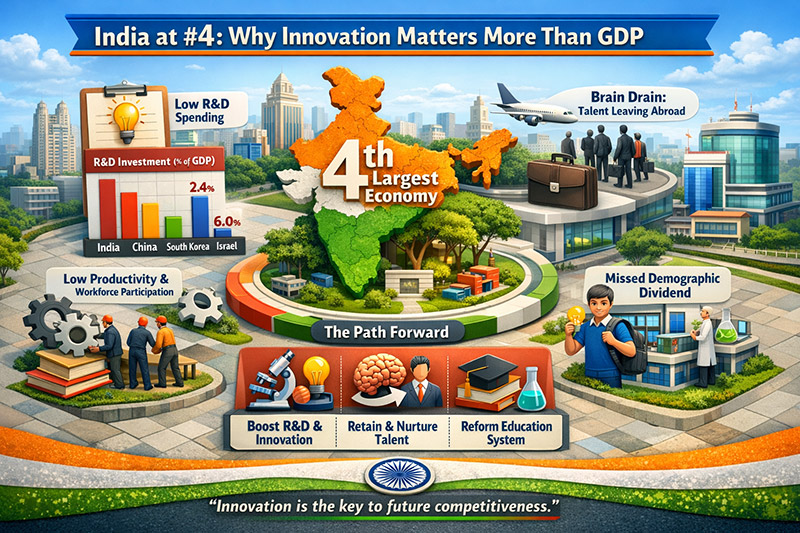
With India ascending as the world’s fourth-largest economy, it becomes the source of national pride in policy-making, industry conversations, and dreams of a billion people. However, amidst this celebration, there comes a reality that Nithin Kamath calls on: the mere scale of an economy does not necessarily ensure its global leadership sustainability in the future. By pointing at a crucial fact that India’s ranking by GDP alone is only a partial reflection of reality, Kamath calls on India to focus on how far it should go to be relevant in the future.
Firstly, the level of investment into research and development in India is only 0.7% of the GDP, which raises concerns about the future of the country. At the same time, nations like Israel or South Korea managed to create innovation-led economies thanks to investments exceeding 4-6%. In his speech, Paul Romer made an apt point by saying that “economic growth springs from better recipes, not just more cooking”. India, indeed, needs new recipes rather than cooking more food.
From an Indian perspective, the achievements are evident. Development of advanced infrastructure like UPI, Aadhaar, or a flourishing startup ecosystem proves the concept of “leapfrogging development” as called on by NITI Aayog. India shows that scale and innovation capabilities do co-exist, thus, providing solutions to the issues that may look complicated otherwise. In addition, its demographic dividend is probably one of the strongest advantages that the country has since “Dream, dream, dream. Dreams transform into thoughts and thoughts result in action”. These words belong to Dr. A.P.J. Abdul Kalam.
However, the issues are inevitable either. One of the biggest concerns is the insufficient amount of money spent on R&D, which impedes innovation-driven growth and does not let the nation produce original intellectual property and make breakthrough discoveries. According to consistent reports by UNESCO, India falls behind in the number of research works per head relative to global leaders. Furthermore, productivity and employment, especially of women, require improvement too. Also, the level of education, especially primary education, leaves much to be desired. As a result, if the issues are not addressed, the demographic dividend turns into a demographic problem.
Another serious challenge is related to brain drain. Throughout decades, India has been producing world-class talents that drive global innovation centers around the globe. While it brings pride and money back, it deprives India of many opportunities. “India must create conditions where its best minds want to stay, not just succeed abroad”, said Raghuram Rajan. The problem is not only retaining the talent but ensuring it can flourish in the country.
On the other hand, there emerges an interesting development in recent years. Increasing numbers of entrepreneurs and researchers choose to work inside their country thanks to growing interest in startups and initiatives like Startup India or Digital India. The private sector, too, realizes that only innovative development can make its businesses competitive in the long term. An example of it is Kamath’s Rainmatter Foundation showing the way on how private capital can boost innovations and sustainability.
To sum up, the message for any nation worldwide is clear: it is necessary to create the future by investing in knowledge creation, interdisciplinary research, and human capital development. India, endowed with its great scale, diversity, and intellectual resources, is uniquely positioned to do so. However, it requires a paradigm shift from the current model.
To move forward, everyone needs to share the responsibility. The government should increase the level of investment into R&D, simplify regulations, reform the educational system. The private sector should switch from focusing on efficiency and profitability towards innovation-driven growth. The academia needs to connect theory with practice. The society needs to develop an environment where curiosity and experimentation are welcomed, and failure is seen as the step on the way to success.
It would be wrong to believe that being the fourth largest economy is the end goal for India. It is just a milestone, and the real question is how far it will be able to take this economic momentum to intellectual and technological leadership. Like in the Rig Veda, let noble thoughts come from all directions. However, now, India needs to create some of its own.
Dr. Prahlada N.B
MBBS (JJMMC), MS (PGIMER, Chandigarh).
MBA in Healthcare & Hospital Management (BITS, Pilani),
Postgraduate Certificate in Technology Leadership and Innovation (MIT, USA)
Executive Programme in Strategic Management (IIM, Lucknow)
Senior Management Programme in Healthcare Management (IIM, Kozhikode)
Advanced Certificate in AI for Digital Health and Imaging Program (IISc, Bengaluru).
Senior Professor and former Head,
Department of ENT-Head & Neck Surgery, Skull Base Surgery, Cochlear Implant Surgery.
Basaveshwara Medical College & Hospital, Chitradurga, Karnataka, India.
My Vision: I don’t want to be a genius. I want to be a person with a bundle of experience.
My Mission: Help others achieve their life’s objectives in my presence or absence!
My Values: Creating value for others.
Leave a reply


























Leave a reply