
When Parminder Singh, the ex-managing director of Google, shared a personal experience of his wife’s surgery from a private hospital, the response to the post on LinkedIn was quite unexpected. Although the cost of a similar procedure was estimated to be nearly ₹25 lakh in Singapore, Parminder Singh’s wife had to pay only ₹1.7 lakh, without any deterioration in quality. It was quite shocking to note that a procedure performed by equally skilled surgeons, aided by similar setups, costs fifteen times as much across a developed country, thus proving that India provides the best value for money for healthcare across the world.
This is merely a case that is typical of a much larger phenomenon. The medical value travel business offered by India is already estimated to be worth approximately ₹75,000 crores, and this is growing every year. People from Africa, the Middle East, Southeast Asia, as well as a section of the developed world, have actually been migrating to Indian medical centers for heart surgeries, for handling various forms of cancers, for organ transplants, for handling fractures, among other complex surgeries. These trends can be attributed to reasons that exceed mere costs; these include faith in the skills of Indian medical experts, the training Indian medical experts have acquired across the world, and the modern medical infrastructure of private medical institutions.
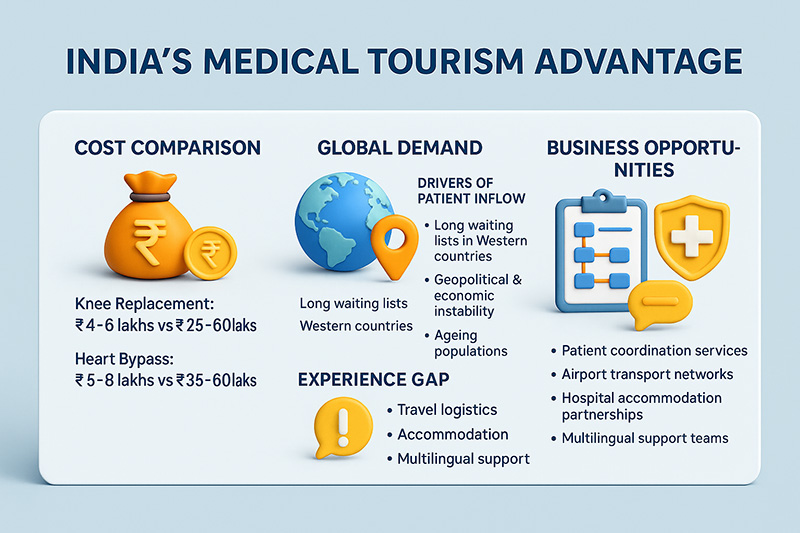
India’s biggest strength is its ability to provide world-class quality healthcare at a significantly lower rate than what is practiced worldwide. Orthopedic, cardiac, and oncology surgeries can be significantly expensive, at five to ten times what is charged in either the West or developed Asian Countries. Knee replacement surgeries that can cost between ₹25 to ₹60 lakhs elsewhere can be done for ₹4 to ₹6 lakhs here. Even a coronary artery bypass, a typical operation that can take up to ₹35 to ₹60 lakhs in a developed country, can be done for less than ₹8 lakhs here. Moreover, most of these Indian specialists have had extensive training courses at American or British centers, and most Indian medical facilities have foreign accreditation, where reduced costs aren’t necessarily a sign of reduced quality. Of course, this is what Amartya Sen emphasizes about medical quality for the world.
Global trends, of course, are also forcing a greater number of patients to turn to India. Waiting lists that can be long indeed within Western nations such as the UK or Canada mean that patients have little choice but to look for faster-acting solutions elsewhere. In parts of Africa or the Middle East, instances of political or economic turmoil mean that patients lack adequate access to quality healthcare. Aging populations, as found in Japan, Germany, or even Italy, mean that these nations’ healthcare systems, for all their excellence, can provide a unique and unprecedented challenge. It is thus a development that, as Peter Drucker, a leadership strategist, noted, “the greatest opportunities lie in satisfying unmet needs,” that India is now at the epicentre of such an opportunity.
In order to grasp what India’s next step is, it’s quite insightful to examine the case of another country, that of Thailand, and its unprecedented success. India’s medical tourism, estimated to be above ₹1.6 lakh crores, did not become what it is because of its world-class healthcare system; its impeccable patient experience was what made its medical tourism such a massive success. Right from airport pick-up, translation services, to post-surgery recovery resorts, and payment deals, the whole experience was centered around the patients. The actual operation was merely a part of the experience; the rest was carefully coordinated. That is where India currently lags behind.
India’s surgeons, healthcare facilities, and cost-effectiveness are already in place. The missing piece is a hassle-free experience that is just as smooth, anticipated, and comforting post-operation. Issues of documentation, airport transfer, communication, accommodations, navigating the city, and post-operative follow-up have been reported to be a hassle by some foreign patients. These areas of concern say nothing about a lack of medical competency—that’s being covered. As per global telemedicine pioneer Dr. Joseph Kvedar, “In the next era of health innovation, experience will be as important as expertise.” This is what India is left to achieve.
An enormous entrepreneurial space exists to develop patient coordination platforms that can address pre-travel medical advice and cost estimates, right up to visa assistance, airport transfers, and post-visit schedules. Specialised medical travel networks, or basically hospital-connected transport and concierge services, can remarkably lessen stress for foreign patients. Carefully selected accommodation collaborations, especially around prominent hospitals, can provide ‘hygiene-assured’ and ‘family-friendly’ accommodations without inconsistent experiences. Multilingual customer assistance teams available in Arabic, French, Russian, Bangla, Swahili, or Bahasa can amazingly boost patient trust. Henry Ford’s experience that “working together is success” can be directly applied to this; the future requires unconditional cohesion among hospitals, hotels, travel companies, and platforms.
Although the future for India is bright, the ambitions of India’s health tourism can also take into consideration that it is already faced with some challenges. The patient experience is variable from one urban center to another, and the non-clinical components of health tourism can be of variable quality. Congested urban centers, perceptions of cleanliness, and a lack of cohesion can serve as a barrier to entry for health tourists. At a macro-economic level, India is lacking a national identity as a high-quality healthcare destination, although this is a problem that can be dealt with.
Ultimately, Parminder Singh’s posting on social media brought to attention a fact that a lot of people involved in the healthcare industry have realized for a long time—the potential for Indian medical tourism is a lot greater than mere costs. The world already recognizes India as a place that offers good value for money; what the world wants now is for India to make the experience hassle-free. This is where the next massive opportunity for growth is to be found, and this is certainly a shortcoming that India can improve if it wants to better even the example set by a country such as Thailand.
The future of healthcare in India is for those who can effectively balance clinical acumen and coordinated effort. And now the question is this: Who is going to build that eco-system that can shift India from being the “affordable option to become the ‘preferred global destination for healthcare’”?
Leave a reply




















Dear Dr. Prahlada N. B Sir,
Ecostem of Indian medical industry is poised for remarkable growth, driven by expertise and affordability.
Expertised Indian surgeons, though foreign trained, are bringing world-class healthcare to the country.
Enormous entrepreneurial space is available for developing patient coordination platforms and medical travel networks.
Efforts are being made to enhance the patient experience, including multilingual customer assistance teams available in languages such as Arabic, French, Russian, Bangla, Swahili, and Bahasa.
Elevating the standards of healthcare tourism, India can now offer a hassle-free experience to international patients.
Emerging as a preferred destination for medical tourism, India has the potential to outsmart Thailand and other competitors.
Expertly balancing clinical acumen and coordinated effort will be crucial in achieving this goal.
Ensuring a seamless experience, from airport pick-up to post-surgery recovery, will be essential in attracting more medical tourists.
Efforts to improve infrastructure, cleanliness, and cohesion will also contribute to India's success in medical tourism.
Embracing this opportunity, India can become the go-to destination for high-quality, affordable healthcare.
Eagerly looking forward to seeing the transformation of India's medical tourism industry.
Best regards…🙏
Reply