
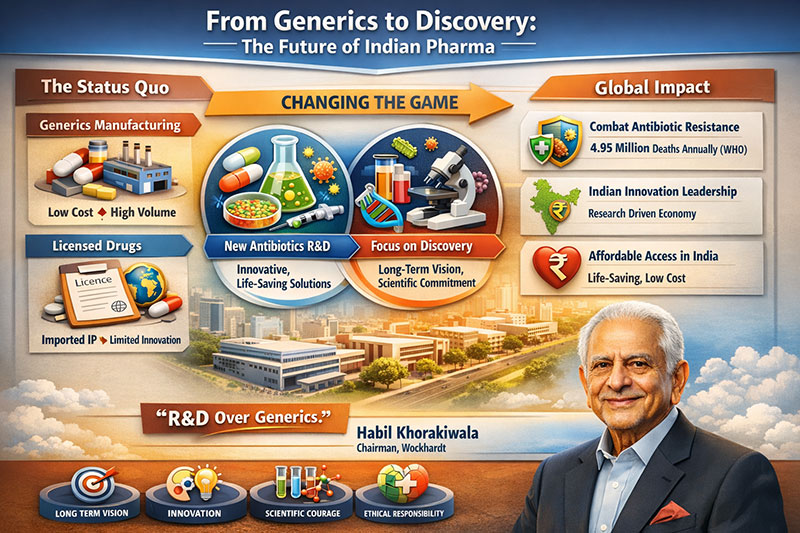
Lessons from Wockhardt and Habil Khorakiwala
One question I routinely ask pharmaceutical representatives who visit my clinic is deceptively simple: “Do you have even one product born out of your own R&D?” The pause that follows is often revealing. India proudly calls itself the Pharmacy of the World, yet the uncomfortable truth is that most Indian pharmaceutical success rests on generics and molecules licensed or reverse-engineered from elsewhere. Scale and efficiency we have mastered. Original innovation, far less so.
Against this backdrop, the story of Wockhardt stands apart—not merely as a corporate turnaround, but as a reminder of what patient, conviction-driven research can achieve in an ecosystem addicted to short-term returns.
At 83, Habil Khorakiwala does not speak like a man preserving legacy. He speaks like a scientist still chasing relevance. Over nearly three decades, while peers doubled down on generics, he stayed invested in one of the most unforgiving frontiers in modern medicine: new antibiotic discovery. Globally, antibiotic R&D has been abandoned by Big Pharma because returns are uncertain, timelines are long, and stewardship rightly limits volume sales. According to the WHO, antimicrobial resistance (AMR) is already among the top global health threats, causing an estimated 4.95 million deaths worldwide annually—a figure that exceeds many pandemics in cumulative impact (WHO, 2022).
This is precisely the space Wockhardt chose to inhabit.
For more than 25 years, Khorakiwala funded discovery research when there was no applause, no market premium, and no certainty of success. That perseverance is now visible in molecules like Zaynich (WCK 5222) and nafithromycin, drugs that are not “me-too” products but first-in-class or best-in-class solutions for infections that no longer respond to existing antibiotics. Published clinical data presented at international forums such as the Clinical and Laboratory Standards Institute (CLSI) demonstrate unprecedented susceptibility breakpoints for resistant gram-negative pathogens—an objective, globally accepted validation of scientific novelty.
From a business lens, this matters profoundly.
Innovation is not merely about patents; it is about strategic asymmetry. While hundreds of companies fight over shrinking margins in generics, a single successful new chemical entity can define a company’s future for decades. Analysts cited in Economic Times Prime estimate that Zaynich alone could address a global market exceeding USD 500 million, with long-term potential far higher if resistance patterns evolve as expected (ET Prime, 2024).
Yet the real lesson is not the molecule—it is the mindset.
Wockhardt’s journey has been anything but linear. Regulatory setbacks, debt crises, asset sales, and exits from hospitals, nutrition businesses, and US generics nearly dismantled the enterprise. But through every fire sale and restructuring, one division remained untouched: research. Scientists stayed. Pipelines survived. Institutional memory endured. This is leadership clarity in its purest form—knowing what to abandon and what to protect at all costs.
When former President APJ Abdul Kalam praised Wockhardt’s in-house research during his visit to Aurangabad, he was underscoring a national imperative: countries that do not innovate in healthcare remain perpetually dependent, regardless of manufacturing scale. Economic history repeatedly confirms this—from Japan’s post-war pharma strategy to South Korea’s biotech rise—that R&D depth, not production volume, determines long-term relevance.
Khorakiwala’s recent decision to exit loss-making US generics and focus exclusively on innovation-led portfolios reflects another mature insight: focus is the final form of strategy. By outsourcing manufacturing and concentrating on discovery, clinical science, and licensing, Wockhardt is aligning capital with competence—a lesson many businesses learn too late.
Perhaps the most inspiring element is ethical restraint. Even as Zaynich targets premium Western markets, Khorakiwala has publicly committed to lower pricing in India, acknowledging that innovation without access is moral failure. This balance between shareholder value and societal responsibility is increasingly recognized in global health economics as the only sustainable model (WHO & OECD policy papers on AMR, 2021–2023).
The message for Indian business leaders—inside and outside pharma—is unmistakable. Innovation is slow. R&D is lonely. Returns are delayed. But when it works, it does not merely generate profit; it changes destiny—of companies, countries, and patients who otherwise have no options left.
In an era obsessed with quarterly results, Wockhardt reminds us that some victories are measured not in quarters, but in decades.
Dr. Prahlada N.B
MBBS (JJMMC), MS (PGIMER, Chandigarh).
MBA in Healthcare & Hospital Management (BITS, Pilani),
Postgraduate Certificate in Technology Leadership and Innovation (MIT, USA)
Executive Programme in Strategic Management (IIM, Lucknow)
Senior Management Programme in Healthcare Management (IIM, Kozhikode)
Advanced Certificate in AI for Digital Health and Imaging Program (IISc, Bengaluru).
Senior Professor and former Head,
Department of ENT-Head & Neck Surgery, Skull Base Surgery, Cochlear Implant Surgery.
Basaveshwara Medical College & Hospital, Chitradurga, Karnataka, India.
My Vision: I don’t want to be a genius. I want to be a person with a bundle of experience.
My Mission: Help others achieve their life’s objectives in my presence or absence!
My Values: Creating value for others.
References:
- World Health Organization. Global burden of bacterial antimicrobial resistance in 2019. WHO; 2022.
- Economic Times Prime. Habil Khorakiwala is rebuilding Wockhardt from the ground up. ET Prime; 2024.
- Clinical and Laboratory Standards Institute (CLSI). Breakpoint determinations for novel antibiotics. CLSI Proceedings; 2023–2024.
- OECD & WHO. Incentivising antibiotic research and ensuring access. Policy reports; 2021–2023.



























Leave a reply