
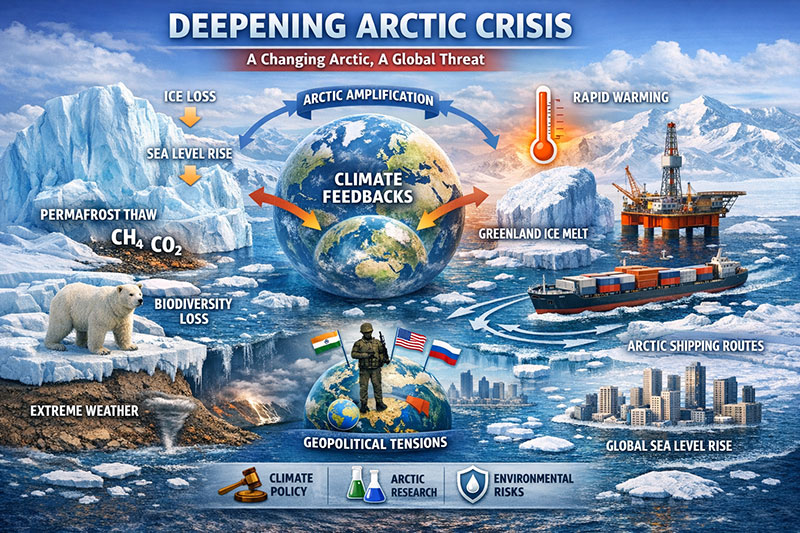
The Arctic is no longer a distant frozen landscape that stands in the backdrop of the Earth’s climate narrative; it is becoming one of the key drivers of this narrative. Data from satellite observations reveal that the extent of summer melt in the Arctic sea ice is decreasing drastically, with a loss of 12.2 percent per decade, according to NASA.
Whereas reflective ice is replaced by the darker colour of the ocean, the area absorbs more solar radiation, which enhances the phenomenon of “Arctic amplification.” The IPCC indicates that high confidence exists that the continued warming of the Arctic will remain above the global mean values in the current century.
However, such an intensifying Arctic crisis has implications that are far from limited to polar bears and postcards. Specifically, the Arctic is an important part of the earth’s cryosphere and the earth’s circulation system as a whole. Moreover, the loss of mass in Greenland and Arctic glaciers inevitably leads to global sea levels rising.
Such current media attention to the Greenland bedrock and ice sensitivities has highlighted the point that even relatively limited warming levels can result in large commitments of ice loss in the future, although the timing of such commitments is not known with certainty.
At the same time, the warming of permafrost raises a new hazard because stored carbon can be released in the form of CO2 and methane, providing a new warming ‘push’. The assessment of permafrost-carbon feedbacks in the IPCC Report has identified the importance of this climate feedback, which suggests that the warming ‘push’ has a substantial impact, although not greater than fossil fuel sources, but has the potential to act quickly.
Where the “pros” are tempting—and why they’re risky
Others see opportunity in the opening of the Arctic region. “Shorter maritime trade routes, resource development, and expanded fishing grounds are among the more common justifications.” There does appear to be growth in Arctic maritime traffic, at least according to the Arctic Council’s “PAME,” or “Protection of the Arctic Marine Environment,” which indicates that the distance travelled in the Arctic Polar Code region has grown appreciably during the past decade.
“In a world that is energy hungry, resources like these, which are hydrocarbons and critical minerals, can be very strategically attractive.”
However, these “benefits” are inextricably linked with severe negative environmental factors. Increased traffic increases the risk of the deposition of black carbon (which reduces the albedo of ice by darkening it) and oil spills in an area that would be uniquely challenging to respond to. Take the case of the IMO’s ban on the use of heavy fuel oil (as of July 2024); although well-intentioned, the “admissible” alternative fuels would “are likely to pose challenges for the purpose of oil spill response in cold Arctic waters.”
The Cons: Cascading Ecological, Geopolitical, & Human Impacts
The Arctic crisis has to do with more than just biophysically based concerns; it has to do with social and geopolitical considerations as well. Indigenous populations have to contend with disrupted paths for hunting, shifting patterns of game, and degraded infrastructure due to melting permafrost. Then there’s the shift in ecosystems due to the decline of ice-supported food chains and impacts on fish and biodiversity. Geopolitically, it’s been exacerbated by increased Arctic accessibility, which has led to challenges in maritime transportation routes, strategic defence positioning, and resource development
The rhetoric on the international stage has sharpened. UN Secretary General António Guterres observed, “Humanity has opened the gates of hell” in a major speech on climate change. The choice of words was not an accident; the urgency of climate change is outpacing the pace of politics.
“The evidence relating to this is unequivocal,” states IPCC, “that human influence has warmed the atmosphere, ocean, and land.” The IPCC’s wording is more clinical but no less direct: “unequivocal that human influence has warmed the atmosphere, ocean and land.”
Indian perspective: why the Arctic is also an Indian monsoon issue
For India, the Arctic is becoming an increasingly “near” issue. India became an Observer to the Arctic Council in 2013 and has outlined its strategy through its national Arctic policy.
The relevance of India is scientific/climatic and economic. Arctic climate change might interact with weather patterns in mid-latitude regions or possibly monsoonal climate in India. Recent peer-reviewed research is actively pursuing research connections between sea-ice variability in the Arctic region and changes in the Indian summer monsoon. A moral anchor in this regard could be the civilizational approach adopted by India. Moreover, the “One Earth, One Family, One Future” approach adopted by Indian Prime Minister Narendra Modi in international forums aptly represents the truth regarding the Arctic crisis, that is, “no one can treat the Arctic as someone else’s backyard.”
Ultimately, it’s a warning and an exam, and the cost of short-term wins far exceeds what comes through in terms of Arctic “progress.” The smart move is neither Arctic development nor exploitation under the guise of progress but Arctic stewardship through and with rapid cuts, through and with responsible shipping, through and with oil spill preparedness, and through and with polar sciences, because what is melting in the Arctic doesn’t stay in the Arctic.
Dr. Prahlada N.B
MBBS (JJMMC), MS (PGIMER, Chandigarh).
MBA in Healthcare & Hospital Management (BITS, Pilani),
Postgraduate Certificate in Technology Leadership and Innovation (MIT, USA)
Executive Programme in Strategic Management (IIM, Lucknow)
Senior Management Programme in Healthcare Management (IIM, Kozhikode)
Advanced Certificate in AI for Digital Health and Imaging Program (IISc, Bengaluru).
Senior Professor and former Head,
Department of ENT-Head & Neck Surgery, Skull Base Surgery, Cochlear Implant Surgery.
Basaveshwara Medical College & Hospital, Chitradurga, Karnataka, India.
My Vision: I don’t want to be a genius. I want to be a person with a bundle of experience.
My Mission: Help others achieve their life’s objectives in my presence or absence!
My Values: Creating value for others.
References (Vancouver Style)
- National Aeronautics and Space Administration (NASA).
Arctic Sea Ice Minimum. Washington (DC): NASA Earth Observatory; 2023.
Available from: https://earthobservatory.nasa.gov
DOI: Not available (institutional web resource) - Intergovernmental Panel on Climate Change (IPCC).
Climate Change 2021: The Physical Science Basis. Contribution of Working Group I to the Sixth Assessment Report. Cambridge: Cambridge University Press; 2021.
DOI: 10.1017/9781009157896 - Intergovernmental Panel on Climate Change (IPCC).
Climate Change 2022: Impacts, Adaptation and Vulnerability. Contribution of Working Group II to the Sixth Assessment Report. Cambridge: Cambridge University Press; 2022.
DOI: 10.1017/9781009325844 - Schuur EAG, McGuire AD, Schädel C, et al.
Climate change and the permafrost carbon feedback. Nature. 2015;520(7546):171–179.
DOI: 10.1038/nature14338 - Arctic Council, Protection of the Arctic Marine Environment (PAME).
Arctic Shipping Status Report. Akureyri (Iceland): Arctic Council Secretariat; 2021.
DOI: Not available (intergovernmental report) - International Maritime Organization (IMO).
International Code for Ships Operating in Polar Waters (Polar Code). London: IMO; 2017 (amended 2024).
DOI: Not available (regulatory instrument) - United Nations Secretary-General.
Guterres A. Remarks on the State of the Global Climate. New York: United Nations; 2023.
DOI: Not available (official UN address) - Government of India, Ministry of Earth Sciences.
India’s Arctic Policy: Building a Partnership for Sustainable Development. New Delhi: Government of India; 2022.
DOI: Not available (government policy document) - Overland J, Francis JA, Hall R, Hanna E, Kim SJ, Vihma T.
The melting Arctic and midlatitude weather patterns: Are they connected? J Clim. 2015;28(20):7917–7932.
DOI: 10.1175/JCLI-D-14-00822.1 - Coumou D, Petoukhov V, Rahmstorf S, Petri S, Schellnhuber HJ.
Quasi-resonant circulation regimes and hemispheric synchronization of extreme weather in boreal summer. Proc Natl Acad Sci U S A. 2014;111(34):12331–12336.
DOI: 10.1073/pnas.1412797111






















Leave a reply