
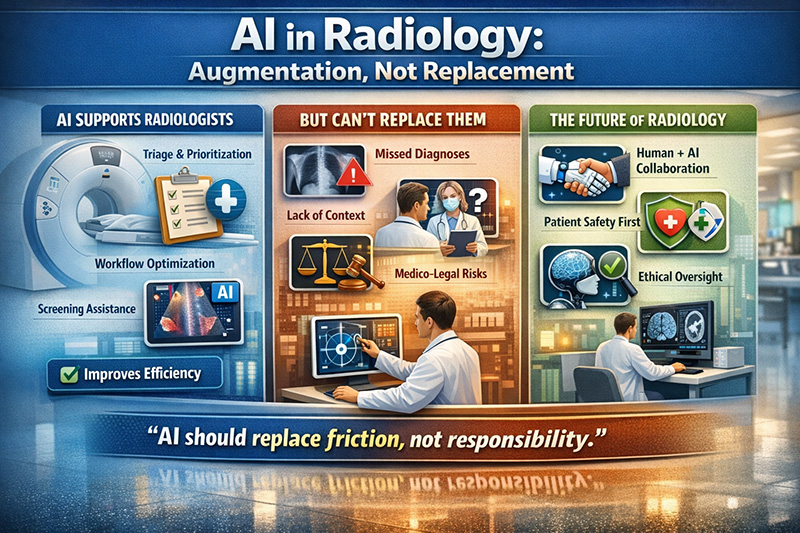
The idea that artificial intelligence will take over and replace radiologists is one of the most repeated myths in medical technologies, and your pasted excerpt captures this sentiment very succinctly and well. Indeed, according to Dr. Datta, from AIIMS, New Delhi, the key problem is not even whether AI will add value to radiology or not. AI will do exactly that but whether technical advances alone justify grandiose statements about radiologist workforce being completely replaced is highly debatable. For now, AI will become an integral element of radiological practice but it still cannot be used in the place of radiologists.
In some contexts, however, advocating the use of AI makes a lot of sense. In India, for instance, radiologists face increasing workloads, sub-specialization disparities, and significant delays in report generation. With all of that, AI can aid with triaging, prioritization, quantitative measurements, workflow optimization, report creation, and quality control of radiological examinations. Even globally, the use of AI proves to be effective in improving the workflow when it is integrated into the work of radiologists and not used as an alternative to their skills. In MASAI trial in mammography, for instance, an AI-assisted screening helped reduce the reading burden while preserving clinical safety.
The transition from “AI makes the workflow more efficient” to “AI replaces radiologists” lacks any solid basis, however. According to 2025 Radiology on invasive breast cancers that were missed by an AI-assistant screening tool, the algorithm failed to identify 14% of invasive cancers, 61.7% of which were found to be actionable by independent reviewers. The issue is important since medicine is a discipline with extremely high stakes, so a mistake in one single patient’s screening cannot be tolerated. A minor missed finding can dramatically change the prognosis, treatment, costs, and, most importantly, survival rate of a patient.
The point is relevant in other fields of radiology as well. According to a study published in Radiology in 2025, a wide array of commercially available algorithms demonstrated moderate-to-high sensitivity to diseases in chest x-rays, but they were less accurate in identifying small pneumothoraxes, small effusions, and complex films with multiple findings. Similarly, a recent 2024 European Radiology study concluded that the use of AI might be able to rule out a limited number of normal radiographic images only. All that is consistent with the “human in the loop” paradigm.
From an Indian viewpoint, the distinction is particularly relevant. India requires scalable imaging aid, but its medical infrastructure is rather heterogenous, with different levels of technology, data quality, access to validated AI solutions, and medico-legal environment. For major city hospitals, AI can improve radiologists’ productivity and reduce mental burnout. In smaller institutions, however, AI can be a helpful second opinion or triage tool but not a replacement for a human eye. The replacement, in turn, could worsen existing inequalities because poorly validated algorithms could be used there anyway.
This issue has been addressed by the World Health Organization in its framework for health AI governance, which states that the technology should be made transparent, validated, and safe for patients, accountable for mistakes, and supported by a human in the loop.
The following quote by Geoffrey Hinton from 2016 is relevant in the context, stating that the world “should stop training radiologists,” which was seen as a prophecy at that time. However, the reality proved to be different.
In today’s healthcare, a better approach to AI would be this one: it is meant to remove frictions, not take away responsibilities. It is what healthcare leaders should advocate. The integration of AI in clinical practice should not be viewed as an opportunity to reduce costs but as an investment. The future of radiology is not radiologist vs machine but radiologist with machine support.
Dr. Prahlada N.B
MBBS (JJMMC), MS (PGIMER, Chandigarh).
MBA in Healthcare & Hospital Management (BITS, Pilani),
Postgraduate Certificate in Technology Leadership and Innovation (MIT, USA)
Executive Programme in Strategic Management (IIM, Lucknow)
Senior Management Programme in Healthcare Management (IIM, Kozhikode)
Advanced Certificate in AI for Digital Health and Imaging Program (IISc, Bengaluru).
Senior Professor and former Head,
Department of ENT-Head & Neck Surgery, Skull Base Surgery, Cochlear Implant Surgery.
Basaveshwara Medical College & Hospital, Chitradurga, Karnataka, India.
My Vision: I don’t want to be a genius. I want to be a person with a bundle of experience.
My Mission: Help others achieve their life’s objectives in my presence or absence!
My Values: Creating value for others.
References:
- Lång K, Dustler M, Dahlblom V, et al. Artificial intelligence-supported screen reading versus standard double reading in the Mammography Screening with Artificial Intelligence trial (MASAI): a clinical safety analysis of a randomised, controlled, non-inferiority, single-blinded, screening accuracy study. Lancet Oncol. 2023.
- Woo OH, et al. Invasive Breast Cancers Missed by AI Screening of Mammograms. Radiology. 2025.
- Plesner LL, Müller FC, Brejnebøl MW, et al. Commercially Available Chest Radiograph AI Tools for Detecting Airspace Disease, Pneumothorax, and Pleural Effusion. Radiology. 2023;308(3):e231236.
- Schalekamp S, et al. Performance of AI to exclude normal chest radiographs to reduce radiologists’ workload. Eur Radiol. 2024.
- Khalifa M, Albadawy E. AI in diagnostic imaging: Revolutionising accuracy and efficiency. Imaging. 2024.
- Pesapane F, et al. The translation of in-house imaging AI research into a medical device. Eur J Radiol. 2025.













Leave a reply