
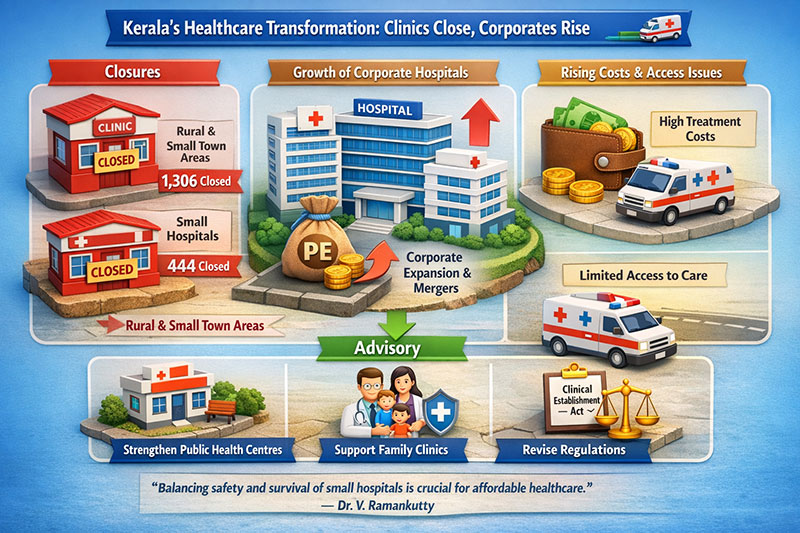
Kerala has long been known for its high public health indicators and community-based treatment, but its private healthcare system is going through a big change. Anna Jose wrote in The New Indian Express on February 24, 2026, that 1,306 outpatient clinics and 444 small hospitals have closed in the last five years. The Indian Medical Association (IMA) says that, strangely enough, the total number of private hospitals went up from 3,677 in 2021 to 5,402 in 2026.
This isn’t a contraction; it’s a consolidation.
From Neighborhood Care to Corporate Corridors
In the past, Kerala’s healthcare system was based on tiny hospitals and doctor-run neighbourhood clinics. These places had cheap consultations, care for pregnant women, small procedures, and family doctors who could keep giving care. The fact that they are closing means more than just that they are going out of business; it also shows a change in how people think about care.
Dr. M. N. Menon, the president of the IMA, said that patients who are forced to go to tertiary corporate hospitals may have to stay in the hospital longer and pay more. People all throughout the world share his worry. The World Health Organization (WHO) has said many times that having good primary and secondary care systems cuts down on hospital stays that could have been avoided and huge health care costs.
Dr. Devi Shetty, the founder of Narayana Health, famously said, “Healthcare becomes unaffordable not because medicine is expensive, but because the system is inefficient.”
When local hospitals close, the system can become less efficient because of too much medicalization and too many procedures.
Changes in Structure That Led to the Closures
Dr. D. Narayana, a health economist, says that regulatory restrictions alone are not to blame. The way people live has changed. Younger patients like specialists more than general practitioners. People moving to cities has made rural areas less populated. Obstetric deliveries, which used to be a big part of small hospitals’ budgets, have now moved to bigger hospitals.
This is similar to what is happening around the world. Over the past ten years, more and more rural hospitals in the United States have closed. This is mostly because of money problems, changes in the population, and problems with being paid. A study from the Harvard T.H. Chan School of Public Health found that closing rural hospitals makes it harder for disadvantaged groups to get care and raises their risk of death.
The Clinical Establishments (Registration and Regulation) Act in India attempts to make sure that quality and safety are the same across the board. Compliance expenditures, such as new technology requirements, infrastructure standards, and digital records, can be too much for small facilities to handle, even though they are good ideas. Dr. V. Ramankutty, a specialist in public health, says that rules should be changed to find a balance between safety and sustainability.
This is a typical policy problem: how to make sure quality without getting rid of providers.
The Rise of Mergers and Acquisitions
The closures happen at the same time as aggressive growth and mergers. Blackstone-backed Quality Care bought KIMSHealth Management in 2023. Caritas Hospital bought Matha Hospital. Baby Memorial Hospital looked into buying other hospitals. There is a lot of private equity money coming into Kerala’s healthcare business.
There are benefits to corporate consolidation:
· Standardized protocols
· Advanced diagnostics
· Better capital access
· Digital integration
But it might also give them more leverage over prices. Nobel Prize-winning economist Joseph Stiglitz has said, “Market concentration often leads to higher prices and fewer choices for consumers.”
Healthcare is especially at risk because patients don’t know the whole price or have the power to negotiate.
The Middle Class Will Face Economic Problems
The middle class in Kerala, which has traditionally relied on reasonably cost local hospitals, may have to pay more out of their own pockets. India already has one of the highest rates of out-of-pocket expenditures in the world, with around 48% of all health spending coming from people’s own pockets, according to the World Bank.
When minor illnesses are treated in tertiary settings, prices go up because of admission fees, tests, and consultations with specialists. Over time, this can increase medical indebtedness.
Dr. A.P.J. Abdul Kalam, former president of India, famously said, “A developed nation is one where healthcare is accessible and affordable to all.”
Accessibility is not just about being close by; it’s also about being able to afford it.
Violence and Lack of Professional Support
Another disturbing aspect is violence against healthcare professionals. It has been said that young doctors are not eager to create their own businesses. Entrepreneurship in primary care is not appealing without legal and social safeguards.
Around the world, doctor burnout and safety concerns have also made independent practice models less popular. The NHS in the UK has a shortage of general practitioners, which is similar to other problems that make people less likely to become doctors.
Advisory: A Balanced Path to Change
Kerala’s healthcare change needs deliberate realignment, not nostalgia or unbridled corporatization.
1. Regulatory Tiering: Set up rules for compliance that are different for each level. Small hospitals should have to meet basic safety standards without having to match the infrastructural needs of larger hospitals.
2. Strengthening the Public Sector: Dr. Narayana is right to stress the need to improve primary and secondary public health centers. A strong public system can help people deal with price shocks.
3. Encouraging Family Medicine: Give doctors tax breaks, low-interest loans, and security help to open clinics in rural and semi-urban regions.
4. Support for Digital Integration: Health IT platforms funded by the government could help small hospitals save money on technology. Models of shared services might make things work better.
5. Clear Pricing Frameworks: Require corporate hospitals to have clearer billing standards to stop them from charging too much.
The Next Step
Healthcare systems all across the world are trying to figure out whether to consolidate or provide community care. Kerala’s narrative isn’t one of a kind, but the stakes are high. The state’s good name for fair healthcare came from a network of public institutions and small private providers.
We can’t think of the future as a fight between small and big businesses. It must be a team effort instead. Corporate hospitals are great at providing complicated third-level treatment. Small hospitals are the foundation of trust and affordability in a community. Public health centers make guarantee that everyone has the same access to care.
Dr. Tedros Adhanom Ghebreyesus, the Director-General of the World Health Organization, said, “Primary healthcare is the foundation of universal health coverage.”
Kerala is currently at a crossroads. The state can keep its health legacy while moving forward if reforms make safety, sustainability, and affordability all work together. If not, the loss of neighbourhood hospitals might subtly change how people get care, how fair it is, and even what kind of care it is in the future.
Dr. Prahlada N.B
MBBS (JJMMC), MS (PGIMER, Chandigarh).
MBA in Healthcare & Hospital Management (BITS, Pilani),
Postgraduate Certificate in Technology Leadership and Innovation (MIT, USA)
Executive Programme in Strategic Management (IIM, Lucknow)
Senior Management Programme in Healthcare Management (IIM, Kozhikode)
Advanced Certificate in AI for Digital Health and Imaging Program (IISc, Bengaluru).
Senior Professor and former Head,
Department of ENT-Head & Neck Surgery, Skull Base Surgery, Cochlear Implant Surgery.
Basaveshwara Medical College & Hospital, Chitradurga, Karnataka, India.
My Vision: I don’t want to be a genius. I want to be a person with a bundle of experience.
My Mission: Help others achieve their life’s objectives in my presence or absence!
Leave a reply





























Leave a reply