
In India and many other places, small and medium-sized hospitals are the main way that people get health care. They are generally started by dedicated doctors and nurses who want to help their communities with honesty and excellence. A lot of tiny hospitals, though, have trouble making money in the first few years of operation, even when they have solid clinical skills and good intentions. The causes are usually not very important. Failure rarely results from a single disastrous decision; instead, it arises from nuanced, cumulative financial and operational disparities that go undetected until it is too late. Peter Drucker, a management thinker, said that the true danger is not turbulence but using old thinking. Many tiny healthcare organizations still work under assumptions that don’t match up with how money really works.
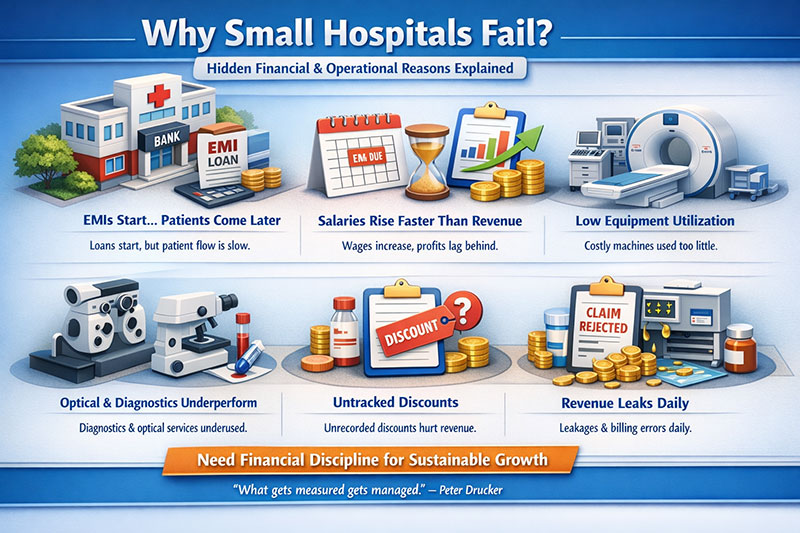
One of the hardest things to deal with is the difference in timing between loan payments and patient flow. When a hospital is established using money from a bank, the monthly payments start virtually right away once the money is given out. But it takes time to build trust with patients, referral networks, brand recall, and community confidence. In India, especially in tier-2 and tier-3 cities, it could take 12 to 24 months for bed occupancy to reach stable levels that can be maintained. But EMI calculations frequently presume that occupancy will be almost perfect from the first year. This puts a pressure on cash flow right away. Similar tendencies can be seen in rural healthcare systems around the world. Health economist Uwe Reinhardt said that hospitals don’t always fail because they don’t have enough patients; they fail because their financial systems anticipate that everything is fine. When sales forecasts are positive but payments come in late, the tension builds up quickly.
Another subtle destabilizer is the fact that salary costs are growing faster than revenue. Healthcare needs a lot of people to work. Nurses, technicians, resident doctors, and administrative personnel all expect to get raises every year. Regulatory rules require certain staffing ratios. But insurance package rates or government payment plans sometimes limit how much money a hospital can make per patient. In India, governmental insurance schemes might not change their rates to keep up with inflation, even if salaries might go up by 8 to 12 percent per year. Over time, the costs of hiring and training people take up a bigger and bigger part of gross revenue. The World Health Organization has pointed out that the cost of workers is the biggest expense for healthcare facilities around the world. Without systems that link production to pay or hiring that is in line with demand, wage increases slowly eat away at margins.
Decisions about capital investments might also make things less stable. Small hospitals often buy high-end imaging equipment, modular operating rooms, or advanced laboratory systems to show that they are good and compete with bigger corporate hospitals. These purchases may make the company look better, but they may not be used as much as they should be. A CT scanner that only does a few scans a day can’t justify its EMI and yearly maintenance contracts. In the same way, operating rooms that are only partially full raise the cost per case by a lot. Clayton Christensen, a business theorist, said that technology must meet demand; if it doesn’t, it destroys value instead of making it. When equipment is bought before the number of patients grows, capital becomes a burden instead of a strategic asset.
Diagnostics and optical services are supposed to be high-margin support verticals, but they often don’t work well in tiny facilities. In many Indian places, doctors still send patients to outside facilities out of habit or because they think the quality is better, even when there are resources in-house. So, potential money is lost every day. International integrated health systems work well in part because ancillary services are closely linked to key therapeutic routes. When labs and imaging centers are barely 30 to 40 percent full, the hospital loses money not only from direct sales but also from cross-subsidy support for inpatient services. It’s not usually ineptitude; it’s more likely that they don’t have a mechanism for tracking and integrating.
Unstructured discounting is a culturally sensitive yet financially risky thing. Negotiating healthcare bills is widespread in India. Consultants might not charge fees out of kindness, administrators might offer discounts to get students to enroll, and changes to packages might happen without any paperwork. These actions may seem kind or smart on their own, but together they make the financial picture look different. What looks like a healthy occupancy rate could lead to a low net realization rate. W. Edwards Deming, a pioneer in quality management, famously said that you can’t manage something if you don’t measure it. If hospitals don’t keep a close eye on their gross and net revenue, they think they are making money when they aren’t.
Silent revenue loss may be the most dangerous hazard. This includes things like unbilled consumables, pharmacy stock inconsistencies, coding mistakes in insurance claims, late claim submissions, and small losses of inventory in operating rooms. These seem small when looked at one at a time. Even a three to five percent leakage rate can have a big effect on yearly financial results when looked at as a whole. Structured revenue cycle management frameworks are used by advanced systems around the world. Smaller hospitals don’t always have this kind of close supervision. The Organisation for Economic Co-operation and Development has said several times that inefficiencies, not just lack of cash, are what cause healthcare systems to have money problems. Inefficiency is not always obvious; it builds up over time as normal operations go on.
The main reason small hospitals fail is not because they don’t provide excellent treatment or are dedicated to their patients. There is no systematic financial governance in place. Many founders, especially in India, are doctors first and administrators because they have to be. Sustainable institutions around the world are more and more using partnerships between doctors and administrators and real-time dashboard analytics. The change that has to happen is both intellectual and practical. Hospitals need to see administration as an important part of medicine, not as something that comes after it. Being financially responsible does not hurt compassion; it helps it.
Small hospitals don’t usually go out of business overnight. They slowly go down because of mismanaged inefficiencies, overly optimistic forecasts, and a lack of quantitative controls. These organizations can thrive as strong foundations of community healthcare if they plan their capital well, hire staff based on demand, keep track of their income carefully, and follow a strict system of governance. Building systems that last is just as important as healing patients in sustainable healthcare.
Dr. Prahlada N.B
MBBS (JJMMC), MS (PGIMER, Chandigarh).
MBA in Healthcare & Hospital Management (BITS, Pilani),
Postgraduate Certificate in Technology Leadership and Innovation (MIT, USA)
Executive Programme in Strategic Management (IIM, Lucknow)
Senior Management Programme in Healthcare Management (IIM, Kozhikode)
Advanced Certificate in AI for Digital Health and Imaging Program (IISc, Bengaluru).
Senior Professor and former Head,
Department of ENT-Head & Neck Surgery, Skull Base Surgery, Cochlear Implant Surgery.
Basaveshwara Medical College & Hospital, Chitradurga, Karnataka, India.
My Vision: I don’t want to be a genius. I want to be a person with a bundle of experience.
My Mission: Help others achieve their life’s objectives in my presence or absence!
Leave a reply





























Leave a reply