
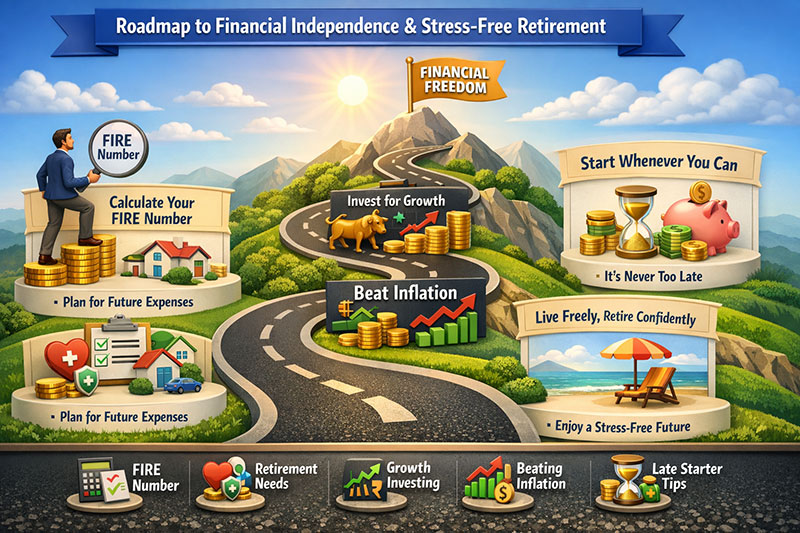
A Practical Roadmap to Financial Independence and Stress-Free Retirement
Most adults work most of the time, not usually because they enjoy what they do, but because they have to because of their bills. Monthly bills, the cost of sending kids to school, healthcare, and social expectations all work together to make it such that income is always spent and there isn’t much room for building wealth over time. This changes work from a choice to a need over time.
The most important thing to know about personal finance is that the only sure method to make sure your money works for you in retirement is to develop wealth. Salary alone, no matter how high, doesn’t usually give you financial freedom unless you turn it into useful assets on a regular basis.
Warren Buffett, a famous investor, once said, “If you don’t find a way to make money while you sleep, you will work until you die.” This advice is just as useful for a paid worker in Bengaluru as it is for a business owner in New York.
Why You Shouldn’t Put Off Planning for Retirement
Having the choice to cease working is what makes retirement stress-free, not stopping early. Being financially independent provides you control over your time, your choices, and your dignity. In India, longer life expectancies, smaller families, and growing healthcare expenditures have made it necessary for people to plan for their own retirement.
Raghuram Rajan, a former governor of the Reserve Bank of India, has said several times how important it is for households to be financially stable. He has said that long-term savings and investing discipline are essential for individual economic stability in a fast changing economy. The fact that pensions are no longer guaranteed and jobs are less stable makes this even more true.
Inflation slowly eats away at your buying power. In 20 to 25 years, a lifestyle that costs ₹50,000 a month now may easily cost ₹1.5 to 2 lakh a month. If you don’t invest your retirement funds in things that grow faster than inflation, they could not be enough when you need them most.
Getting to Know Your FIRE Number
The FIRE idea—Financial Independence, Retire Early—isn’t about quitting your job at 40; it’s about being able to live on your own money. Your FIRE number is the amount of money you need to live on forever through investment returns.
The 25× rule is a guideline that many people employ. Your FIRE number is about ₹3 crore if you spend ₹12 lakh a year. This is based on a long-term real return of roughly 4% after inflation, which means that you can make withdrawals without running out of money.
Economist William Bengen, who came up with the 4% rule, showed that controlled withdrawals from a diversified portfolio might keep you retired for decades. With the right modifications for inflation and asset allocation, the idea still holds true in all places.
How Much Money Do You Really Need to Retire Well?
There is no one number that works for everyone. Retirement demands vary based on lifestyle aspirations, healthcare planning, geography, and dependents. But most Indian families don’t think about how much money they’ll need after they retire, especially how much medical costs would go up, which has always been more than general inflation.
One way to do this is to figure out your present costs, increase them for inflation until you reach your estimated retirement age, and then figure out how much money you will need based on conservative return assumptions. Comfort doesn’t come from having too much; it comes from knowing that your basic needs will be met even when the market goes down.
Benjamin Graham, the originator of value investing, aptly remarked, “The individual investor should act consistently as an investor and not as a speculator.” This kind of thinking is especially helpful when you are planning for retirement.
How to Make Your Money Grow Faster Than Inflation
Over lengthy periods of time, bank deposits alone don’t usually combat inflation. Investments that can help you build wealth over time must include assets that can grow, such as stocks, equity mutual funds, and strategies for diversifying your assets.
Even though Indian equities markets are volatile, they have historically provided better long-term returns than fixed income. The most important things are to be consistent, diversify, and be patient. Systematic investment plans (SIPs) that make regular investments help reduce the hazards of market timing and teach people how to manage their money.
Rakesh Jhunjhunwala, a famous Indian investor, once said, “Markets are like women—always command respect.” The larger message is clear: markets reward people who stick to their guns over time, not those who act on impulse.
Late Start: Still Possible, Still Strong
A lot of people start planning for retirement in their 40s or 50s, and they typically feel bad about it. Time is a great friend, but late comers can still do well if they save more, spread their money around wisely, and have reasonable goals.
If you put off spending, avoid lifestyle inflation, and focus on getting the most out of your investable surplus, the results can be very different. Even small changes to your portfolio, like cutting down on cash that isn’t being used, combining investments, and rebalancing assets, can add a lot of value over time.
Morgan Housel, a financial writer, says in his book The Psychology of Money that “Getting money requires taking risks, being optimistic, and putting yourself out there.” To keep money, you need to be humble and afraid that what you’ve made can be taken away from you just as quickly.
The Path to Being Financially Free
You don’t just get to be financially independent by luck; you have to work for it by being clear, consistent, and in control. Know your figures, invest with a goal in mind, and check your strategy often to make sure it is still on track. The goal is not just to retire early, but to be able to live freely at every stage of life.
Ultimately, money is not about being rich or having a high status. It’s about having peace of mind, being strong, and having options. And that path has to start today.
Dr. Prahlada N.B
MBBS (JJMMC), MS (PGIMER, Chandigarh).
MBA in Healthcare & Hospital Management (BITS, Pilani),
Postgraduate Certificate in Technology Leadership and Innovation (MIT, USA)
Executive Programme in Strategic Management (IIM, Lucknow)
Senior Management Programme in Healthcare Management (IIM, Kozhikode)
Advanced Certificate in AI for Digital Health and Imaging Program (IISc, Bengaluru).
Senior Professor and former Head,
Department of ENT-Head & Neck Surgery, Skull Base Surgery, Cochlear Implant Surgery.
Basaveshwara Medical College & Hospital, Chitradurga, Karnataka, India.
My Vision: I don’t want to be a genius. I want to be a person with a bundle of experience.
My Mission: Help others achieve their life’s objectives in my presence or absence!
My Values: Creating value for others.
Leave a reply



























Leave a reply