
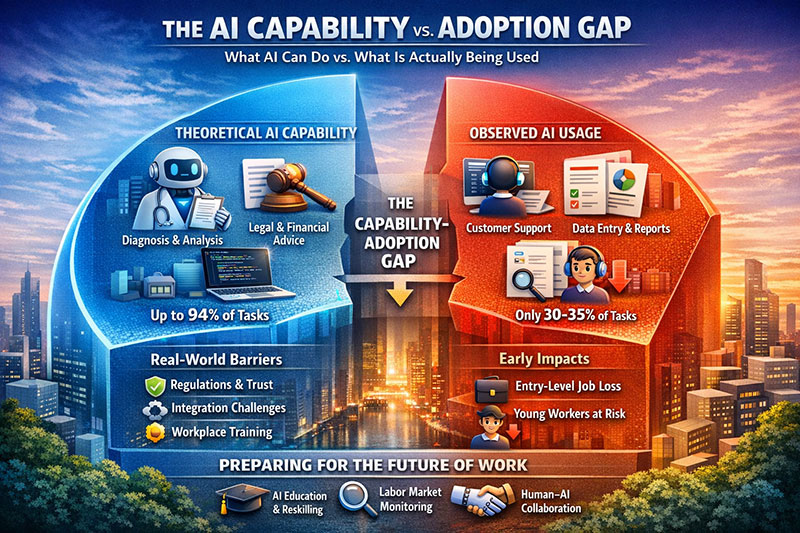
While artificial intelligence is commonly depicted as an incredibly disruptive force that is poised to quickly replace human labour across industries, recent research is beginning to shed light on what is actually happening. One of the first studies to examine the relationship between artificial intelligence and labour is from economists Maxim Massenkoff and Peter McCrory at Anthropic. This groundbreaking research is titled “Labour Market Impacts of AI: A New Measure and Early Evidence” (Anthropic, 2026). This research presents the idea of “observed exposure,” which is intended to help separate the capabilities of artificial intelligence from what is actually being used in labour markets.
This is an important distinction because it shows that the relationship between artificial intelligence and labour is more complicated. While many people believe that artificial intelligence is poised to quickly replace human labour, the reality is that there is currently a significant difference between what is actually being used in labour markets versus what is technologically capable. For example, in many knowledge-based industries such as management, finance, law, and software development, artificial intelligence has the capability to replace human labour. However, in reality, it is not. For example, in the “computer and mathematics” industry, artificial intelligence has the capability to replace 94 percent of
One of the most interesting findings of this study is that there has been no large-scale unemployment as a consequence of AI adoption. The study found no statistically significant increase in unemployment among workers in occupations that are heavily exposed to AI since generative AI tools were introduced in 2022.
This study contradicts some of the doomsday predictions about AI. Throughout history, every time there has been a significant technological revolution, it has taken time for unemployment to rise. The same is true of AI adoption. The study found that many organizations across industries use AI as a productivity tool, not as a replacement for workers.
However, there are many early warning signs of AI adoption that cannot be ignored. One of the most interesting findings of this study is that there is a significant impact of AI adoption on young workers entering the labour market. The study found that there was a 14 percent reduction in job-finding rates among workers aged 22 to 25 in occupations that were heavily exposed to AI tools.
This is a warning sign that knowledge workers, especially those entering the workforce, could be impacted by AI adoption. For instance, writing documents, responding to customer inquiries, simple coding, or analyzing data is becoming increasingly easy with AI tools. Lawrence Katz, a Harvard economist, has previously found in his study of AI adoption that it is usually the first rung of the professional ladder that is impacted by AI adoption, as he found in his study of automation.
The study also disputes the notion that automation is a major driver of job displacement for low-skilled labour. Rather, the jobs most impacted by AI are the most educated and professional occupations. For example, employees in these jobs are more likely to have graduate degrees and higher incomes than employees in less impacted jobs.
This is due in part to the unique abilities of contemporary artificial intelligence systems, particularly large language models, which are well suited for tasks involving text generation, analysis, and reasoning. Indeed, artificial intelligence is increasingly being used for routine cognitive work, not manual labour, according to Michael Osborne, a researcher at Oxford University.
For the Indian economy, the implications of the Anthropic study are significant. For the past two decades, the Indian economy has grown at a high and steady clip due in part to the expansion of the information technology and business process outsourcing industry, which employs millions of Indian professionals in fields including software development, customer relations, and financial analysis. These jobs are similar in many ways to the jobs identified by the Anthropic study as being the most impacted by AI adoption.
For example, if routine tasks in these fields are increasingly automated, the traditional route for young graduates may be impacted. Indeed, the former Secretary of the Indian Ministry of Electronics and Information Technology, Dr. Aruna Sundararajan, has emphasized the need for AI literacy to become a fundamental skill taught in educational systems in order for the Indian economy to continue to enjoy a comparative advantage in the global knowledge economy.
At the same time, international data suggests that the current adoption of AI is actually increasing productivity more than it is reducing employment. Research into the adoption of AI in the workplace in Europe and North America suggests that many organizations are indeed using artificial intelligence to help employees, rather than replace them. For example, the renowned Stanford economist Erik Brynjolfsson, an expert in the field of digital transformation, has argued that we are still in the early stages of what he calls a ‘general-purpose revolution in technology,’ in which productivity growth precedes labour market changes.
Perhaps the greatest value of the Anthropic report is in the framework it provides for tracking these changes over time. This allows us to monitor the adoption of AI in the economy and detect the early warning signs of labour market disruptions before they become severe.
The difference between what AI might do and what it is actually being used for is simply a temporary buffer in the labour market. As organizations learn to use these technologies more effectively, and as economic pressures force us to automate labour, that difference will quickly disappear. It is the nations that invest in adapting to these changes that will thrive in the next stage of the AI revolution.
Dr. Prahlada N.B
MBBS (JJMMC), MS (PGIMER, Chandigarh).
MBA in Healthcare & Hospital Management (BITS, Pilani),
Postgraduate Certificate in Technology Leadership and Innovation (MIT, USA)
Executive Programme in Strategic Management (IIM, Lucknow)
Senior Management Programme in Healthcare Management (IIM, Kozhikode)
Advanced Certificate in AI for Digital Health and Imaging Program (IISc, Bengaluru).
Senior Professor and former Head,
Department of ENT-Head & Neck Surgery, Skull Base Surgery, Cochlear Implant Surgery.
Basaveshwara Medical College & Hospital, Chitradurga, Karnataka, India.
My Vision: I don’t want to be a genius. I want to be a person with a bundle of experience.
My Mission: Help others achieve their life’s objectives in my presence or absence!
Source:
Massenkoff M., McCrory P. (2026). Labour Market Impacts of AI: A New Measure and Early Evidence. Anthropic Research.




























Leave a reply