
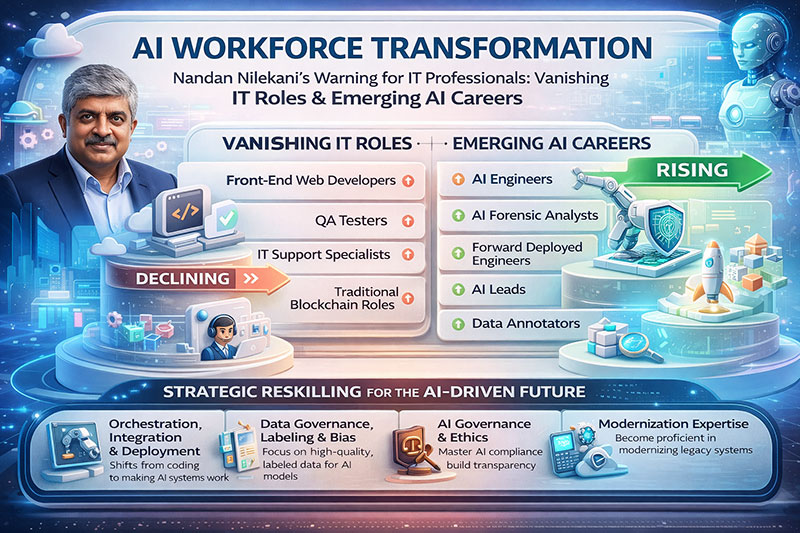
Artificial intelligence is no longer just a tool for boosting productivity; it is changing the way work is done in the worldwide IT business. Nandan Nilekani, co-founder and chairman of Infosys, gave a clear and strategic message at Infosys’ Investor Day 2026: software professionals need to get ready for a big change in how value is created. He said, “Talent will have to deal with the world where writing code will not be the goal, it will be actually making AI work,” according to The Economic Times on February 17, 2026.
This is not a trend that happens in cycles. Nilekani calls it a “root-and-branch” change in the IT workforce.
From Writing Code to Managing AI
In the past, deterministic logic was at the heart of software development: write code, test it, and then deploy it. Being predictable was a good thing, not a bad thing. This paradigm is changed by AI. As the article says, businesses now have to deal with “non-deterministic systems,” where the same prompts can give various results. This changes the way software systems are built, tested, and controlled at their most basic level.
This change has big effects on society and the economy in India, where IT services make up a large part of GDP and employ millions of people. Roles that are common, like:
· Front-End Web Developers
· QA Testers
· IT Support Specialists
· Traditional blockchain-focused professionals
But the story isn’t about getting rid of something; it’s about changing it.
The same tendencies may be seen around the world. AI copilots are making it less necessary to write code by hand in the US. In Europe, the need for AI ethical experts is growing because of rules and regulations. The main goal in India is to expand AI engineering and business use.
The Five Jobs of the Future AI
According to Nilekani’s remarks (page 2), emerging high-growth roles include:
- AI Engineers
- AI Forensic Analysts
- Forward Deployed Engineers
- AI Leads
- Data Annotators
These jobs are a shift from doing things to organizing them. AI engineers develop and improve models. AI forensic analysts look into how models act, any bias they may have, and any strange behaviour they may show. Forward Deployed Engineers put AI into real client contexts, which is especially important for big changes in businesses. AI Leads connect corporate strategy with technical capabilities. People often forget about data annotators, although they make sure that supervised models are trained on high-quality labelled datasets.
Nilekani stressed, “It’s not that you won’t need talent… they’ll be doing different things.”
This is in line with what many people throughout the world think. Satya Nadella has said many times that AI is “reshaping every software category.” At the same time, India’s Digital Public Infrastructure (DPI) revolution—Aadhaar, UPI, ONDC—shows that building systems that can grow requires more than just code.
The Brownfield Challenge: The Real Fight Is Here
Nilekani’s speech may have given the most useful information about legacy systems. He said that AI-generated “greenfield” development is relatively easy, but updating “brownfield” systems that are full of technical debt, silos, and undocumented dependencies is much tougher.
Many of India’s biggest companies, especially in the public sector, banking, and communications, still use infrastructure that is decades old. There are trillions of dollars locked up in legacy structures all around the world. To modernize these systems, you need both AI technologies and a lot of knowledge about how the organization works.
This opens up possibilities. People that know how to work with both old infrastructure and AI transformation will be very desirable. “Translators,” or people who connect old systems with new intelligence, will be in charge of the future.
Discipline, Not Hype: Staying Away from the “AI Slop” Trap
Nilekani gave an important warning: “The fact that you can make things means you can make slop.”
This warning is heard all throughout the world. The quick spread of generative AI technologies can lead to little increases in productivity without any real results for the business. Organizations must put in place:
- Guidelines for using AI that are clear
- Quality gates
- Frameworks for explainability
- Structures of governance
Adopting AI is not just a matter of technology; it’s also a matter of how organizations work. Nilekani said that implementation lags behind model performance since transformation necessitates retraining, data rearrangement, and the redesign of business models.
In India, where businesses are rushing to use AI to be competitive throughout the world, governance frameworks will decide who wins in the long run. The same idea is behind international regulation efforts like the EU AI Act: innovation must be controlled.
Advisory for Professionals: A Plan for Strategic Reskilling
The message is obvious for Indian IT workers and computer workers all over the world.
1. Change from Syntax to Systems Thinking
Instead of merely learning computer languages, learn how to orchestrate, integrate, and deploy AI.
2. Learn how to read data
Learn about data governance, how to classify data, and how to reduce bias.
3. Study the ethics and rules of AI
Forensic analysis and following the rules will be areas of growth.
4. Connect Business and Technology
Professionals who can connect AI outputs to measurable ROI will be in charge of change.
5. Expertise in Modernization
Learn how to move legacy systems and work with hybrid architectures.
“Excellence does not happen by chance,” declared former President A.P.J. Abdul Kalam. It’s a process. The AI transformation is exactly this kind of process: planned, organized, and disciplined.
The World Economic Forum has said that automation will take away some jobs, but it will also generate new ones that need strong digital skills. India is at a critical turning point because of its demographic dividend.
In conclusion, there is a reset of the workforce, not a collapse.
The change talked about at Infosys’ Investor Day 2026 is not about cutting jobs; it’s about staying relevant. The AI revolution isn’t so much about getting rid of people as it is about moving people from doing the same thing over and over again to organizing things intelligently.
Nilekani said that the problem is not a lack of opportunities, but the need to quickly retrain.
In India and around the world, the future of tech jobs will belong to those who know that coding is no longer the end goal. Instead, it is the basis for building, managing, and scaling AI-powered systems.
The time of creating code is over, and the time of making AI work is beginning.
Dr. Prahlada N.B
MBBS (JJMMC), MS (PGIMER, Chandigarh).
MBA in Healthcare & Hospital Management (BITS, Pilani),
Postgraduate Certificate in Technology Leadership and Innovation (MIT, USA)
Executive Programme in Strategic Management (IIM, Lucknow)
Senior Management Programme in Healthcare Management (IIM, Kozhikode)
Advanced Certificate in AI for Digital Health and Imaging Program (IISc, Bengaluru).
Senior Professor and former Head,
Department of ENT-Head & Neck Surgery, Skull Base Surgery, Cochlear Implant Surgery.
Basaveshwara Medical College & Hospital, Chitradurga, Karnataka, India.
My Vision: I don’t want to be a genius. I want to be a person with a bundle of experience.
My Mission: Help others achieve their life’s objectives in my presence or absence!
Leave a reply



























Leave a reply