
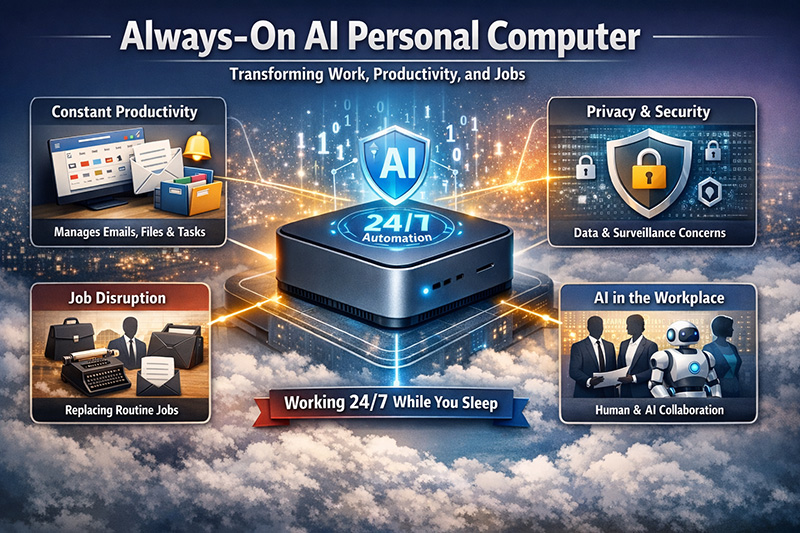
The claim that Perplexity AI has developed a “Mac mini that never turns off” to function as a personal AI agent is provocative, not only as a product idea but also as a measure of the rapidity with which the definition of computing is being redefined. Although no such widely documented official announcement is evident to date, the idea is consistent with the reality of the technology shift towards the development of persistent personal AI agents that evolve into digital workers. Indeed, the evolution of computing technology can be seen as the development of successive paradigms, moving through batch processing, into personal computing, and subsequently into cloud computing.
When IBM introduced the IBM PC in 1981, it revolutionized the way people worked. As technology historian Paul E. Ceruzzi describes in his history of the evolution of computing technology, “A History of Modern Computing” (MIT Press, 2003), the personal computer “shifted computational power from centralized institutions to individuals,”effectively destroying and recreating jobs. The reference to the idea of the “Mac mini that never turns off” as a personal computer is not entirely inaccurate. Does it not imply the redefinition of the term “personal” with the advent of the technology?
The new aspect in this case, however, is the factor of persistence. Conventional computers need data input, while new AI systems work on their own over time. Research by Stanford University on “generative agents” illustrates the capabilities of such AI systems in simulating ongoing activity, memory, and task execution over time (Park et al., 2023). Moreover, OpenAI and other developers are already working on agentic frameworks for such capabilities. What is being discussed in this statement is essentially the development of an edge-based AI agent that works on personal data streams over time.
Essentially, the benefits for such a development from an advocacy perspective are considerable. Continuous activity can potentially increase productivity by automating cognitive work. A report by the McKinsey Global Institute (2023) on generative AI illustrates that up to 60-70% of current work activities can potentially be automated. Essentially, such a system can potentially filter emails overnight, summarize meetings before the workday starts, or even perform strategic activities by connecting different data streams. For professionals in different fields such as healthcare, research, or design, such a system can potentially save time from administrative activities—a problem that has been ongoing for a considerable time.
For example, a report by Shanafelt et al. on “Physician Burnout—Every Physician Has a Story” for Mayo Clinic Proceedings (2016) illustrates the problem of burnout for professionals due to clerical work. India can potentially benefit from such a development. Essentially, India has a rapidly digitizing workforce. Moreover, the country has a strong information technology base. In fact, NITI Aayog in its National Strategy for Artificial Intelligence (2018) illustrates that such a development can potentially “augment human capabilities and unlock economic value across sectors.”Essentially, such a development can potentially act as a virtual operations manager for Indian startups or SMEs.
However, the risks involved are equally significant. The parallel drawn with job displacement is not unfounded. Economists like Erik Brynjolfsson and Andrew McAfee, in their book “The Second Machine Age” published in 2014, propose the idea of “skill-biased technological change,” which states that digital technologies can affect cognitive jobs. An omnipresent AI, which is constantly at work and is involved in cognitive work, is not only detrimental to clerical work but also to white-collar jobs. The International Labor Organization (ILO), in its report published in 2023, states that the impact of generative AI can be felt in administrative and professional jobs, especially in the service-based economy.
The other significant factor is privacy and security issues. The continuous processing of personal information raises issues of surveillance, ownership, and potential security breaches. Unlike cloud computing, which may have issues with security, edge AI offers a sense of control, but this control will now fall on the developers and users to implement proper security measures.
There is a philosophical change in this concept as well. Satya Nadella, the current CEO of Microsoft, has mentioned in a speech that artificial intelligence is changing from “tools to teammates.” This change in concept emphasizes the use of artificial intelligence in a collaborative manner, not a replacement for humans. However, with autonomous and continuous artificial intelligence, this line becomes blurred, and issues of responsibility, authorship, and identity are brought to the surface.
In conclusion, regardless of whether this product exists in this manner, the future is clear: continuous artificial intelligence is the next step in personal computing, which will redefine productivity, work, and ethics. The parallel drawn with personal computing in 1981 is significant, but this change may be more significant than the last, as Klaus Schwab, founder of the World Economic Forum, mentioned in “The Fourth Industrial Revolution” in 2016: “we stand on the brink of a technological revolution that will fundamentally alter the way we live, work, and relate to one another.”The question is no longer will this technology emerge, but how will we incorporate this technology in a manner that benefits society as a whole.
Dr. Prahlada N.B
MBBS (JJMMC), MS (PGIMER, Chandigarh).
MBA in Healthcare & Hospital Management (BITS, Pilani),
Postgraduate Certificate in Technology Leadership and Innovation (MIT, USA)
Executive Programme in Strategic Management (IIM, Lucknow)
Senior Management Programme in Healthcare Management (IIM, Kozhikode)
Advanced Certificate in AI for Digital Health and Imaging Program (IISc, Bengaluru).
Senior Professor and former Head,
Department of ENT-Head & Neck Surgery, Skull Base Surgery, Cochlear Implant Surgery.
Basaveshwara Medical College & Hospital, Chitradurga, Karnataka, India.
My Vision: I don’t want to be a genius. I want to be a person with a bundle of experience.
My Mission: Help others achieve their life’s objectives in my presence or absence!
My Values: Creating value for others.
Leave a reply


























Leave a reply