
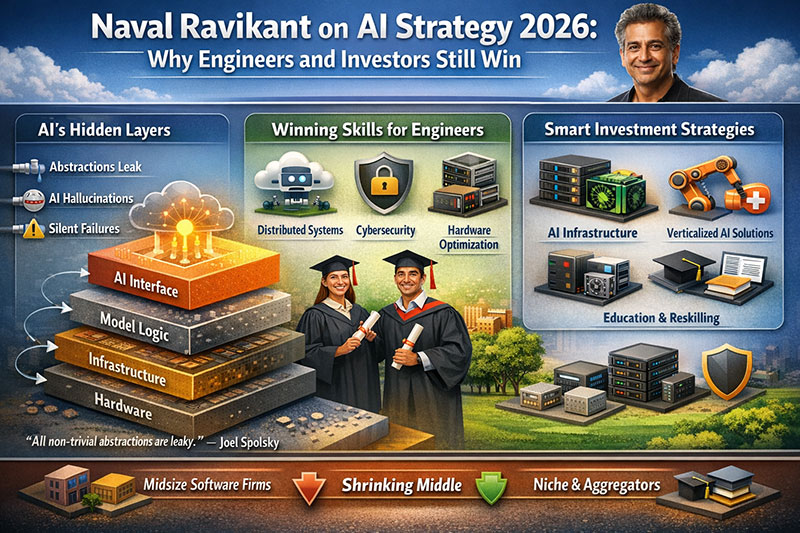
In a recent walking dialogue with Nivi, Naval Ravikant articulated a thesis that may shape how we think about artificial intelligence, careers, and capital allocation over the next decade. Stripped of studio theatrics, his reflections returned to first principles: leverage, judgment, and ownership.
For founders, professionals, and investors—particularly in fast-growing ecosystems like India—the core message is clear: AI is not eliminating opportunity; it is redistributing advantage. And that advantage belongs to those who understand what lies beneath the abstraction.
Engineers Still Win—Because Abstractions Leak
One of the most powerful insights in Naval’s framework is deceptively simple: abstractions leak.
AI systems generate code, write reports, summarize contracts, and even design products. Yet they hallucinate. They miss edge cases. They introduce subtle logical flaws. These are not peripheral errors; in finance, healthcare, or cybersecurity, they can be existential.
As computer scientist Joel Spolsky famously observed, “All non-trivial abstractions, to some degree, are leaky.” This principle applies directly to large language models and generative AI systems. The smoother the interface appears, the more critical it becomes to understand the machinery underneath.
Internationally, this is visible in how companies like OpenAI and Google DeepMind employ not just prompt engineers, but infrastructure architects, alignment researchers, and distributed systems experts. The surface layer may look conversational; the foundation is intensely technical.
The financial implication is significant: engineers who understand infrastructure, model limitations, and system architecture possess durable economic value. The future does not reward generic coders. It rewards those who can diagnose failures one layer below the AI output.
The Indian Engineering Dividend—If Repositioned Correctly
India produces over a million engineering graduates annually. For two decades, much of this workforce powered the global outsourcing and services economy. The AI era, however, demands repositioning.
The next wave of winners will not be entry-level developers competing with automated code generation. They will be professionals skilled in:
- Distributed systems and cloud architecture.
- Cybersecurity and adversarial robustness.
- Hardware acceleration and chip-level optimization.
- Data governance and model evaluation.
Consider the rapid expansion of AI data centers in India, supported by firms like NVIDIA and hyperscale cloud providers. Infrastructure is becoming strategic national capital. Engineers who understand GPU clusters, latency management, and reliability engineering are no longer support staff—they are leverage multipliers.
From a capital allocation perspective, investors should examine not only AI application startups but also foundational infrastructure firms. As in previous technology cycles, the “picks and shovels” often outperform the gold rush.
AI and the Hollowing of the Middle
Naval’s broader thesis extends beyond engineering. He suggests the app economy is splitting into three layers: dominant aggregators, a long tail of niche players, and a disappearing middle.
Mid-sized software firms that once thrived by serving narrow enterprise use cases face compression. AI-integrated platforms can replicate and absorb these functions quickly. This mirrors what happened during the platform era described by international business scholars studying network effects.
For Indian SMEs and technology service providers, the lesson is stark: either move up the stack toward product ownership or move down into defensible hyper-specialized niches. Remaining in the middle—offering incremental feature sets without differentiation—is financially dangerous.
AI as Capital Efficiency
Another underappreciated dimension of Naval’s thinking is capital efficiency. AI reduces marginal cost in design, prototyping, marketing copy generation, and analytics. This shifts startup economics.
Where a founder once needed a 10-person technical team, they may now begin with two domain experts and AI tools. Burn rates shrink. Time-to-market compresses. Return on invested capital improves.
From an Indian perspective, this democratizes entrepreneurship beyond metropolitan hubs like Bengaluru or Hyderabad. A specialist in Davangere or Coimbatore can prototype globally competitive tools using advanced AI platforms.
Yet capital efficiency does not eliminate the need for judgment. AI accelerates execution; it does not guarantee product-market fit. As Naval has long argued, wealth is created by ownership in scalable assets—not by hourly output.
Strategic Advisory for 2026
For Engineers: Go deeper, not broader. Master the layer below the AI interface. Study systems design, model evaluation, and cybersecurity. The most resilient careers will belong to those who understand failure modes.
For Founders: Use AI aggressively to compress cost and experimentation cycles—but retain human oversight where risk is high. Treat AI as an amplifier, not an oracle.
For Investors: Allocate across three categories:
- Core AI infrastructure
- Verticalized AI solutions with defensible domain depth
- Education and reskilling platforms that prepare talent for this shift
Avoid mid-tier commoditized software firms vulnerable to platform absorption.
The Psychological Shift
Perhaps the most important takeaway from Naval’s reflections is psychological. Anxiety about AI often stems from distance. Engagement reduces fear.
“The future belongs to those who understand leverage.”
In India, where demographic dividend meets digital infrastructure, the opportunity is profound—but only if talent upgrades its abstraction depth.
Globally, the pattern is consistent: every technological wave rewards those who move closer to the source of power. In the AI decade, that source is not the chat interface. It is the architecture beneath it.
Engineers still win—because reality still matters.
Dr. Prahlada N.B
MBBS (JJMMC), MS (PGIMER, Chandigarh).
MBA in Healthcare & Hospital Management (BITS, Pilani),
Postgraduate Certificate in Technology Leadership and Innovation (MIT, USA)
Executive Programme in Strategic Management (IIM, Lucknow)
Senior Management Programme in Healthcare Management (IIM, Kozhikode)
Advanced Certificate in AI for Digital Health and Imaging Program (IISc, Bengaluru).
Senior Professor and former Head,
Department of ENT-Head & Neck Surgery, Skull Base Surgery, Cochlear Implant Surgery.
Basaveshwara Medical College & Hospital, Chitradurga, Karnataka, India.
My Vision: I don’t want to be a genius. I want to be a person with a bundle of experience.
My Mission: Help others achieve their life’s objectives in my presence or absence!
Leave a reply




























Leave a reply