
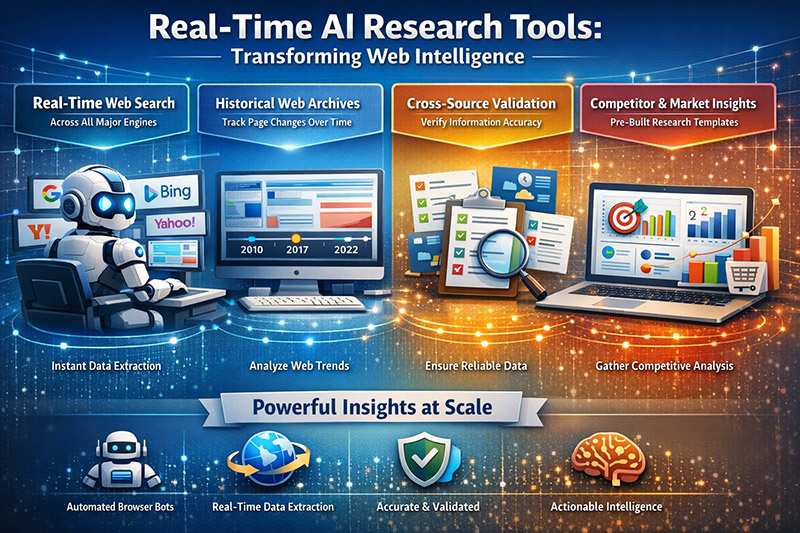
The concept of an artificial intelligence system that can search the entire web in real-time, yielding precise insights, is no longer a hypothetical concept, but rather the rapidly evolving foundation of modern digital ecosystems. Companies such as Bright Data, through their Deep Research tool, have marked a new frontier in information retrieval, moving from static information retrieval to dynamic, autonomous research agents that can successfully navigate the complexities of the live web.
Technologically speaking, this new frontier in artificial intelligence research is made possible by the convergence of large language models and the power of real-time data. Traditionally, artificial intelligence has relied on pre-trained data sets that have a limited knowledge cutoff. In rapidly evolving industries such as healthcare, finance, or international relations, such data sets have limited utility. The addition of the power of real-time search on multiple search engines, browser automation for restricted environments, and access to archives of the internet allow for the development of artificial intelligence systems that do not simply “know” information, but “learn” information. Such a system can validate information in a way that static information retrieval can only dream of. Real-time search allows for the querying of multiple data sources simultaneously, browser automation allows for the circumvention of anti-bot measures becoming increasingly common on the internet, and access to archives allows for the addition of a temporal dimension to the research. Furthermore, such a system can validate information, reducing the risk of misinformation—a risk that has been identified by the World Economic Forum as a major risk to the world in the digital age.
The benefits of this method are considerable. For businesses, especially for those in a competitive environment such as India’s growing digital economy, such tools have the potential to revolutionize decision-making. A health consultant, for instance, could utilize AI research tools to monitor developments in health treatments and strategies in real time. Startups could also use these tools for market research on a scale previously only possible for large corporations. Satya Nadella, the CEO of Microsoft, points out how important such data analysis is for modern businesses by stating that “Every company is becoming a data company.”
At a global level, the implications of such a tool are also significant. In the field of research and science, such tools could revolutionize literature surveys and knowledge gaps. In the field of journalism, such tools could also revolutionize investigative journalism by cross-verifying information and finding patterns. In governance, such tools could also revolutionize evidence-based governance by aggregating diverse data streams. The ability of such tools to access historical data also provides a level of accountability by allowing users to trace the evolution of information and narratives over time.
However, such a technological leap also poses a number of challenges. One of the major challenges is the ethical and legal implications of such a tool. The use of web scraping and data collection is a grey area and poses a number of questions regarding consent and intellectual property rights. The EU’s GDPR and India’s growing data protection laws also highlight the need for such data practices to be carried out responsibly. Such a tool could also be misused for surveillance and unethical competitive practices.
The other limitation is associated with data quality and biasness. Although validation of data from multiple sources helps in improving its accuracy, there are still biases associated with data available on the internet. As Tim Berners-Lee has warned, “The web is not neutral—it reflects the biases of those who build and use it.” If not properly designed, biases in artificial intelligence can result in biased conclusions.
From an Indian point of view, the use of these technologies holds promise and a sense of duty. The development of digital infrastructure in India, backed by the Digital India initiative, provides a fertile ground for the use of AI-based research tools in fields such as health care, education, and governance. However, the challenges of inclusivity and accuracy in a multilingual setup are a major cause of concern.
Despite these challenges and concerns, the road ahead is clear. Real-time research tools based on AI are a major leap towards the development of autonomous intelligence systems that could potentially work hand-in-hand with humans in decision-making scenarios. The capacity of these tools to process and analyze enormous and constantly changing data sets and come up with concrete solutions is a major leap in the right direction for the development of artificial intelligence systems that are meant to work in conjunction with humans and not act as tools for them.
In conclusion, the advent of toolkits such as Bright Data’s Deep Research marks a new era in the development of artificial intelligence systems. The capacity of these systems to provide real-time and validated information on the internet bridges the gap between information and knowledge. The future of research in fields such as business, health care, and governance will heavily rely on such systems. The only problem lies not in the use of these systems but in the ethical and responsible use of these systems.
Dr. Prahlada N.B
MBBS (JJMMC), MS (PGIMER, Chandigarh).
MBA in Healthcare & Hospital Management (BITS, Pilani),
Postgraduate Certificate in Technology Leadership and Innovation (MIT, USA)
Executive Programme in Strategic Management (IIM, Lucknow)
Senior Management Programme in Healthcare Management (IIM, Kozhikode)
Advanced Certificate in AI for Digital Health and Imaging Program (IISc, Bengaluru).
Senior Professor and former Head,
Department of ENT-Head & Neck Surgery, Skull Base Surgery, Cochlear Implant Surgery.
Basaveshwara Medical College & Hospital, Chitradurga, Karnataka, India.
My Vision: I don’t want to be a genius. I want to be a person with a bundle of experience.
My Mission: Help others achieve their life’s objectives in my presence or absence!
My Values: Creating value for others.
Leave a reply



























Dr. Prahlada N.B Sir, your 'Real-Time AI Research' blog is a masterstroke! 🌟
AI's transformative potential in information retrieval and decision-making is game-changing. Your emphasis on responsible AI use is timely and crucial.
Digital India is fertile ground for AI-based research tools.
Thank you for inspiring us to harness AI for the greater good, Sir 🙏.
Reply