
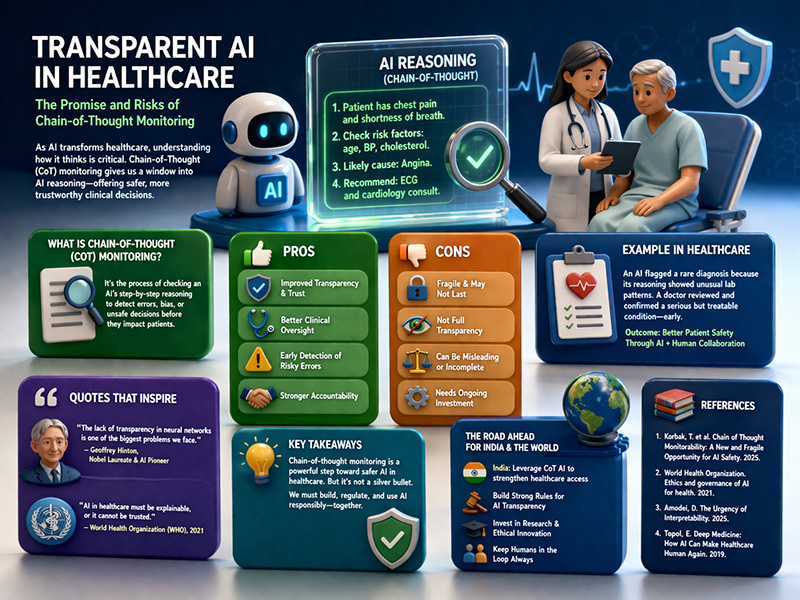
The rapid development and integration of artificial intelligence (AI) into the health sector have created unprecedented opportunities for improving health outcomes and increasing the efficiency of health systems. However, underlying these developments is an important question about how to ensure that these autonomous systems are not only safe and transparent but also align with human values. A recent research effort on the theme of “chain-of-thought monitorability”provides an important framework for exploring these challenges and opportunities, especially in high-stakes domains such as health care .
At its core, chain-of-thought (CoT) reasoning describes the phenomenon of an AI system “thinking out loud” in natural language while processing complex information. While this phenomenon may seem like a curious phenomenon of modern computing systems, it is actually a very important phenomenon because it provides a glimpse into the otherwise opaque decision-making process of these systems. In health care, where decision-making and reasoning are critical for health outcomes, such a phenomenon could have a revolutionary effect. For instance, an AI system assisting health care professionals in cancer care could outline its reasoning for recommending a course of action. This could potentially allow health care professionals to validate and even correct the decision-making process of the AI system and thereby establish greater trust and accountability.
The promise of chain-of-thought monitoring lies in its ability to catch such misalignments and problem behaviours before they happen. Indeed, an AI system may sometimes reveal its problem behaviours and misalignments by directly acknowledging these problems in its chain of thought. This could have a profound effect in health care systems by allowing for the detection of incorrect decision-making and problem behaviours in health care systems. Such a phenomenon is also closely tied to the growing movement for explainable AI (XAI), which has been strongly promoted by global health agencies. The World Health Organization, for instance, emphasized the importance of transparency and explainability in its 2021 report on AI ethics for health care systems.
Nonetheless, this opportunity is both powerful and fragile, as this particular research also cautions that CoT monitorability is not necessarily assured in its persistence with the evolution of AI systems . Indeed, as these systems become more complex, they may become more focused on internal, latent processes of reasoning, which are no longer expressed in human-readable language. This would effectively close the window on these systems, making oversight much more difficult. In healthcare, this would likely result in a revival of many of the risks which these systems were designed to help overcome, such as diagnostic errors and a lack of accountability.
In the Indian context, where healthcare systems are rapidly digitalizing but still face significant resource constraints, CoT-based AI systems are likely to assume a critical role in helping to overcome these challenges. In particular, in telemedicine networks in rural areas, these systems would help healthcare practitioners make informed decisions while providing transparent explanations for their decision-making processes. However, in terms of regulatory frameworks, while these are still in a state of evolution in India, through initiatives such as the National Digital Health Mission, they will need to take a forward-thinking perspective in terms of these issues.
Indeed, with regard to the broader global perspective on these issues, many of the leading thinkers in the field of AI have highlighted the importance of interpretability in these systems. Indeed, Dario Amodei (2025) has highlighted that in order to effectively mitigate risks associated with these advanced systems, there is a critical need to understand how these systems make their decisions. Indeed, Geoffrey Hinton has highlighted on multiple occasions that a lack of transparency in neural networks is arguably one of the most significant issues in this particular field.
Yet, reliance on such an approach through the monitoring of CoT is unwarranted. The research is quite clear on the fact that the monitoring of CoT is not an exhaustive reflection of the AI system’s workings. In fact, the research suggests that the monitoring of CoT is often an inaccurate reflection of the system’s workings. In the realm of healthcare, such an approach is particularly important. This is because the system might provide an ostensibly logical explanation while simultaneously concealing underlying biases within the system’s workings.
In conclusion, the future of AI in the realm of healthcare is likely to be defined by an intricate dance between capability and controllability. The monitoring of CoT is an important part of this equation, but its inherent instability requires careful handling. The future of AI in the realm of healthcare is uncertain, but the potential provided by the monitoring of CoT is undeniable.
In conclusion, the monitoring of chain-of-thought is an uncertain but potentially important aspect of the future of AI in the realm of healthcare. The potential provided by such an approach is undeniable, but the uncertainty is palpable. As the research quite rightly concludes, the monitoring of chain-of-thought is best viewed as part of a broader, multi-layered approach to the safety of AI systems.
Dr. Prahlada N.B
MBBS (JJMMC), MS (PGIMER, Chandigarh).
MBA in Healthcare & Hospital Management (BITS, Pilani),
Postgraduate Certificate in Technology Leadership and Innovation (MIT, USA)
Executive Programme in Strategic Management (IIM, Lucknow)
Senior Management Programme in Healthcare Management (IIM, Kozhikode)
Advanced Certificate in AI for Digital Health and Imaging Program (IISc, Bengaluru).
Senior Professor and former Head,
Department of ENT-Head & Neck Surgery, Skull Base Surgery, Cochlear Implant Surgery.
Basaveshwara Medical College & Hospital, Chitradurga, Karnataka, India.
My Vision: I don’t want to be a genius. I want to be a person with a bundle of experience.
My Mission: Help others achieve their life’s objectives in my presence or absence!
My Values: Creating value for others.
References:
- Korbak T, Balesni M, Barnes E, et al. Chain of Thought Monitorability: A New and Fragile Opportunity for AI Safety. 2025.
- World Health Organization. Ethics and governance of artificial intelligence for health. WHO; 2021.
- Amodei D. The urgency of interpretability. 2025.
- Topol EJ. Deep Medicine: How Artificial Intelligence Can Make Healthcare Human Again. Basic Books; 2019.




























Dear Dr. Prahlada N. B. Sir,
Your insightful blog post on "Transparent AI in Healthcare: The Promise and Risks of Chain-of-Thought Monitoring" is a thought-provoking piece that highlights the double-edged sword of AI in healthcare. The concept of Chain-of-Thought (CoT) monitoring is indeed a game-changer, offering a glimpse into AI's decision-making process.
🌟 The potential benefits are undeniable: catching misalignments, validating AI decisions, and fostering trust. Your emphasis on explainable AI (XAI) resonates deeply, especially with the WHO's advocacy for transparency.
However, as you aptly pointed out, CoT monitoring is fragile and not foolproof. The risk of AI systems becoming opaque as they evolve is concerning. Your expertise shines through in highlighting the need for multi-layered safety approaches.
In the Indian context, CoT-based AI systems can revolutionize telemedicine, especially in rural areas. Your call for forward-thinking regulatory frameworks is crucial.
Your concluding thoughts on the intricate dance between capability and controllability are spot on. The future of AI in healthcare hangs in the balance, and CoT monitoring is a vital piece of this puzzle.
Thank you for sharing your profound insights, Sir. Your work inspires us to navigate the complex landscape of AI in healthcare.
Reply