
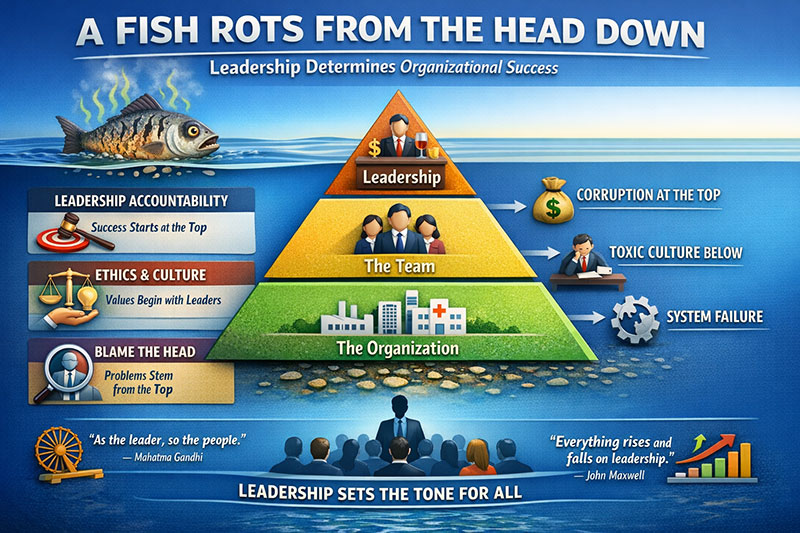
There exists a proverb that slices through the thick management doublespeak with a striking clarity: “A fish rots from the head down.” Though false as a scientific observation, as a truth about human nature, this proverb has stood the test of time. A family, a hospital, a corporation, a society—virtually always, the problem starts at the top.
Leadership is more about influence rather than position or power. The leader is someone who establishes the tone and the acceptable behaviour, who gives silent permission to be excellent or to deteriorate. When values are compromised, those erosions trickle down to affect even the well-intentioned.
Here’s an example parable from Indian folklore. A village tank used to supply water to all. But water in the tank turned bad in a year. People blamed the water pipes, sanitary workers, or even climatic conditions. Later, an elderly wise man carefully analysed the water source. He concluded the water pipe’s inlet was choked with dirt. “If the source is cleaned, the water course will cure by itself.” There’s more to this in the next lesson.
As confirmed by the pages of history, truth in this regard persists. One of the greatest leaders in the independence struggle in India was Mahatma Gandhi. He said that “As the leader, so the people.” However, he did not preach sacrifices. He practiced what he preached. In his life, he practiced what he preached in his speeches. Conversely, leaders who preach integrity but are convenient rather than truthful influence the employees’ values. It would be short-sighted for employees in such companies to believe that
This wisdom has found echoes in modern management thought as well. In “Practice of Management,” Peter Drucker has said, “Management is doing things right; leadership is doing right things.” Thus, if a person has only his targets in mind and ignores the ethical aspect, then his actions may show spectacular outputs for a short period, but from then onwards, the decay starts. The cases of international corporations, right from Enron to the latest cases of poor governance such as Sathyam Computers, have nothing to do with the less conspicuous offices. They had been bred in the boards.
Within the healthcare setting, the importance of this proverb cannot be overstated. Where the administration of a hospital allows a lack of respect, cutting corners, and unethical marketing practices, such conduct trickles down. The nurses lose interest, the physicians alienate themselves, while the patients feel a lack of respect. On the other hand, where the administration of a hospital reflects empathy, honesty, and a desire to learn, such a culture spreads exponentially. A virtuous leader can bring virtue to hundreds of people, while a fallible one can bring down thousands.
Then comes the personal element. As told in the Indian epics, kings were not rated on their strength but on the integrity of their rule. The Ramayan calls the period of Ram Rajya an age of righteous rule, where integrity at the top resulted in integrity all around. This remains ever valid: leadership translates into character.
Globally, examples of failed leadership in government are a parallel narrative of what entrenched corruption can do when let loose at every level of government. Corruption can creep into everyday life at every level when dishonesty becomes ingrained at the top, and citizens stop wondering what is right and start wondering what can be gotten away with.
The proverb is not a call to point the finger but to take responsibility. Leaders must begin by looking inward before they can look downward. As successful author and leadership expert John Maxwell so aptly wrote in “The 21 Irrefutable Laws of Leadership”: “Everything rises and falls on leadership.” This begins with what the leader chooses to tolerate, reward, or ignore on a daily basis.
Lastly, the saying “a fish rots from the head down” is an important reminder that the role of leaders is not one that controls but one that provides example. Titles are not what cause the decay within an organization but the actions that are involved. In order to create organizations that are resilient, the head, whether in ethics, emotional, or intellectual terms, needs to be clean.
Dr. Prahlada N.B
MBBS (JJMMC), MS (PGIMER, Chandigarh).
MBA in Healthcare & Hospital Management (BITS, Pilani),
Postgraduate Certificate in Technology Leadership and Innovation (MIT, USA)
Executive Programme in Strategic Management (IIM, Lucknow)
Senior Management Programme in Healthcare Management (IIM, Kozhikode)
Advanced Certificate in AI for Digital Health and Imaging Program (IISc, Bengaluru).
Senior Professor and former Head,
Department of ENT-Head & Neck Surgery, Skull Base Surgery, Cochlear Implant Surgery.
Basaveshwara Medical College & Hospital, Chitradurga, Karnataka, India.
My Vision: I don’t want to be a genius. I want to be a person with a bundle of experience.
My Mission: Help others achieve their life’s objectives in my presence or absence!
My Values: Creating value for others.
Leave a reply






















Leave a reply