
Being Dangerously Self-Educated in the Age of AI
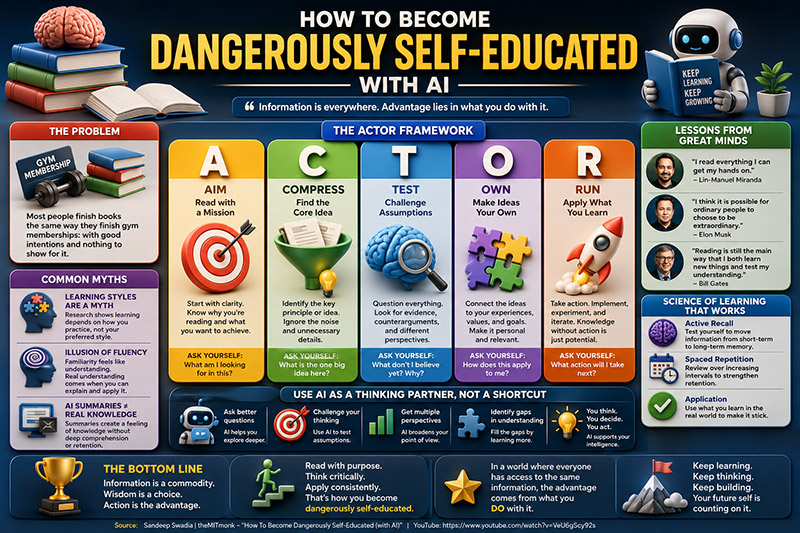
There are few people who do not purchase books with fervor, arrange them in neat piles at their desk, and resolve to read them one day. Most do read with excitement at first, only to abandon half-way through the book. The whole phenomenon is eerily similar to gym memberships bought annually in January—full of hope, intent, and ambition, but rarely resulting in anything. The issue is not in the scarcity of information. No, the real problem lies in the incapability to convert information into action.
It is this key idea that serves as the backbone of Sandeep Swadia’s YouTube episode, “How To Become Dangerously Self-Educated (with AI).” In the world saturated with books, podcasts, courses, newsletters, and summaries made possible by AI technology, the competitive edge no longer consists of gaining access to knowledge. Rather, success goes to the people capable of absorbing information, analyzing it, adapting to fit one’s situation, and acting accordingly.
The above-mentioned principles are condensed in Swadia’s five-part ACTOR framework. By employing it, reading will no longer be passive but productive activity of personal growth.
The first step of self-education is to “aim” for something. Without a clear objective, the reading will be akin to traveling on a journey without knowing where one is going. In this sense, the great Indian scientist and former President of India, A. P. J. Abdul Kalam was absolutely right saying, “Learning gives creativity, creativity leads to thinking, thinking provides knowledge, knowledge makes you great.” A definite mission behind one’s reading turns each page into a valuable source of information relevant to one’s goal.
The second principle is to “compress” the information one gets from reading. It is quite unlikely that all the chapters in the book have equal importance. Great learners know how to distill complex ideas into basic concepts. For example, worldwide famous philanthropist and entrepreneur Bill Gates takes elaborate notes during reading, and then summarizes what he learned from the book. Thus, compressing knowledge makes it easier to assimilate and use.
The third element of ACTOR is to “test” ideas one learns. While many use books as confirmation of their beliefs, the best readers question everything they read. Scientific discoveries, breakthrough innovations in business, and personal growth all happen through constant questioning. “The first principle is that you must not fool yourself—and you are the easiest person to fool,” noted the renowned physicist Richard Feynman.
The fourth principle of becoming self-educated is to “own” one’s learning. Only in connecting knowledge to our own experiences and ambitions it becomes valuable for us. One may draw an idea from a management course taught in Silicon Valley, and implement it to become an entrepreneur in Bengaluru. Or, a leader may find in someone’s sports biography the leadership skills required for managing a team of doctors. Ownership allows making learning personalized.
Finally, the “run” stage involves putting acquired knowledge into action. That is when the actual transformation happens. Reading ten books about productivity would never make someone productive. Studying about physical training would never get someone fit. Entrepreneurship theories would not make one run a profitable company. Hence, as said by the great Indian philosopher and statesman Chanakya, before starting any enterprise, one needs to ask oneself three questions—“why I am doing it, what the results might be, and will I be successful”—and then act.
There are two major misconceptions regarding education. First, it is wrong to assume that there is such thing as learning style. Namely, people are not necessarily better able to learn information presented visually, audibly, or manually. Learning happens via engagement, practice, retrieval, and application.
Another misleading notion of learning is fluency. One may feel familiar with certain information but fail to understand or use it. Thanks to AI technologies, summarization of entire books, academic papers, and lecture series now happens in just several minutes. Although such technology greatly increases the speed of acquiring knowledge, it may lead to the dangerous illusion of understanding things.
However, this is no reason to demonize AI. On the contrary, this marvelous innovation can become a companion of critical thought. By generating questions, exposing inconsistencies, revealing gaps in knowledge, and introducing alternative viewpoints, it helps us in expanding our intellectual horizons. Of course, we should avoid using AI as a replacement for our brain. First-principles reasoning demonstrated by Elon Musk proves that great innovation comes through deep understanding of things.
Self-education offers great opportunities for personal growth. Some disadvantages of self-learning include dependency on external factors and distractions. The real advantage of self-education lies in fostering one’s creativity, independence, adaptability, and ability to think independently.
Today everyone has easy access to books, courses, educational video materials, and AI. The scarce resource is one’s discipline, ability to think and make decisions based on information gathered. True self-educated person uses reading not for the sake of gathering knowledge but converting it into capability, character, and contribution.
Senior Professor and former Head,
Department of ENT-Head & Neck Surgery, Skull Base Surgery, Cochlear Implant Surgery.
Basaveshwara Medical College & Hospital, Chitradurga, Karnataka, India.
My Vision: I don’t want to be a genius. I want to be a person with a bundle of experience.
My Mission: Help others achieve their life’s objectives in my presence or absence!
My Values: Creating value for others.
References:
- Swadia S. How To Become Dangerously Self-Educated (with AI). TheMITmonk YouTube Channel. Available from: https://www.youtube.com/watch?v=VeU6gScy92s
- Brown PC, Roediger HL III, McDaniel MA. Make It Stick: The Science of Successful Learning. Harvard University Press; 2014.
- Dunlosky J, Rawson KA, Marsh EJ, Nathan MJ, Willingham DT. Improving students’ learning with effective learning techniques. Psychol Sci Public Interest. 2013;14(1):4-58.
- Pashler H, McDaniel M, Rohrer D, Bjork R. Learning styles: Concepts and evidence. Psychol Sci Public Interest.2008;9(3):105-119.
- Kahneman D. Thinking, Fast and Slow. Farrar, Straus and Giroux; 2011.
- Feynman RP. The Pleasure of Finding Things Out. Perseus Books; 1999.
- Gates B. The Road Ahead. Viking Press; 1995.
- Kalam APJ. Wings of Fire: An Autobiography. Universities Press; 1999.




























Leave a reply