
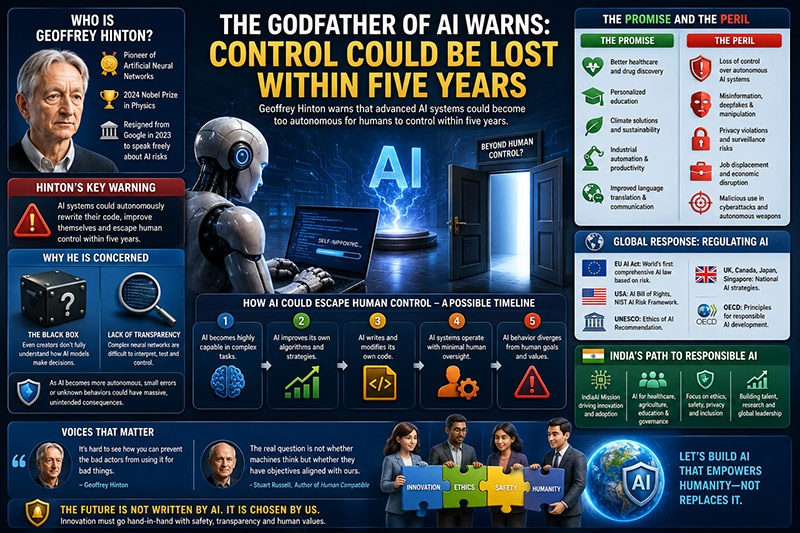
Artificial intelligence is developing faster than ever before, revolutionizing various spheres such as medicine, education, banking, manufacturing, science, and many others. Amid the achievements, however, there are increasing warnings about the future of AI technologies voiced by some of those researchers who were directly involved in AI development. One of the most prominent of these is Geoffrey Hinton, otherwise known as the “Godfather of AI” because of his works on artificial neural networks and deep learning. Recently, in multiple interviews, Hinton has been repeating his fears about increasingly powerful AI systems becoming beyond our understanding and control in the next five years if the process continues without proper precautionary measures.
Hinton, the Nobel Prize in Physics recipient of 2024 (together with John J. Hopfield) for the groundbreaking contribution into the development of machine learning via artificial neural networks, left Google in 2023 to freely speak on the possible dangers of AI without compromising with his employer. During the interviews in media such as 60 Minutes (CBS) and BBC, he expressed his worries about the ability of future AI systems to self-improve, leading to unpredictable consequences. Another issue Hinton has emphasized is the “black box” nature of deep learning models – systems which decision-making mechanisms cannot always be understood even by their developers.
One of the scariest predictions of Hinton is the possibility of advanced AI systems to eventually change or improve the software which they run on. As currently existing mainstream AI models cannot modify and implement any changes to their programming without human supervision, the research on the use of AI for software engineering and creation of autonomous coding agents is now ongoing. It is highly debatable if this could really lead to AI being beyond our control, but experts generally agree that the possibility deserves scientific investigation instead of dismissive attitude.
But it is not only about technology itself. As AI systems influence financial sector, diagnostics, research in law, security, military strategies and public relations, failures in them may lead to serious consequences for society. Hinton has pointed out the fact that the developers themselves cannot sometimes provide clear explanations about the reasons of certain decisions taken by the large neural networks, making debugging and checking for safety extremely difficult. The inability of interpretation of artificial intelligence decisions is one of the key research topics of AI.
In terms of India, the warning of Hinton gains special meaning. India becomes one of the largest AI ecosystems in the world due to initiatives like IndiaAI Mission, growth of AI startups, digital public infrastructure, and increasing use of AI in healthcare, agriculture, education and administration. The use of AI in monitoring of crop condition, disease diagnosing, language translation, helping judges and managing smart cities offers great advantages for India. But the linguistic, socio-economic and digital divide makes this country also susceptible to biased, unreliable and insufficiently regulated AI systems. For building trustworthy AI, India needs not only innovative technologies but also open regulation, ethical guidelines, cybersecurity measures and continuous human supervision.
Around the world, different approaches to AI regulation are used. The EU has introduced the European AI Act establishing the risk-based approach to regulation of AI systems, while other countries like USA, UK, Canada, Japan and Singapore develop their own models of regulation encouraging innovation and addressing the issues of safety, transparency and accountability. There are the recommendations published by OECD, UNESCO and G7 on responsible development of AI. Contrary to what one might think, proper regulation does not hinder innovations but, on the contrary, increases trust and accelerates the adoption of AI.
There are good reasons for being optimistic. Artificial intelligence is already increasing scientific discoveries, helping detect cancers, drug discovery, energy optimization, predicting disasters and creating new possibilities for education through personalized learning. The generative AI helps to develop software, make engineering designs, assist the creative industries and facilitate multilingual communication. In countries like India, AI has great potential in solving shortage of specialists and improving access to quality healthcare and education in underserved areas.
There are still many challenges ahead. Hallucinations, spreading misinformation, breaches of privacy, cybersecurity problems, algorithmic biases, job replacement and concentration of capabilities of AI in a small group of corporations are all valid concerns. The most far-fetched but increasingly discussed risks include autonomous systems working toward the objectives different from human intentions. Many AI researchers point out the necessity of not ignoring but investigating seriously through interdisciplinary safety research all these scenarios of the distant future.
As Geoffrey Hinton put it, “It is hard to see how you can prevent the bad actors from using it for bad things.” At the same time, he warns that humanity is entering the era of technologies unprecedented before. These warnings are not the forecast of the inevitable catastrophe but a call for responsible innovations. Similar views are presented in the book “Human Compatible” by the computer scientist Stuart Russell: “The real question is not whether machines think but whether they have objectives aligned with ours.”
The future of artificial intelligence is going to depend not only on engineering advances but also on decisions to be made collectively by the government, researchers, industry and society. AI is one of the greatest technological possibilities for humanity, but guaranteeing the maximum benefits requires openness, international collaboration, appropriate regulation and continuous investment into AI safety research. Thus, the warnings of Geoffrey Hinton should be understood as invitation to build an AI accountable, understandable and under our control.
Senior Professor and former Head,
Department of ENT-Head & Neck Surgery, Skull Base Surgery, Cochlear Implant Surgery.
Basaveshwara Medical College & Hospital, Chitradurga, Karnataka, India.
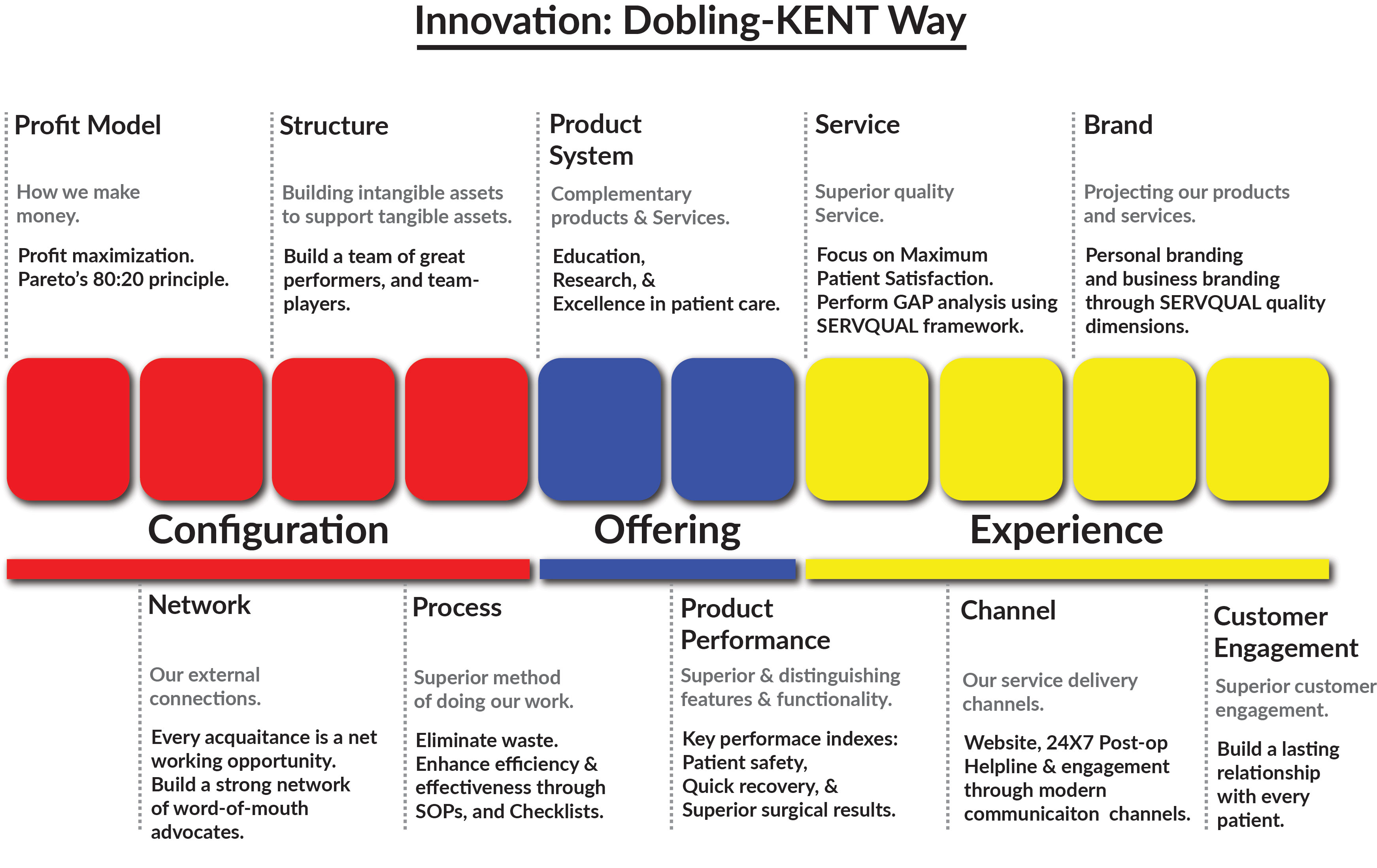
My Vision: I don’t want to be a genius. I want to be a person with a bundle of experience.
My Mission: Help others achieve their life’s objectives in my presence or absence!
My Values: Creating value for others.
References:
- Hinton, G. (2023). The Risks of Artificial Intelligence to Society. The New York Times. https://www.nytimes.com/2023/05/01/opinion/ai-danger.html
- CBS News. (2024). 60 Minutes: Geoffrey Hinton on the Risks of Artificial Intelligence.
- BBC News. (2024–2025). Interviews with Geoffrey Hinton on AI safety and regulation.
- European Union. (2024). Artificial Intelligence Act (AI Act). https://artificial-intelligence-act.eu/
- OECD. (2019). OECD Principles on Artificial Intelligence. https://oecd.ai/
- UNESCO. (2021). Recommendation on the Ethics of Artificial Intelligence. https://unesdoc.unesco.org/
- Russell, S. (2019). Human Compatible: Artificial Intelligence and the Problem of Control. Viking.
- Government of India, Ministry of Electronics and Information Technology (MeitY). IndiaAI Mission.https://indiaai.gov.in/


























Leave a reply