
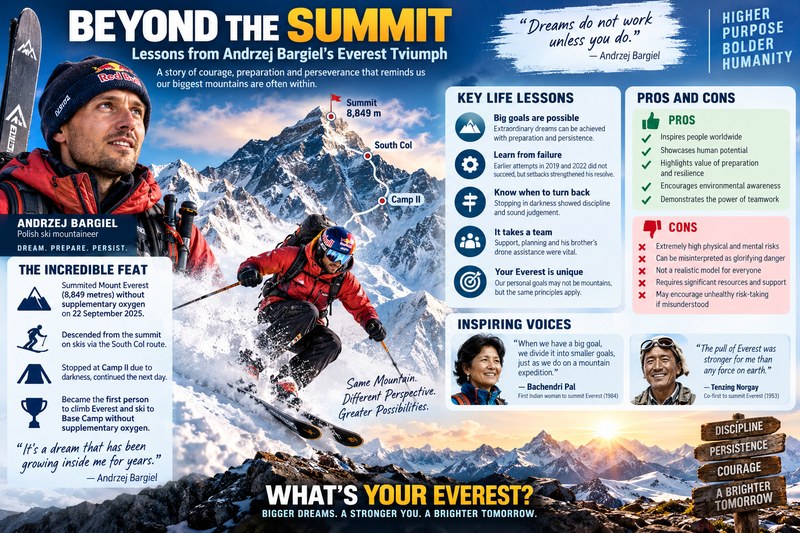
Last evening, as I was walking on the treadmill, I found myself watching a video which turned a routine workout into an unexpected lesson on what people can accomplish. The hero of the clip was Andrzej Bargiel, a Polish ski mountaineer. What he did initially appeared almost impossible – he scaled Mount Everest without using additional oxygen and then ski-descended from its summit. However, as I explored his story deeper, I understood that its true value lies not in skiing, not in mountaineering and not even in breaking records. Its value lies in what can happen when an apparently unrealistic goal is combined with preparation, patience, failure, judgement and persistence.
On September 22, 2025, Bargiel reached the summit of Everest which stands 8,849 metres high. He had spent almost 16 hours climbing through the so-called death zone above 8,000 metres and hadn’t used any bottled oxygen. From the top, he put on his skis and descended via South Col route. He stopped at Camp II because of the darkness and didn’t take the risky decision to proceed further. Next morning, he resumed his descent, managed to overcome the dangerous Khumbu Icefall with some help of his brother Bartek’s drone and got to Base Camp. Thus, Bargiel became the first person who scaled Everest and ski-descended from its summit to the altitude of Base Camp without any supplementary oxygen.
However, what makes his achievement especially impressive is the fact that it wasn’t his first try. Expeditions of 2019 and 2022 hadn’t yielded the desired result, and during the latter attempt, he turned back near South Col due to worsening weather conditions and increasing winds. So, failure didn’t escape his story. Instead, it became a part of the preparation to success. As Bargiel himself said, the descent from Everest summit has been his dream which had “been growing inside me for years.”
This nuance is essential. The motivational culture often praises the perseverance of people so much that it risks accidentally glorifying their recklessness. Bargiel’s story teaches a more subtle lesson: perseverance doesn’t mean never stopping. Perseverance means never abandoning the big picture only because the current attempt has to be stopped. To know when it’s time to stop may take as much bravery as knowing when it’s time to proceed. Bargiel’s choice of stopping at Camp II during the descent instead of risking himself in darkness demonstrates judgement rather than lack of courage.
Of course, there are some evident drawbacks of taking an extreme adventure too literally. Climbing high-altitude mountains is a potentially fatal activity which requires exceptional physical conditioning, special logistical support and definitely isn’t an example for everyday risk-taking. Therefore, the lesson shouldn’t be read in the literal sense: that everybody should risk themselves this way. Also, the lesson shouldn’t be romanticized in the sense that hard conditions ensure the achievement. The lesson is different. Extraordinary goals become more achievable when people prepare for them, break them into manageable pieces, learn from unsuccessful attempts and distinguish courageous decisions from risky ones.
India also has its own inspiring parallel in Bachendri Pal who was the first Indian woman who scaled Everest in 1984. During the expedition, she managed to survive a serious avalanche and continued despite the fact that others turned back. Decades later, Pal beautifully explained the value of mountaineering beyond the mountains: when people face a big goal, she said, they don’t achieve it in one big step, but divide it into smaller goals, just like climbers who create a number of camps while scaling the mountain. Pal claims that this process gives people the experience of developing “courage, confidence” and team spirit together with patience and interpersonal skills. The philosophy applies equally well to creation of an institution, conducting research, learning a profession, overcoming the failure and changing one’s life.
In addition to this, Bargiel’s achievement is an integral part of a longer Himalayan tradition. In 1953, Tenzing Norgay and Edmund Hillary became the first confirmed climbers who reached the summit of Everest. Later, Hillary emphasized that it didn’t matter for a mountaineer who stepped first onto the summit, while the partnership was more important. As for Norgay, he brilliantly described the psychology of aspirations in the book Tiger of the Snows: “The pull of Everest was stronger for me than any force on earth.”
Bargiel had already proven this philosophy excellently in 2018 when he became the first climber who completed a ski descent of K2 after scaling the 8,611-metre mountain without supplementary oxygen. Thus, Everest was not a miraculous overnight achievement, but just another camp on a very long mountain of preparation.
Probably, this is the lesson that is worth taking from the treadmill to everyday life. People’s Everest can be not 8,849 metres high. It can be an incomplete book, an ambitious research project, a struggling organization, a new skill, a difficult exam, a business idea or an extremely personal dream. People may fail on the first attempt. They may have to turn back due to unfavourable conditions on the second one. There may even appear times when it’s the wisest decision to make.
But it doesn’t always mean that it’s giving up.
Sometimes, it’s simply going back to Base Camp to get better prepared, learn more, become stronger and try again.
And, maybe, when people eventually reach the summit, their greatest achievement won’t be in the fact that they have overcome the mountain, but in the fact that somewhere on their way up they’ve become those people who are capable of doing this.
Senior Professor and former Head,
Department of ENT-Head & Neck Surgery, Skull Base Surgery, Cochlear Implant Surgery.
Basaveshwara Medical College & Hospital, Chitradurga, Karnataka, India.
My Vision: I don’t want to be a genius. I want to be a person with a bundle of experience.
My Mission: Help others achieve their life’s objectives in my presence or absence!
My Values: Creating value for others.
References:
Andrzej Bargiel, official website, “K2 Ski Challenge” and biographical record.
American Alpine Club. “K2 on Skis: The First Descent of the World’s Second-Highest Peak.” American Alpine Journal, 2019.
Guinness World Records. “First Ski Descent of K2.”
Peeters, Thomas. “Andrzej Bargiel Just Skied Down Everest Without Bottled Oxygen.” Red Bull, updated November 10, 2025.
Rudzka, Magdalena. “Andrzej Bargiel… Zjechał na nartach z Mount Everestu bez tlenu.” National Geographic Polska, September 25, 2025.
National Geographic. “Sir Edmund Hillary and Tenzing Norgay—1953 Everest.”
Economic Times. “The Day Bachendri Conquered the Everest and a Lot More,” May 2020.
Tata Steel. “Bachendri Pal,” corporate profile and Tata Steel Adventure Foundation record.
Norgay, Tenzing, and James Ramsey Ullman. Tiger of the Snows: The Autobiography of Tenzing of Everest. New York: G. P. Putnam’s Sons, 1955.
Leave a reply











Leave a reply