
The Case for Efficiency, Open Models, and Their Possible Future
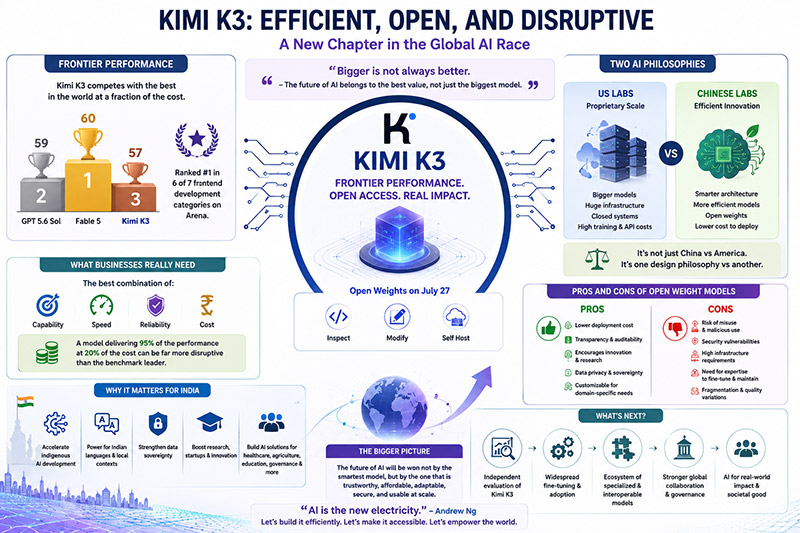
Throughout the past three years, the artificial intelligence industry has operated on one clear assumption: the most advanced AI models will continue appearing in a few select American labs that have access to significant computing power, huge investments, and unique research. The recent unveiling of Kimi K3 from Moonshot AI calls this assumption into question. Even though benchmark rankings are subject to interpretation, Kimi K3 managed to demonstrate close-to-frontier capabilities in comparison with other models like Anthropic’s Fable 5 and OpenAI’s GPT-5.6 Sol. Not only did the AI pass various engineering benchmarks, in particular frontend, but also Moonshot AI stated that Kimi K3 will be open-weighted and thus available to inspect, train, and self-host, instead of using proprietary cloud services only.
“AI is the new electricity,” said computer scientist Andrew Ng in his famous quote. But just like electricity, what matters is not only its production but distribution as well. Kimi K3 stands for the latter part.
For quite a long time, AI superiority used to be defined simply by benchmark rankings and parameter numbers. Currently, the equation changes: enterprises are judging their AI by four criteria – capability, speed, reliability, and price. In practice, a model that performs slightly worse but has much lower costs might bring even higher economic benefit than the current benchmark champion. Similar cases of revolutionary progress have occurred in numerous other industries in history.
The analogy with the automobile industry is especially appropriate. During the 1970s and 1980s, American manufacturers were focused mainly on producing larger and more powerful cars, while Japanese companies like Toyota paid attention to efficiency and reliability. As shown by Harvard Business School professor Clayton Christensen in his book The Innovator’s Dilemma (1997), disruptive technologies often succeeded because they offered a good enough performance combined with significantly lower price instead of superior performance on all fronts compared to incumbents. Perhaps, AI is heading to such an era too.
From a technical standpoint, Kimi K3 proves that architectural innovations can sometimes compensate for brute force scaling. As reported by Moonshot AI, Kimi K3 features huge Mixture-of-Experts architecture with selective expert activation, thus allowing the model to activate only a subset of its parameters during each token processing. Additionally, Moonshot has already provided innovation in running large-context models efficiently using optimized inference architectures.
Open weight is arguably an even more important feature than benchmark capabilities. With open-weight models, universities, governments, health care establishments, and enterprises gain opportunities to audit the behaviour of these models, tailor them for various use cases, protect private data by hosting the models themselves and becoming less dependent on foreign cloud providers. For countries like India, which prioritize issues of data sovereignty and multi-lingual AI, open-weight frontier models would greatly accelerate local AI development.
India is very well positioned to benefit from the above-mentioned change. Various government programs like the IndiaAI mission, investments in semiconductor infrastructure, and the presence of a huge software engineering community in the country provide the necessary environment for adaptation of open models for use in healthcare, agriculture, legal systems, education, regional language translations, and administration. Instead of building every frontier model from scratch, Indian researchers and startups can deliver higher value by tailoring good open models for Indian needs and complying with domestic regulations.
Still, care is needed here. The ability to perform well in benchmarks is not equivalent to reliable performance in real-world scenarios. Evaluation of Kimi K3 in independent testing would gain more meaning as soon as researchers begin working with released weights under various loads. There are still questions about infrastructure requirements, security, governance, intellectual property and allegations related to training methodologies that appear in the industry. Besides, even though the model is open-weight, Kimi K3 is an extremely big model that requires significant server-class computing power, rather than ordinary consumer hardware.
Benefits of this generation of efficient open models are quite obvious. First of all, they reduce deployment costs, increase transparency, foster innovation, encourage academic research, decrease dependency on proprietary APIs and allow governments and regulated industries to have more control over their sensitive information. At the same time, open models present a number of challenges related to misuses, cybersecurity risks, responsible governance, costs of infrastructure, maintenance of models and possible fragmentation of ecosystems with various quality levels.
Globally, Kimi K3 illustrates a certain philosophical split between companies. On one hand, there are American AI companies developing increasingly large proprietary foundation models with massive investments in hardware and cloud infrastructure. On the other hand, several Chinese laboratories are now putting emphasis on efficient algorithms, open-weighting and competitive pricing. This is not about rivalry between China and the USA; it is about rivalry between innovation paradigms – proprietary scaling and accessible efficiency.
In the next phases of development of artificial intelligence, success will not depend only on who builds the smartest model. Winners of the race would be those who create trustworthy, affordable, flexible, safe and deployable AI in millions of use cases. Thus, the future might belong not to benchmark champions but models that provide maximum value per unit of computations.
The next decade probably will not bring a single champion AI system. It is likely to bring an ecosystem of specialized, interoperable and increasingly open models serving various industries around the world. India finds itself in an extraordinary position now – not only the position of consumption of artificial intelligence designed somewhere else, but also the position of creating globally relevant AI solutions in local languages and addressing local public needs and software engineering excellence. Just as in the history of technology, revolutions are rarely won by the biggest inventions; they are won by innovations making the revolutionary technology accessible to everybody.
Senior Professor and former Head,
Department of ENT-Head & Neck Surgery, Skull Base Surgery, Cochlear Implant Surgery.
Basaveshwara Medical College & Hospital, Chitradurga, Karnataka, India.
My Vision: I don’t want to be a genius. I want to be a person with a bundle of experience.
My Mission: Help others achieve their life’s objectives in my presence or absence!
My Values: Creating value for others.
References:
Christensen, C. M. (1997). The Innovator’s Dilemma. Harvard Business School Press.
Ng, A. (2017). “AI is the new electricity.” Stanford University AI Lab and multiple public keynote addresses.
MarketWatch. (2026). Meet Kimi K3, the newest Chinese AI model haunting Silicon Valley.
Associated Press. (2026). Chinese AI model takes US tech industry by surprise with abilities rivaling Claude and ChatGPT.
Financial Times. (2026). Chinese AI start-up Moonshot launches model challenging Anthropic’s lead.
Moonshot AI. Qin, R., et al. (2024). Mooncake: A KVCache-centric Disaggregated Architecture for LLM Serving. arXiv:2407.00079.
Leave a reply



























Leave a reply