
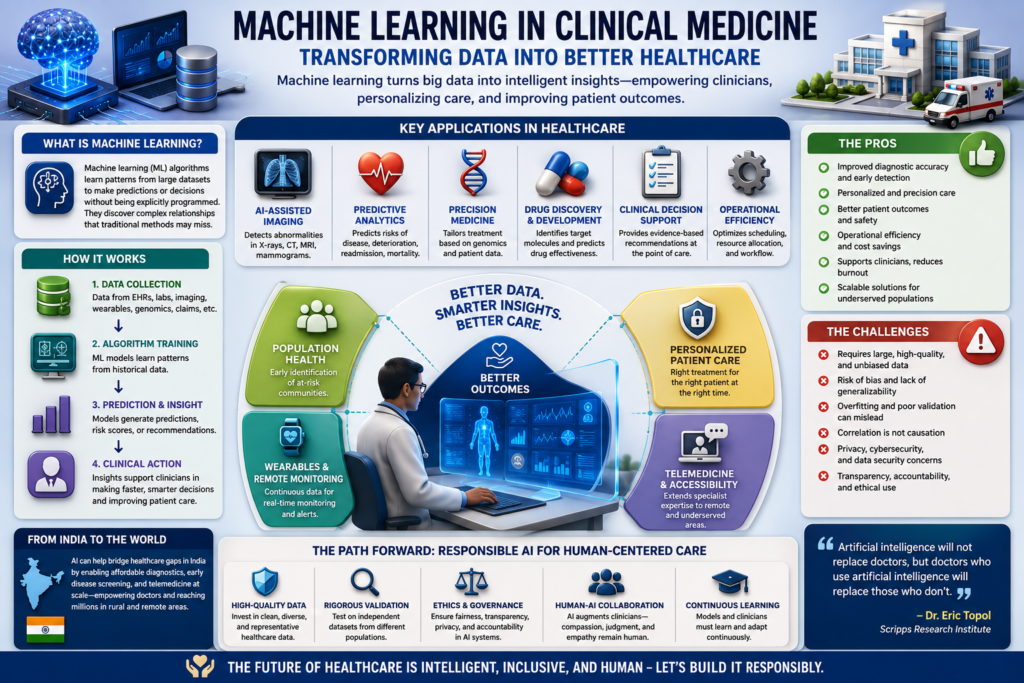
The intersection of big data, artificial intelligence (AI) and machine learning (ML) is transforming medicine at a tremendous pace. Although medicine has always produced significant amounts of data due to laboratory tests, imaging, EHRs, genomic studies etc., the true transformation does not lie in the data itself but in the possibility of translating these data into clinically useful information. This key idea is conveyed by Dr. Ziad Obermeyer (Harvard Medical School) and Dr. Ezekiel J. Emanuel (University of Pennsylvania) in their famous paper “Predicting the Future—Big Data, Machine Learning, and Clinical Medicine” published in the New England Journal of Medicine (2016).
According to the authors, ML differs from traditional rules-based expert systems significantly. While clinical decision support systems rely on pre-programmed medical knowledge, machine learning algorithms discover relations between various parameters within patient’s data, allowing for recognition of complex relations that might be hidden even for an experienced physician. As the authors point out, “Algorithms—not data sets—will prove transformative”, implying that intelligence rather than data collection will shape the future of medicine.
Such a transformation has already happened worldwide. In radiology, algorithms based on deep learning have been proved capable of detecting abnormalities on chest x-rays, CT-scans, mammograms and retinal images with a precision close to and, in some cases, exceeding the precision of the experts. Google’s DeepMind created AI systems capable of diagnosing diseases in the retina and numerous FDA-approved AI algorithms currently help radiologists in detecting strokes, pulmonary embolisms, fractures and cancers. Machine learning also expedites the process of drug development with predictions of protein structure; for example, DeepMind’s AlphaFold made a great impact on structural biology.
From the perspective of India, the consequences are no less far-reaching. In this country, there is a considerable shortage of medical staff per population, especially in rural and underprivileged areas. Machine learning can be helpful to alleviate this problem via automated detection of diabetic retinopathy, tuberculosis, cervical cancer, heart diseases and maternity risks through relatively inexpensive digital solutions. Some Indian institutions such as AIIMS, IITs, Indian Council of Medical Research (ICMR) and some Indian healthcare startups have started using AI for diagnostics, telemedicine, pathology and public health monitoring. Along with the Ayushman Bharat Digital Mission, the use of AI in clinical decision support allows bringing specialist-level competence across the whole of India.
There are many benefits of using machine learning in medicine. Predictive analytics enables identification of high-risk patients even before any clinical symptoms appear and helps in time-efficient intervention. Customized therapeutic approaches can be suggested by analyzing millions of patients’ data rather than just following average numbers for the whole population. Administrative benefits include automated documentation, optimal resource allocation and intelligent scheduling, decreasing the stress of the physician and increasing the efficiency of hospitals. Besides, AI algorithms remain consistent regardless of fatigue or workload making them perfect assistants in high-throughput clinical settings.
Some limitations described by the article are correct as well. ML algorithms need large amounts of high-quality unbiased data. Datasets with poor curation may create biased algorithms that work perfectly in one group but poorly in another. The authors warn about confusing prediction with causality, reminding clinicians that statistical relations do not imply biological ones. Moreover, overfitting, lack of validation and low generalizability stay methodological problems.
Aside from technical issues, there are ethical questions. Protection of patients’ privacy, cybersecurity, algorithmic transparency, obtaining informed consent and accountability are yet to be resolved. Algorithms trained mostly on Western population may perform differently in different ethnic groups like in India. Thus, regulatory control, continuous auditing and physician supervision will still be required for equitable and safe implementation.
Instead of replacing physicians, machine learning is becoming a powerful tool for clinical decision-making. With the progress of healthcare becoming more data-driven due to genomics, wearables, continuous monitoring of physiological parameters and multi-modal imaging, the cognitive load of physicians will exceed their capacity without any assistance. AI is capable of processing these complicated datasets into information useful for the physician, leaving him/her time to focus on communication, ethical decisions and personalization.
In the future, the most successful countries in terms of healthcare will be the ones able to incorporate trustworthy AI systems into their healthcare systems in the framework of patient-centered values. Cooperation between physicians and machine learning algorithms is the key to success. The winners in this transformation will be the patients as their collective data allow continuous improvement of medical knowledge.
“Artificial intelligence will not replace doctors, but doctors who use artificial intelligence will replace those who do not.” – Attributed to Dr. Eric Topol, Scripps Research Institute.
Senior Professor and former Head,
Department of ENT-Head & Neck Surgery, Skull Base Surgery, Cochlear Implant Surgery.
Basaveshwara Medical College & Hospital, Chitradurga, Karnataka, India.
My Vision: I don’t want to be a genius. I want to be a person with a bundle of experience.
My Mission: Help others achieve their life’s objectives in my presence or absence!
My Values: Creating value for others.
References:
- Obermeyer Z, Emanuel EJ. Predicting the Future—Big Data, Machine Learning, and Clinical Medicine. New England Journal of Medicine. 2016;375(13):1216–1219. doi:10.1056/NEJMp1606181.
- Topol EJ. Deep Medicine: How Artificial Intelligence Can Make Healthcare Human Again. Basic Books; 2019.
- Rajkomar A, Dean J, Kohane I. Machine Learning in Medicine. New England Journal of Medicine.2019;380:1347–1358.
- World Health Organization. Ethics and Governance of Artificial Intelligence for Health. Geneva: WHO; 2021.
- National Institution for Transforming India (NITI Aayog). National Strategy for Artificial Intelligence #AIforAll.Government of India; 2018.
- Ministry of Health & Family Welfare, Government of India. Ayushman Bharat Digital Mission (ABDM)documentation.



























Leave a reply