
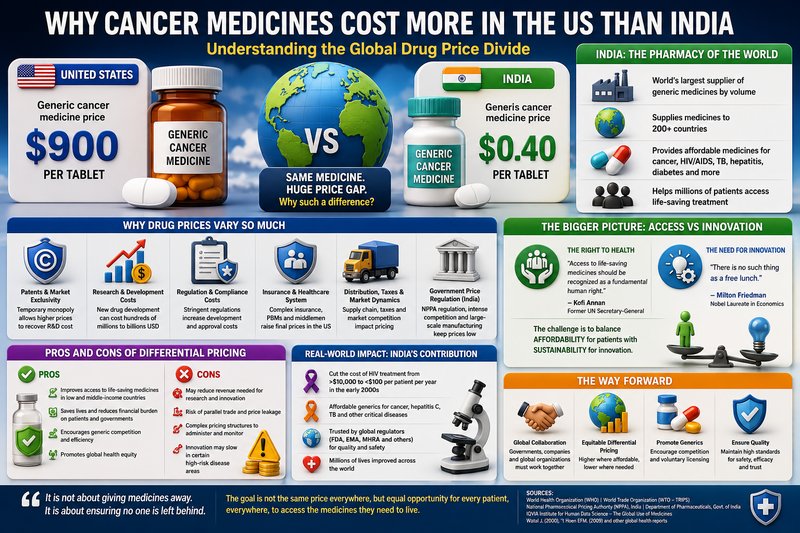
Recent media discussion in the United States involving an American patient has once again brought up an old issue of healthcare globally following the reports that a particular generic cancer medication costs about $900 per tablet in the United States but the same drug is available in India at about $0.40 per tablet. It is worth noting that the price varies according to the manufacturer, insurance plans, pharmacy, and drug status but this difference raises an important question, namely: should life-saving medicines have the same price worldwide?
India is an important actor in this discussion. Often called the “pharmacy of the world,” India produces some 20% of the world’s generic medications by volume and exports its pharmaceutical products to more than 200 countries and territories. Indian pharmaceutical companies produce generic versions of medicines for cancer, HIV/AIDS, tuberculosis, cardiovascular diseases, diabetes, and other conditions thus extending access to treatment of millions of patients in low and middle-income countries. This has changed the face of global public health care and made India an essential partner in international healthcare.
The difference in prices among countries occurs not only because of manufacturing costs but because of the interaction of pharmaceutical patents, regulation of production, research and development investments, exclusivity of market, taxation, insurance reimbursement system, distribution, and national pricing policy. In the USA, where the prices are based on market mechanism, the pharmaceutical companies have much freedom in setting prices during the period of patent protection. Even when generic competition starts, prices can be relatively high because of the work of pharmacy benefit managers, wholesalers, insurance, and the cost of healthcare administration. In India, the pharmaceutical market is characterized by large-scale manufacturing of generic products, price competition, regulation of prices by the National Pharmaceutical Pricing Authority (NPPA), and healthcare environment where patients pay out-of-pocket thus making affordable prices an important incentive.
The implications of this situation are considerable from the business perspective. Development of new medicine requires great amount of money, and its cost may be from hundreds to several billions of US dollars taking into account failed attempts and lengthy clinical trials. Patent gives companies a temporary monopoly and helps them to earn money and invest further in research. Without sufficient financial incentives, many biotechnology companies believe that investment in risky research on diseases like cancer, Alzheimer’s disease, and rare genetic diseases can drop considerably. As Milton Friedman, the economist, put it, “There is no such thing as a free lunch,” thus reminding the policymakers that medical breakthroughs need considerable financial investments.
But this is a fair argument. Access to essential medicines should not depend on geographical location or purchasing power. Kofi Annan, the former UN Secretary-General, said, “Access to life-saving medicines should be recognized as a fundamental human right.” It is the basic principle of global health initiatives launched by WHO that has been persistently advocating equitable access to essential medicines as a key part of universal health care.
India offers multiple examples of how affordable generics can change global healthcare. During the HIV/AIDS crisis in the early 2000s, Indian manufacturers managed to decrease the annual cost of antiretroviral therapy from more than US$10,000 per patient to under US$100 making it possible to provide treatment to people in Africa and other resource-limited regions. Such success stories can be seen in the sphere of oncology, hepatitis C treatment, tuberculosis treatment, and vaccines where Indian companies provide cheap alternatives to branded medicines without compromising international manufacturing standards.
However, there are some challenges for Indian generic pharmaceutical industry too. Ensuring good quality of drugs produced by thousands of companies requires constant regulation. Some Indian pharmaceutical companies won approvals of agencies such as FDA, EMA, and MHRA, thus proving that the products can be affordable and at the same time meet the requirements of international standards. But occasional regulatory observations and manufacturing violations require both manufacturers and regulators to maintain permanent quality control.
From the business perspective, it is unlikely that the uniform global pricing of medicines will be feasible and desirable. Income levels, healthcare financing, insurance coverage, and economic power of the countries are very different. However, the majority of health economists believe in the idea of equitable differential pricing when richer countries pay more prices that help sustain the innovation in pharmaceuticals, and poorer countries get cheaper medicines thanks to negotiated deals, voluntary licenses, or increased generic competition.
Thus, the future of global healthcare depends on the ability to find a balance between rewarding innovations and providing universal access to medicines. All the parties including governments, pharmaceutical companies, insurers, international organizations, and generic manufacturers need to collaborate to come up with the right pricing model that would promote innovations without denying the patients access to the drugs because of financial issues. In the age of globalization, medicines cannot be just business but essential part of healthcare.
The question in the context of this paper should not be whether every country should pay the same price for the life-saving medicines. It should be whether every patient regardless of his/her country, income, and healthcare system should have an opportunity to buy them. From this point, there is a growing international consensus that affordability should be considered not only as an economic issue but a moral one.
Senior Professor and former Head,
Department of ENT-Head & Neck Surgery, Skull Base Surgery, Cochlear Implant Surgery.
Basaveshwara Medical College & Hospital, Chitradurga, Karnataka, India.
My Vision: I don’t want to be a genius. I want to be a person with a bundle of experience.
My Mission: Help others achieve their life’s objectives in my presence or absence!
My Values: Creating value for others.
References:
- World Health Organization (WHO). Access to Medicines and Health Products. https://www.who.int/health-topics/access-to-medicines-and-health-products
- World Trade Organization. Agreement on Trade-Related Aspects of Intellectual Property Rights (TRIPS).
- National Pharmaceutical Pricing Authority. Drug Price Control Order (DPCO) and pharmaceutical pricing publications.
- Department of Pharmaceuticals. Annual reports and policy documents on the Indian pharmaceutical sector.
- IQVIA Institute for Human Data Science. The Global Use of Medicines (various editions).
- Watal J. Pharmaceutical Patents, Prices and Welfare Losses: A Simulation Study of Policy Options for India Under the WTO TRIPS Agreement. The World Economy. 2000.
- ‘t Hoen EFM. Private Patents and Public Health: Changing Intellectual Property Rules for Access to Medicines. Health Action International.



























Leave a reply