
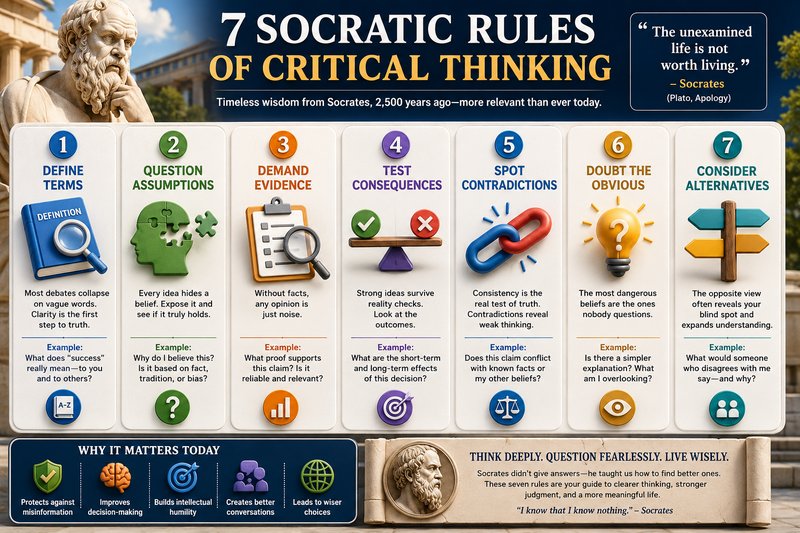
More than two and a half millennia ago, Athenian philosopher Socrates (c. 470 – 399 BC) developed a way of thinking that still appears highly relevant in contemporary society. Rather than claiming to have the answers, Socrates became known for asking provocative questions that revealed contradictions, promoted critical thinking, and stimulated further consideration of issues. Socratic Method continues to inspire philosophy, education, legal system, medicine, science all over the world. In a time of social media, artificial intelligence, fake news, rapidly spreading opinions, Socratic Method may appear more relevant than ever. As Socrates used to say, “The unexamined life is not worth living.” This quotation made famous by Plato in Apology shows that the basis of wisdom is not certainty, but self-examination.
One of the first principles of critical thinking is the precise definition of terms. There are many cases when disagreement occurs not because of the clash of basic positions, but because of the use of terms with different meanings. Such terms as success, freedom, development, patriotism, justice and many others can mean very different things for different people. Clear definition of terms is needed for fruitful discussion. However, the problem with excessive emphasis on definitions can appear during practical decision making if it is necessary to act immediately. As Aristotle said, “The least initial deviation from the truth is multiplied later a thousandfold.”
The second principle of critical thinking is the questioning of assumptions. All opinions are based on certain beliefs that are often taken for granted. Socrates taught people to examine these underlying beliefs before accepting conclusions. Contemporary society has many assumptions on such subjects as careers, technologies, education, social standing, etc. For example, many people believe that better grades always mean successful professional career, while nowadays employers appreciate creativity, communication skills, adaptability, and emotional intelligence in addition to good results at universities. Moreover, the assumptions on gender roles, entrepreneurship, artificial intelligence, etc., need constant examination. It is often mentioned that the famous quote of Indian philosopher Jiddu Krishnamurti “It is no measure of health to be well adjusted to a profoundly sick society” proves that commonly accepted beliefs are not always true. However, questioning of every assumption is a risky practice because it leads to indecisiveness and excessive skepticism, and therefore, reasonable judgment is needed.
The third principle is the demand of evidence. Opinion that is not supported with facts is prone to being biased, distorted, and manipulated. Nowadays, in the era of information technology, information spreads faster than it can be verified, and therefore, evidence-based thinking is necessary. Scientific discoveries, medicines, engineering solutions, policies all are based on systematic evidence, not personal preferences. For example, during the COVID-19 pandemic evidence-based medicine helped to separate facts from speculations. On the other hand, blind following of data does not take into account human values, ethics, and special circumstances. As statistician W. Edwards Deming said, “Without data, you’re just another person with an opinion.” However, the data itself should be treated critically because poor-quality evidence leads to wrong conclusions.
The fourth principle is the examination of consequences. Good idea is valuable only when it works in practice. Decisions should be made after looking not only at immediate profit, but also at long-term consequences. Urbanization policies that aim at the fast-growing city can help in stimulating economy, but will make additional pressure on environment if sustainability is not considered. Technological innovations bring a lot of convenience, but raise many questions on such problems as privacy, job loss, addiction to digital technologies. In India, growth of digital economy creates enormous opportunities, and many moral responsibilities too. Mahatma Gandhi’s words “The future depends on what you do today” can be used as advice on evaluation of consequences. This process allows responsible innovations and avoids reckless enthusiasm. However, it is impossible to predict every consequence, and uncertainty should not serve as an excuse for doing nothing.
The fifth principle is the identification of contradictions. Logical consistency is one of the most important signs of sound reasoning. When actions contradict values, contradictions show that something wrong is happening with our thinking. Companies may speak about sustainability while wasting their resources, people may support honest behaviour, but tolerate dishonesty if it is convenient for them. The identification of such contradictions helps to improve beliefs and build character. In science contradictions between theory and observations can lead to discoveries because they force scientists to reconsider their theories. For example, Albert Einstein once stated, “The important thing is not to stop questioning.” However, in the case of people and societies there are situations when contradictions are the result of conflicting goals, not hypocrisy.
The sixth principle of critical thinking is the doubt of obvious. Most of history’s great breakthroughs happened because somebody doubted common beliefs. For centuries, it was believed that all diseases were caused by “bad air,” until germ theory revolutionized medicine. Similar things happen in renewable energy, digital payments, space exploration. One of the great achievements of India was affordable space missions by the Indian Space Research Organisation (ISRO). These successes came because somebody dared to doubt such conventional beliefs as high cost of space projects. However, doubt of everything can result in conspiracy thinking and distrust in experts. Critical attitude to the information differs radically from denial of established evidence.
The seventh and probably the most powerful principle is the consideration of alternatives. Discussion of opposite views makes our understanding stronger. To listen to those who oppose helps to find hidden problems that could not be found without it. Democracies, scientific community, successful companies thrive because of the presence of different points of view. The great Indian philosophical tradition includes the debates of such schools of thoughts as Nyaya, Vedanta, Buddhism, Jainism, that all provide special ideas about truth and knowledge. According to Nobel laureate Amartya Sen’s book The Argumentative Indian, India’s rich experience of public reasoning is one of the best qualities of India. Of course, endless consideration of possible alternatives can lead to postponement of decisions, and therefore, balance between open mind and judgment is required.
Socratic method is based not on simple provision of answers, but on wise questions. Its advantages are increased intellectual humility, improved decision-making, ability to resist misinformation, better scientific reasoning and healthy discussion. Its limitations are in excess of questioning that can paralyze people, make them cynical, cause endless debates without action. Therefore, the challenge is the balance of critical thinking and practical wisdom.
In a world where there is plenty of information, but not enough reflection, Socrates provides us with a reminder that true intelligence is measured not by knowledge, but by the examination of our beliefs. Each wise question gives an opportunity to replace illusions with facts, prejudices with evidence, and certainty with wisdom. As Socrates once said, “I know that I know nothing.” Instead of expressing ignorance, these words celebrate intellectual humility that is the key starting point of learning and progress.
References:
- Plato. Apology. Translated by G. M. A. Grube, revised by John M. Cooper. In Plato: Complete Works. Hackett Publishing, 1997.
- Plato. The Republic. Various scholarly editions.
- Aristotle. Metaphysics. Various scholarly translations.
- Sen, A. (2005). The Argumentative Indian: Writings on Indian History, Culture and Identity. Penguin Books.
- Krishnamurti, J. (1954). The First and Last Freedom. Harper & Brothers.
- Deming, W. E. (1986). Out of the Crisis. MIT Press.
- Paul, R., & Elder, L. (2020). The Miniature Guide to Critical Thinking: Concepts and Tools. Foundation for Critical Thinking.
- Facione, P. A. (2015). Critical Thinking: What It Is and Why It Counts. Insight Assessment.
- UNESCO. (2021). Reimagining Our Futures Together: A New Social Contract for Education.
- National Academies of Sciences, Engineering, and Medicine. (2017). Communicating Science Effectively: A Research Agenda. National Academies Press.

























Leave a reply