
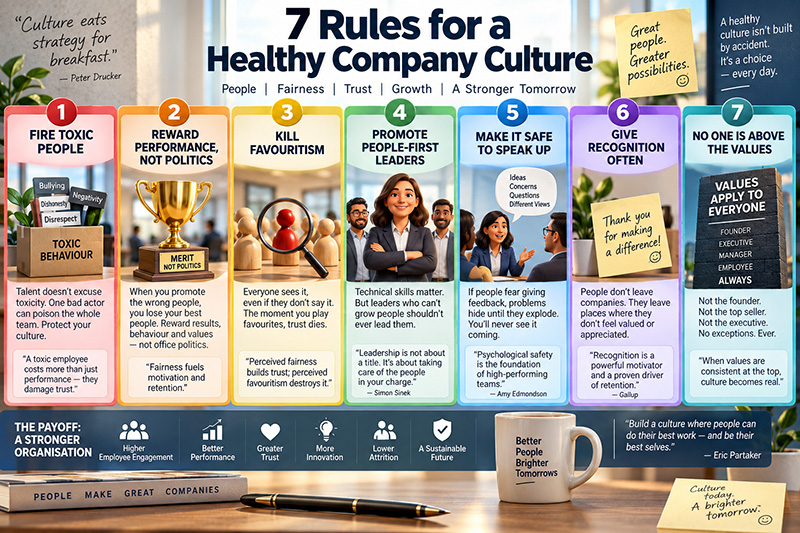
A good organizational culture does not come from motivational posters, annual retreats, and great mission statements. No, it comes day-to-day from the decisions made about who gets hired, rewarded, promoted, listened to—and fired. This is the fundamental tenet that underlies Eric Partaker’s “7 Rules for a Healthy Company Culture,” a set of guidelines that has been widely circulated in the wake of this leadership coach and entrepreneur. The seven principles are clear: fire toxic people; reward performance and not politics; eliminate favouritism; hire leaders who put people first; make it safe to speak up; give recognition often; and ensure no one—including founders and senior executives—is above the organization’s values. A published commentary on Partaker’s framework similarly states that even a brilliant but difficult “jerk” can bring down morale, and promotion of politically savvy people is not necessarily beneficial for the organization.
Partaker’s first rule—”Fire Toxic People”—is meant to shock, but his principle deserves attention. Organizations sometimes overlook a brilliant surgeon, engineer, sales person, or executive, simply due to his/her individual achievements. However, performance cannot be measured only by individual outcomes. Individuals who humiliate coworkers, withhold information, intimidate junior staff, or undermine collaboration cause costs that are not displayed on performance dashboards. Yet the right conclusion here is not to dismiss “difficult” people instantly. Organizations require fair investigation, feedback, coaching, and due process. A hardworking employee, whistleblower, or constructive dissenter cannot be labelled as “toxic” just because he/she makes some people feel uncomfortable.
The second and third principles—”Reward Performance and Not Politics” and “Eliminate Favouritism”—are particularly relevant to hierarchical organizations. Employees see not only how they are treated but also who receives attractive assignments, promotions, leadership attention, and recognition. There is ample evidence to support this point in India. According to Great Place To Work India, employees who experience favouritism trust their organizations at 60%, while those who perceive managerial fairness report 91%. Deloitte India Culture Sensing Report similarly identifies favouritism as a reason why organizations perform poorly in terms of “performance and results.”
However, “reward performance” needs clarification. Sometimes performance cannot be reduced to sales, publications, procedures performed, or quarterly targets. Sales people who deliver extraordinary results by making unrealistic promises, or managers who hit the targets by overworking a team are statistically high performers, but not necessarily institutional ones. Therefore, organizations need criteria that take into account results, behaviour, teamwork, and values.
Partaker’s fourth rule—”Promote People-First Leaders”—addresses a common organizational mistake: the assumption that technical excellence is automatically transferred to leadership.
The best-performing engineer does not have to become the best engineering manager, and the most accomplished clinician does not necessarily become the best hospital administrator. Gallup’s latest research on Indian workplaces similarly states that management is a different function requiring different talent, development, and support. Moreover, organizational culture is created through managerial decisions concerning performance, recognition, strengths, and feedback.
Perhaps the most important rule is “Make It Safe to Speak Up.” In her pioneering research, Amy Edmonson defined team psychological safety as the shared belief that the team is safe for interpersonal risk-taking. Based on the analysis of 51 work teams, Edmonson found that psychological safety was linked to learning behaviour, which in turn positively correlated with team performance. Edmonson makes it very clear that psychological safety does not mean permissiveness. Instead, it means that people can freely express themselves without fear of embarrassment, rejection, and punishment.
This point is crucial in Indian organizations with their organizational hierarchy that may make it socially difficult to challenge a senior colleague. For instance, a junior nurse who sees that there is a medication error in a hospital should feel free to challenge a senior doctor. In an engineering organization, a junior engineer should be able to warn that some design assumption is unsafe. In an aircraft cockpit, laboratory, or manufacturing facility, silence caused by hierarchy may cost more than a temporary disagreement. PwC’s research on India workforce similarly states that leaders should embrace discussion and dissent as elements of fostering organizational trust.
The sixth rule—”Give Recognition Often”—seems to be soft, but there is evidence that it leads to organizational consequences. Following almost 3,500 employees from 2022 to 2024, Gallup and Workhuman found that well-recognized employees were 45% less likely to change their organizations in two years. Indian evidence suggests the same direction: according to Great Place To Work India’s 2025 recognition research based on over 5.7 million voices of employees in over 2,000 organizations, recognition increases trust, commitment, and motivation. However, recognition should be authentic and fair; excessive praise of favourites reinforces the very political culture that the framework wants to dismantle.
Finally, probably the most powerful rule suggested by Partaker is “No One Is Above the Values.” This transforms organizational values from rhetoric to law. If punctuality is expected only from junior staff, accountability only from employees, respect only from junior to senior, and fiscal responsibility only from everybody except executive team, employees will know that the culture is not equal to values. This is also true of Gallup’s research on India: the values of the organization acquire meaning when they are consistently demonstrated in promotion, resource allocation, performance reviews, recognition, and leadership actions.
Nonetheless, it should be kept in mind that there is a danger in treating these seven principles as commandments. “Fire toxic people” may become an excuse for authoritarian management; “reward performance” may lead to unhealthy competition; “people-first” may lead to irresponsibility; psychological safety may be understood as the absence of criticism; recognition may be a cheap praise. A healthy culture requires balancing these competing principles: compassion vs. accountability, openness vs. standards, performance vs. ethics, and individual performance vs. team performance.
This is particularly relevant to rapidly growing organizations in India. Ethics and compliance represent cultural strengths of many Indian organizations, according to Gallup and the National HRD Network. However, performance management and responsiveness to disruption are still considered organizational risks. Similarly, the India research of Deloitte reports positive cultural picture in the country, but about a quarter of surveyed organizations belong to the lagging group characterized by poor recognition, little career opportunities, and bad work-life balance.
In conclusion, company culture is not what an organization claims to believe in. Culture is what employees see every day when values become inconvenient. Who gets promoted? Who is listened to? Who is credited? What happens when a powerful executive behaves poorly? Can a junior employee openly say, “I think we are making a mistake”?
Therefore, Partaker’s seven rules can be considered as a leadership test rather than a checklist. The deeper meaning of this framework can be encapsulated in one question: would the organization make the same decision if the person was the most powerful or profitable employee? If the answer is yes, the values become culture. If no, they remain words on a wall.
Senior Professor and former Head,
Department of ENT-Head & Neck Surgery, Skull Base Surgery, Cochlear Implant Surgery.
Basaveshwara Medical College & Hospital, Chitradurga, Karnataka, India.
My Vision: I don’t want to be a genius. I want to be a person with a bundle of experience.
My Mission: Help others achieve their life’s objectives in my presence or absence!
My Values: Creating value for others.
References
- Amy C. Edmondson, “Psychological Safety and Learning Behavior in Work Teams,” Administrative Science Quarterly, 44(2), 1999, pp. 350–383.
- Gallup & Workhuman, research on employee recognition and retention, 2024.
- Great Place To Work India & Vantage Circle, The Recognition Effect: A Leadership Blueprint for Emotionally Intelligent Workplaces, 2025.
- Deloitte India, Culture Sensing Report 2024–25.
- Gallup/NHRDN, The Culture Imperative: Insights for India’s Next Chapter.
- PwC India, Workforce Hopes and Fears Survey: India Perspective.



























Leave a reply