
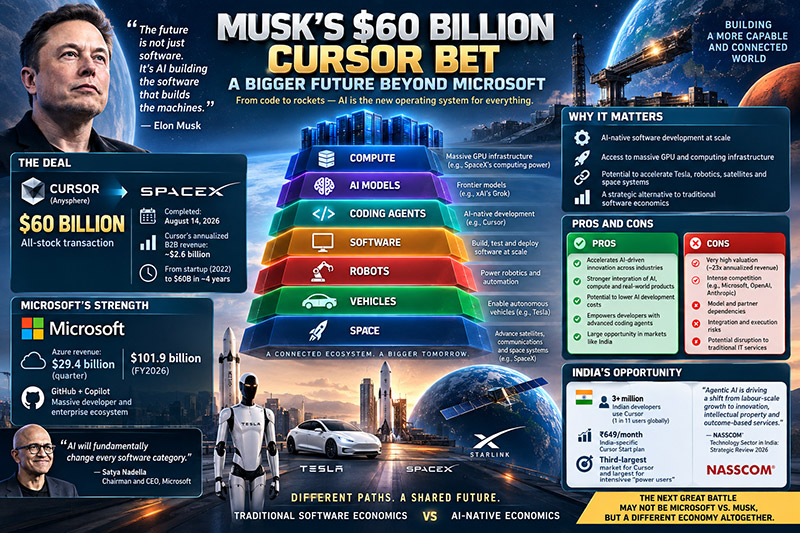
While Elon Musk’s latest venture certainly catches the eye thanks to its staggering cost, there’s more to it. What it means is the evolution of the economics of software. On August 14, 2026, SpaceX finalized the acquisition of Anysphere, the creator of AI coding platform Cursor, in a deal valued at $60 billion implied equity. In an instant, a company which had only been founded in 2022 became one of the most strategic assets in the new AI-software industry.
What looks like an astonishing figure is actually a reflection of how fast Cursor’s progress was. Reuters reported that Cursor had annualized business-to-business revenue of roughly $2.6 billion, while IDC described it as the biggest deal in AI software history. In under four years, Cursor grew from being a startup to become a product which is important enough for SpaceX to swap $60 billion worth of equity for it. That’s not just startup growth; that’s a sign of how the software development layer gets repriced in the AI economy.
Why would Musk get an AI coding company?
The answer might be related to vertical integration. Tesla successfully integrated software, AI, battery production, manufacturing and vehicles. SpaceX combines launch systems, satellites, communication capabilities and ever-growing computing infrastructure. SpaceX had already acquired xAI and brought Grok and frontier-model development into its organization. Cursor provides another important layer: AI systems which help humans and autonomous agents build software.
This stack may thus be thought of as a compute power driving AI models; AI models powering coding agents; coding agents creating software; and software controlling robots, vehicles, satellites and eventually autonomous physical systems. In this scenario, strategically valuable asset will no longer be an application. It will be an intelligence continuously creating, testing and improving the application.
That sets up this strategy in fascinating competition with Microsoft. While Microsoft enjoys advantages that Musk cannot simply duplicate: Azure, GitHub, Visual Studio, enterprise relationships and Copilot distribution. Microsoft has recently disclosed that Azure brings it $29.4 billion in its latest quarter and $101.9 billion in the fiscal year ending June 30, 2026. Thus, Microsoft has effectively built one of the most powerful software-and-cloud distribution mechanisms in history.
Musk appears to be developing a different kind of architecture. Rather than controlling only the software layer, the plan is to connect computing infrastructure, foundation models, coding agents and physical machines. Reuters reports that SpaceX and Cursor are already jointly training coding technology, while IDC states that Cursor’s Composer model got trained using xAI’s Colossus computing infrastructure. The strategic issue here isn’t whether Cursor can simply compete with GitHub Copilot. It is whether AI coding agents can become an operational layer in Musk’s industrial ecosystem.
There are plenty of advantages. By owning coding interface, SpaceX and xAI gain direct access to developers, enterprise clients and feedback loops. Control of compute may reduce dependence on external infrastructure providers. Advanced coding agents may also significantly shorten development cycles for rockets, satellites, robotics and other software-dependent systems.
However, there are significant risks as well. At $60 billion against approximately $2.6 billion of annualized B2B revenue, the acquisition is 23 times more valuable than revenue. Cursor is competing in an extremely competitive landscape where there is GitHub Copilot, Claude Code and Codex from Microsoft, Anthropic and OpenAI respectively. Model dependency is another potential vulnerability: according to Wired, OpenAI stopped working with Cursor after the SpaceX acquisition. Vertical integration can bring efficiency but also technological concentration, organizational complexities and platform-vs-platform conflicts since many of those platforms need neutrality while corporations are built on one.
India plays an essential role in this competition. Cursor claims that more than three million Indian developers use its platform, which amounts to almost one out of eleven Cursor users in the world, and launched ₹649-per-month India-specific Cursor Start plan in July. India is already Cursor’s third largest market and apparently its largest market for intensive “power users.” Meanwhile, NASSCOM predicts that India’s technology industry will grow to $315 billion in FY2026 and calls agentic AI an element of structural transition from labor-scale growth to innovation, intellectual property and outcome-based services.
This transition creates opportunities but also disruption. Agentic AI allows Indian startups and small developer teams to create sophisticated products at dramatically lower costs. However, it poses threat to the traditional IT-services economics based on billable hours for thousands of engineers. Reuters has already reported that Indian IT contracts are shifting to outcome-based pricing amid client demands for AI-enabled productivity.
Thus, the $60 billion Cursor acquisition shouldn’t be boiled down to the headline of “Musk versus Microsoft”. Microsoft offers extraordinary advantages in cloud infrastructure, enterprise software and developer distribution. Musk is trying to do something different: he’s connecting intelligence to the physical systems that this intelligence ultimately controls.
And if agents of artificial intelligence start writing, testing, debugging and deploying software, software economics might become very different too. Valuable question might change from “Who writes the best software?” to “Who owns the intelligence that continuously creates and improves it?”
That’s why Cursor matters. Musk is essentially betting that the future of software is not simply software delivery from the cloud. It is AI creating the software that creates and controls the machine.
And if this thesis is successful, $60 billion might turn out to be a strategically brilliant decision. Otherwise, Cursor might become a perfect illustration of how AI valuations can go above economic realities.
Either way, investors and India’s technology industry should keep an eye on this situation. The next major tech battle might not be about Musk versus Microsoft. It may be about traditional software economics versus a new AI economy.
MBBS (JJMMC), MS (PGIMER, Chandigarh).
MBA in Healthcare & Hospital Management (BITS, Pilani),
Postgraduate Certificate in Technology Leadership and Innovation (MIT, USA)
Executive Programme in Strategic Management (IIM, Lucknow)
Senior Management Programme in Healthcare Management (IIM, Kozhikode)
Advanced Certificate in AI for Digital Health and Imaging Program (IISc, Bengaluru).
Senior Professor and former Head,
Department of ENT-Head & Neck Surgery, Skull Base Surgery, Cochlear Implant Surgery.
Basaveshwara Medical College & Hospital, Chitradurga, Karnataka, India.
My Vision: I don’t want to be a genius. I want to be a person with a bundle of experience.
My Mission: Help others achieve their life’s objectives in my presence or absence!
My Values: Creating value for others.
References:
- Space Exploration Technologies Corp. Current report (Form 8-K): completion of acquisition of Anysphere, Inc. Washington (DC): U.S. Securities and Exchange Commission; 2026 Aug 14 [cited 2026 Sep 9]. Available from: SEC filing.
- Reuters. SpaceX to buy Cursor AI coding agent operator Anysphere for $60 billion. 2026. Available from: Reuters report via Investing.com.
- International Data Corporation. SpaceX, Cursor and the race to build the best coding LLM in the world [Internet]. 2026 [cited 2026 Sep 9]. Available from: IDC analysis.
- Reuters. Microsoft to reveal Azure cloud sales in financial reporting shift. 2026 Sep 2 [cited 2026 Sep 9]. Available from: Reuters — Microsoft Azure report.
- Cursor. Cursor Start: a new plan for developers in India [Internet]. 2026 [cited 2026 Sep 9]. Available from: Cursor India announcement.
- TechCrunch. Cursor launches a cheaper plan in India as it doubles down on its third-largest market [Internet]. 2026 Jul 21 [cited 2026 Sep 9]. Available from: TechCrunch report.
- Nasscom Insights. Technology sector in India: strategic review 2026 [Internet]. 2026 Feb 24 [cited 2026 Sep 9]. Available from: Nasscom Strategic Review 2026.
- Reuters. India IT industry surpasses $300 billion amid AI-driven challenges, openings [Internet]. 2026 Feb 24 [cited 2026 Sep 9]. Available from: Reuters — India technology industry report.
- Reuters. AI reshapes India’s IT services sector contracts as clients demand more for less [Internet]. 2026 Aug 20 [cited 2026 Sep 9]. Available from: Reuters — AI and Indian IT services.
- Microsoft. GitHub Copilot: AI coding assistant [Internet]. Redmond (WA): Microsoft; 2026 [cited 2026 Sep 9]. Available from: Microsoft — GitHub Copilot.
- Anysphere Inc. Cursor: the AI code editor [Internet]. 2026 [cited 2026 Sep 9]. Available from: Cursor official website.
- Wired. OpenAI cut off a billion-dollar customer to avoid Elon Musk [Internet]. 2026 Sep [cited 2026 Sep 9]. Available from: Wired report




























Leave a reply