
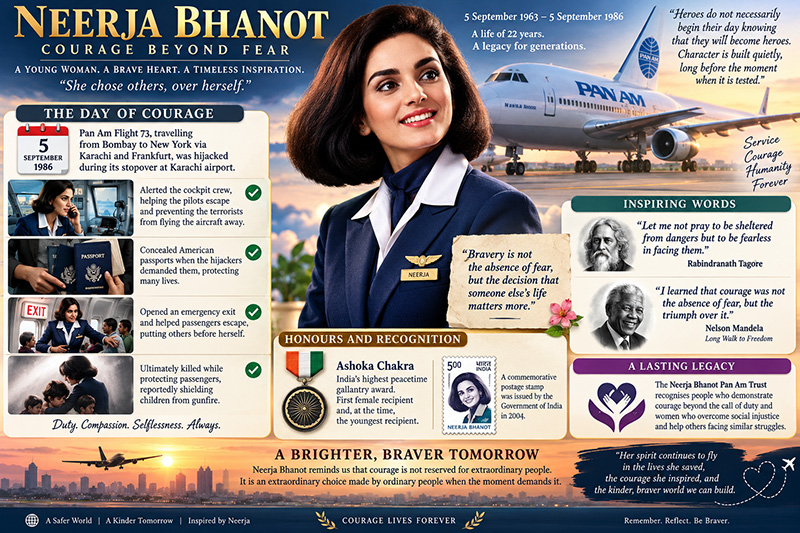
The life of Neerja Bhanot, although brief, is commonly judged not by the number of years she lived, but by the principles she embraced in key moments of her life. Bhanot only lived for twenty-two years, but she showed bravery, compassion, and selflessness in the last hours of her life which inspire generations worldwide even forty years later.
On 5 September 1986, the Pan Am Flight 73 traveling from Bombay to New York with stops in Karachi and Frankfurt was hijacked during its stopover at Karachi airport. Bhanja was the senior purser of the flight and just two days before her 23rd birthday. The incident resulted in a lengthy hostage situation which lasted for about seventeen hours.
Once armed hijackers came into the airplane, Bhanot immediately informed the cockpit crew of the hijacking, thus allowing pilots to leave and prevent terrorists from controlling the airplane. The next task was to hide American passports as terrorists attempted to get passengers’ passports to find Americans on board. Finally, in complete darkness and amidst gunshots, she opened an emergency door and helped passengers to get out of the plane, putting the lives of others above her own safety. Bhanot was eventually killed saving other passengers, probably shielding children from gunshots.
This point should be noted because bravery does not mean necessarily fearlessness; rather, it means prioritizing another person’s life, some principle, or duty over one’s own fears.
This thought was expressed by Nelson Mandela in his work Long Walk to Freedom: “I learned that courage was not the absence of fear, but the triumph over it.” In case of Bhanot, her deeds are a good example illustrating that idea. Even though no one knows what exactly went through her mind during those seventeen hours, it is obvious that in any situation she chose responsibility over personal safety.
This fact adds more value to her bravery because she was not a soldier or trained fighter. She was a young civilian professional performing an ordinary job in extraordinary times. One of the lessons which can be learned from this story is that a hero does not enter the day in order to become a hero; he or she just acts responsibly every day.
Posthumously, India awarded Bhanot with Ashoka Chakra, which is the highest award in peacetime for gallantry. Bhanot was the first woman recipient and the youngest recipient at that time. She also received awards from the countries of Pakistan and the United States. In 2004, Government of India released a commemorative postage stamp honouring her memory.
Bhanot’s Ashoka Chakra award was described in terms of “loyalties to the passengers of the aircraft in distress” as an everlasting tribute to the finest qualities of the human spirit.
In particular, there is something uniquely Indian but at the same time universal about this sacrifice of Bhanot. Rabindranath Tagore’s aphorism in Fruit-Gathering—”Let me not pray to be sheltered from dangers but to be fearless in facing them”—almost seems fulfilled in the life of Bhanot.
What is important is that the legacy of this girl extends beyond the borders of India since the people she protected were not distinguished by their nationality, religion, or passport; they were just people entrusted to her care. As a result, this story shifts from the story of Indian heroism to the story of universal humanity.
Bhanot’s family created the Neerja Bhanot Pan Am Trust to honor people who demonstrate courage beyond duty and to help women overcoming social injustice and assisting others who face the same problems. As a consequence, sacrifice of one young woman becomes a source of new stories of bravery.
On the anniversary of her death, the best way to commemorate Bhanot is not only to remember the way she died, but also to think about the way she chose to live in her decisive moments: when the situation offered her to leave, she stayed; when fear told her to submit, she chose to perform her duty; when other people needed help, she put them ahead of herself.
Although most people do not have to deal with hijacking airplanes, every person meets situations when it is necessary to choose between comfort and responsibility, silence and speaking, self-interest and compassion, fear and morality.
The story of Bhanot demonstrates that bravery is not exclusive to extraordinary people; it is just an extraordinary choice of ordinary people in such situations.
Forty years after that September morning, the importance of Neerja Bhanot remains unchanged. Her young life gives a message which becomes increasingly important: life is not measured by the time spent on self-protection, but by the commitments one embraces and the people one chooses to protect.
Senior Professor and former Head,
Department of ENT-Head & Neck Surgery, Skull Base Surgery, Cochlear Implant Surgery.
Basaveshwara Medical College & Hospital, Chitradurga, Karnataka, India.
My Vision: I don’t want to be a genius. I want to be a person with a bundle of experience.
My Mission: Help others achieve their life’s objectives in my presence or absence!
My Values: Creating value for others.
References:
Government of India, Press Information Bureau, Ministry of Communications. Commemorative Postage Stamps in Honour of Ashok Chakra Winners Neerja Bhanot and Randhir Prasad Verma, 8 October 2004.
Ministry of Civil Aviation, Government of India. Remembering the unwavering courage of Neerja Bhanot.
Pan Am Historical Foundation. Remembering Neerja Bhanot on Hijacked Pan Am Flight 73.
Menon, Smitha. “The Story of Neerja Bhanot, India’s Bravest Flight Attendant.” Condé Nast Traveller India, 19 January 2016.
Mandela, Nelson. Long Walk to Freedom: The Autobiography of Nelson Mandela. Little, Brown, 1994.
Tagore, Rabindranath. Fruit-Gathering, poem LXXIX.
State Council of Educational Research and Training, Tamil Nadu. A Story of Self Sacrifice and Bravery, Standard VII English textbook, 2019.
Leave a reply























Leave a reply