
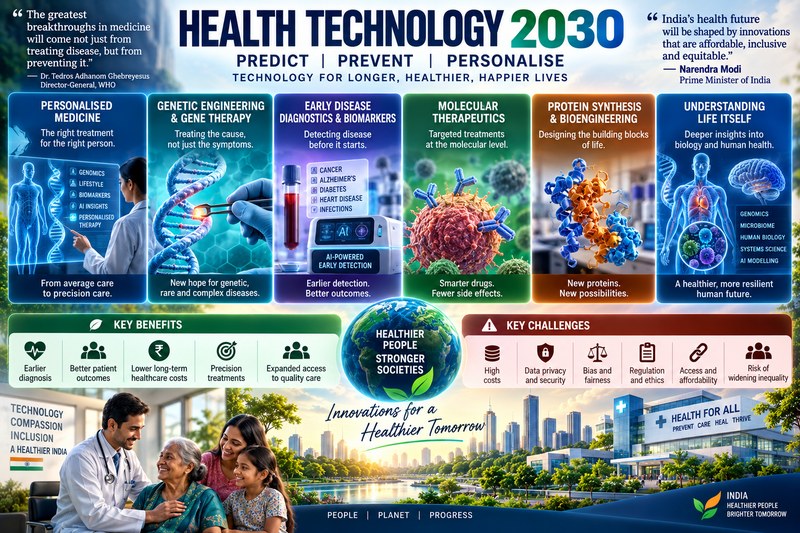
Throughout most of modern medicine, healthcare has followed a fairly standard pattern. Symptoms arise, a diagnosis is reached, and treatment starts. The Health megatrend in the IEEE Technology Megatrends 2030 report foresees an entirely different future ahead, where disease is predicted earlier, characterized molecularly, and treated personally. Written by a 166-member IEEE Future Directions technology team, the report sees health as one of five forces transforming the world and recognizes personalized medicine as the technology that would make the greatest impact on humankind among 30 technology predictions made in it.
According to the report, six major health technologies exist: personalized medicine; genetic medicine and gene therapy; early disease diagnostics and biomarkers; molecular therapeutics; protein synthesis; and deep understanding of life itself. None of these are to be seen as standalone breakthroughs. Rather, their true strength lies in convergence with AI, genomics, digital biomarkers, wearables and computational biology.
Personalized medicine, perhaps more than anything else, marks the departure point from the “one treatment fits all” approach. In future, instead of administering identical treatment to two people having the same diagnosis, the doctor could combine genomic data, biomarkers, imaging, lifestyle information and treatment history in order to find out the optimal therapy for each individual. The IEEE team expects to see many startups develop personalized diagnostics and treatments over the next five years and expects the pace of development of molecularly precise treatments to accelerate thanks to AI.
Diagnosis too can be truly revolutionary. Medicine has its true value not only in treatment of advanced diseases but in the ability to identify risk before it is too late. Liquid biopsies, molecular biomarkers, AI-powered imaging and constant monitoring via wearables can transform healthcare from occasional visits to hospital into constant surveillance. According to the IEEE report, early disease detection, AI-assisted wearables, bio-digital twins and prognostic AI for chronic-disease prediction are among significant signals and high-risk/high-reward technologies.
Genetic medicine takes things even further – not just in diagnosing the disease but even in correcting its biological origin. Gene therapy and gene editing have already shown that medicine is capable of interfering with DNA directly instead of managing the effects that arise from it. According to the IEEE analysis, genetic engineering will start to spread into various therapeutic fields and some of its applications will come into mainstream medicine. Yet this is where optimism regarding the potential of these technologies needs to be tempered. According to the same report, genetic manipulation comes with long-term uncertainty, risks of misusage and even biosecurity threats.
For India, all of this could prove extremely relevant. A population of over 1.4 billion means massive clinical diversity and scale but advanced personalized medicine cannot be left available only to wealthy urban citizens. Opportunities for India lie in combining genomics and AI with affordable diagnostics, digital health infrastructure and population-scale public health. India’s changing regulatory approach is already addressing this issue: Ethical Guidelines for Application of Artificial Intelligence in Biomedical Research and Healthcare issued by the Indian Council of Medical Research specifically address ethical decision-making, governance, informed consent and responsibilities of developers, clinicians, researchers and institutions.
The benefits of this approach are obvious: early diagnosis, optimal choice of the therapy, fewer useless treatments, faster drug discovery and possibly reduced cost of long-term healthcare expenses. AI could recognize the patterns that are not seen by humans and enable specialists to provide their expertise to underserved regions. Even IEEE report sees healthcare as the area where AI could “improve patient outcomes, reduce costs, and increase efficiency.”
The cons are equally critical. Genomic and medical data is immensely sensitive. Unrepresentative databases may lead to biased algorithms; false-positive screening may create unnecessary stress and procedures; unclear recommendations of AI add complications to accountability; advanced therapies may exacerbate inequality gap; and genetic manipulation raises difficult ethical issues of consent, inheritance and human interference with nature. The IEEE report regularly names privacy, bias, transparency, regulation, trust and data quality as obstacles for AI-assisted systems.
Thus, the goal is not AI substituting doctors but technology helping medicine to become more predictive while preserving the clinical judgement and human empathy. India and the whole world should simultaneously invest in genomics, biomarkers, AI, digital infrastructure, clinical validation, affordability, privacy and ethical governance. Technology can tell more and more about human body; wisdom will decide what will be done with that information.
Healthcare transition of 2030 may ultimately be summed up in three words: predict, prevent, personalize. If this will happen in scientifically valid, ethically regulated and globally available way, healthcare may slowly shift from the question “how do we treat this disease?” to the more powerful question: “how can we prevent this person from getting ill in the first place?”
Senior Professor and former Head,
Department of ENT-Head & Neck Surgery, Skull Base Surgery, Cochlear Implant Surgery.
Basaveshwara Medical College & Hospital, Chitradurga, Karnataka, India.
My Vision: I don’t want to be a genius. I want to be a person with a bundle of experience.
My Mission: Help others achieve their life’s objectives in my presence or absence!
My Values: Creating value for others.
References:
- IEEE Future Directions Committee, Industry Advisory Board. Technology Megatrends 2030. The report identifies five megatrends and 30 associated breakthrough technologies, including six health-technology predictions.
- IEEE Future Directions Committee, Industry Advisory Board. Technology Megatrends 2030: Technology Predictions. Health predictions include personalised medicine, genetic engineering/gene therapy, early diagnostics and biomarkers, molecular therapeutics, protein synthesis and understanding life.
- IEEE Future Directions Committee, Industry Advisory Board. Technology Megatrends 2030: Survey—Megatrends Technologies Predictions Grades. The survey assigns particularly high humanity-impact assessments to personalised medicine and genetic engineering/gene therapy.
- Indian Council of Medical Research. Ethical Guidelines for Application of Artificial Intelligence in Biomedical Research and Healthcare. New Delhi: DHR-ICMR AI Cell; 2023.
- Indian Council of Medical Research — AI Healthcare Ethical Guidelines




























Leave a reply