
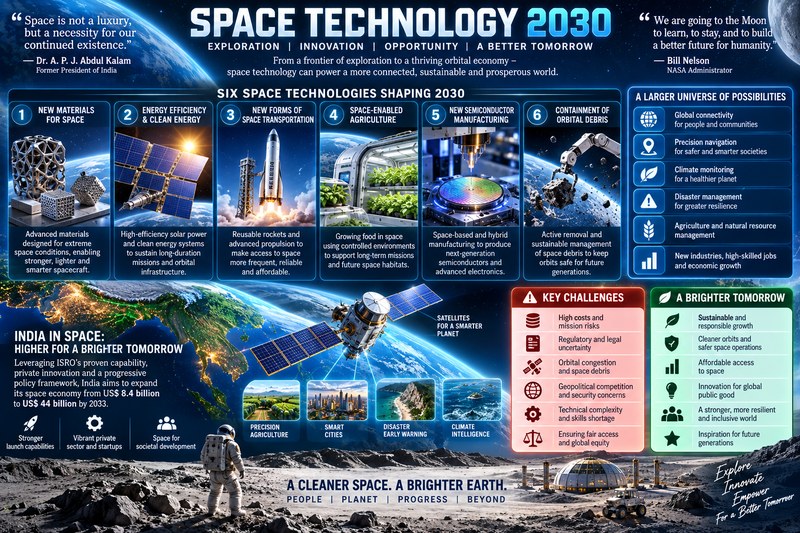
For most of the space age, outer space was principally the domain of governments, national prestige and scientific exploration. By 2030, that model is likely to look increasingly incomplete. The Space Technology megatrend identified in IEEE’s Technology Megatrends 2030 envisages space becoming an economic and technological infrastructure—supporting communications, navigation, climate monitoring, agriculture, manufacturing and potentially energy and resource utilisation. The report sees signals already emerging in reusable rockets, commercial investment, autonomous spacecraft, space-resource utilisation and renewed deep-space exploration.
The report, developed by the IEEE Future Directions Committee’s Industry Advisory Board and its collaborators, concentrates its Space Technology megatrend around six areas: new materials; energy efficiency and clean energy; new forms of mass transportation; space-enabled agriculture; new semiconductor manufacturing; and containment of orbital debris. It anticipates materials that may exploit conditions unavailable on Earth, increasingly reusable transportation, early space-agriculture applications, hybrid semiconductor manufacturing involving space-based processes, and eventually a commercial market for orbital-debris removal.
Perhaps the most important enabling technology is cheaper, reusable access to orbit. Rockets historically resembled aircraft that were discarded after every flight; reusability begins to change that economics. IEEE predicts that reusable rockets could become dramatically more affordable. Internationally, NASA’s Moon-to-Mars architecture similarly emphasises maintainability, reuse, recycling, industry collaboration and the development of an economic sphere extending beyond Earth orbit.
Once transportation becomes less expensive, space itself begins to resemble an industrial environment. Microgravity and vacuum may enable specialised materials or manufacturing processes difficult to reproduce terrestrially. The IEEE report anticipates new materials and potentially hybrid semiconductor manufacturing, while its broader analysis considers asteroid mining, off-Earth manufacturing, space-based solar power and data centres in space as high-risk, high-reward possibilities. These concepts remain far less mature than satellite communications or Earth observation, however, and should be understood as technological possibilities rather than inevitable outcomes.
The benefits extend much closer to home. IEEE argues that space systems can improve global connectivity, navigation and continuous Earth observation, while supporting climate monitoring, disaster management, resource sustainability, agriculture and infrastructure resilience. It also sees opportunities for high-skilled employment and downstream data businesses. For developing economies, this may be space technology’s greatest promise: its value need not be measured by how many people leave Earth, but by how effectively satellites improve life on Earth.
That argument has particular significance for India. ISRO describes its mission as harnessing space technology for national development while pursuing planetary exploration, including Earth observation, communications, navigation, meteorology and societal applications. The Indian Space Policy 2023 goes further by encouraging private participation across the space-economy value chain and defining space as a driver of socioeconomic development, environmental protection, security and scientific inquiry. As ISRO succinctly states in describing its reform agenda, an open space sector is intended to accelerate “growth, job creation as well as innovations.”
India therefore has an opportunity to combine ISRO’s accumulated engineering capability with startups, private capital, universities and manufacturing. In September 2026, ISRO said India’s space economy was about US$8.4 billion and that the country aims to expand its global space-market participation to US$44 billion by 2033. This could create opportunities extending from launch vehicles and satellites to geospatial analytics, precision agriculture, communications, climate intelligence, component manufacturing and space robotics.
Yet the new space economy carries serious disadvantages. IEEE identifies fragmented regulation, spectrum and orbital-slot competition, sovereignty concerns, skills shortages, overcrowded orbits and debris among its constraints. Resource extraction raises unresolved questions about ownership; orbital surveillance creates privacy and geopolitical concerns; space-based solar power entails enormous cost and possible security issues; and commercial expansion risks reproducing terrestrial inequality beyond Earth. The report explicitly identifies legal ambiguity and extreme mission risk around asteroid mining and off-Earth manufacturing.
The most immediate warning is space debris. ESA’s newly released Space Environment Report 2026 says more than 300 launches placed over 4,000 payloads into orbit during 2025, while the debris population continued to expand. ESA argues that prevention alone is no longer sufficient and that active debris removal must become part of the solution. This strongly reinforces IEEE’s decision to include orbital-debris containment among its six core space predictions.
The case for space technology, therefore, should not be an argument for expansion at any cost. It should be an argument for responsible expansion: reusable transportation, sustainable spacecraft, debris removal, shared standards, transparent regulation, peaceful exploration and wider access to the economic benefits of orbital infrastructure. IEEE itself identifies “fair access to space” among the forces that could shape the coming decade.
The twentieth-century question was whether humanity could reach space. The question for 2030 is more demanding: can humanity build an economy in space without repeating the environmental, geopolitical and economic mistakes made on Earth? For India, the opportunity is especially compelling—not merely to become a nation that launches into space, but to help shape a space economy that connects science, enterprise and national development with sustainability and human benefit.
Senior Professor and former Head,
Department of ENT-Head & Neck Surgery, Skull Base Surgery, Cochlear Implant Surgery.
Basaveshwara Medical College & Hospital, Chitradurga, Karnataka, India.
My Vision: I don’t want to be a genius. I want to be a person with a bundle of experience.
My Mission: Help others achieve their life’s objectives in my presence or absence!
My Values: Creating value for others.
References
- IEEE Future Directions Committee, Industry Advisory Board. Technology Megatrends 2030. Space Technology sections and technology predictions.
- Indian Space Research Organisation — Indian Space Policy 2023. Government of India, Department of Space.
- ISRO — Vision, Mission and Objectives. Indian Space Research Organisation.
- ISRO — Space Sector Reforms and the Role of ISRO. Indian Space Research Organisation, September 6, 2026.
- European Space Agency — Space Environment Report 2026. ESA Space Debris Office, September 11, 2026.
- NASA — Moon to Mars Architecture: Strategy and Objectives. National Aeronautics and Space Administration.




























Leave a reply