
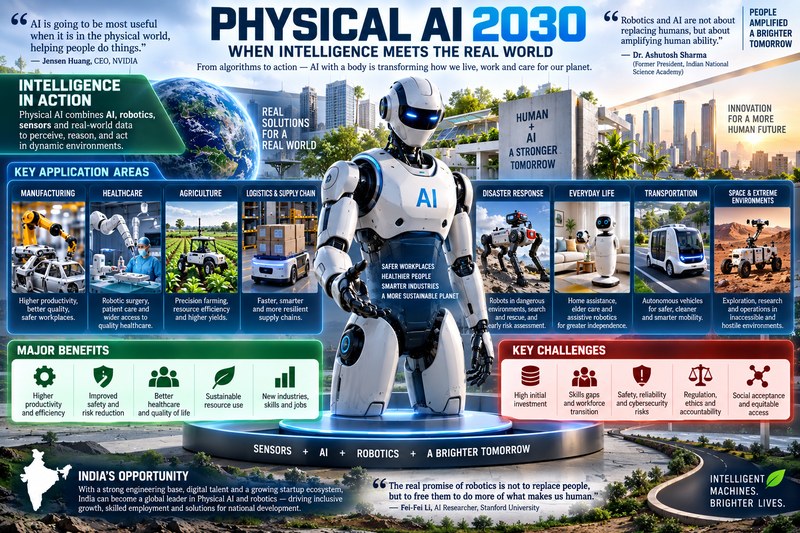
Beyond screen-based applications, the next big leap will be when artificial intelligence becomes able to see, hear, understand, interact and handle objects in the real world. This is the key element of Physical AI, which is the convergence of artificial intelligence, robotics, sensors, advanced materials, edge computing and autonomous systems. In Technology Megatrends 2030, the IEEE Future Directions Committee’s Industry Advisory Board identifies Physical AI and hyper-automation as one of five technology megatrends which have the potential to redefine the next decade. The signals included in the report are multimodal vision-language-action systems, exoskeletons, autonomous vehicles and highly capable robotic platforms.
What sets Physical AI apart from the previous generation of robotics? Most industrial robots perform pre-programmed movements in highly structured environments. Physical AI aims at developing machines that perceive, reason and act in response to changing environment. The IEEE focuses this revolution in six areas: trustworthy and reliable AI along with cybersecurity; energy-efficient intelligence; new materials used for skins and sensors; autonomous collaborative robotics; human-AI interaction; and edge AI sensory and tactile capability.
The international trend towards Physical AI is visible. According to the International Federation of Robotics, 542,000 industrial robots were installed worldwide in 2024, double the installation in 2014, while there were 4.664 million operational industrial robots globally. IFR President Takayuki Ito puts the change in a few words: “The transformation of many industries into the digital and automated age has seen massive growth in demand.” The next frontier for this transformation is going from fixed automation to collaborative robots, autonomous mobile machines, intelligent prosthetics, medical robotics and ultimately more universal robots.
The possibilities could be great. IEEE expects the use of Physical AI to boost efficiency and safety and reduce human presence in hazardous environments like mining, construction, and oil and gas industries. In the area of healthcare, remotely operated and intelligent robots could assist triage, diagnostics, surgeries and even health care delivery; in agriculture, intelligent machines combined with digital twins of the crop and the soil could facilitate precision farming; in education, virtual environments would allow to train students in safe and cost-effective ways. Robots should therefore be considered not only as labor substitutes, but also as machines capable of reaching places too dangerous, too tiring, inaccessible or requiring extraordinary precision for human beings.
For India, Physical AI poses an industrial and strategic opportunity, but also challenges. IFR’s World Robotics 2025 records 9,100 industrial robot installations in India in 2024, up 7%, making India the sixth country in the world for annual installations, with automotive industry taking up 45% of Indian installations. Given India’s huge manufacturing base and ambitions in electronics, cars and advanced manufacturing, robotics can enhance quality, efficiency and competitiveness. However, India’s opportunity should be larger than importing machines; developing domestic robotics, sensors, actuators, machine vision, edge AI, simulation software and system integration could generate an indigenous Physical-AI ecosystem.
However, the opportunity should not mask the limitations of adopting Physical AI. The IEEE identified initial high investments, skills shortage, lack of connectivity and infrastructure of industrial IoT, cybersecurity threats, regulation fragmentation, safety issues, and cultural resistance as the barriers. With more autonomous systems come another limitation: An error of an AI is not just a mistake in an on-screen sentence anymore. When it is implemented in the moving robot, car, surgery platform or an industrial machine, the reasoning failure can have physical consequences. Accordingly, IEEE identifies safety, lack of explainability, control and coordination problems among risks of autonomous AI systems.
Employment requires special consideration too. Automation might get rid of or change repetitive manual labor, but IEEE anticipates new jobs in maintenance of robots, system integration, simulation design, data analysis and human-robot interaction. Therefore, India’s task is not to protect current jobs from robots, but to prepare for the jobs of tomorrow’s human-machine workplace. The recommendations in the report correctly emphasize the importance of an “Augmentation First” strategy: going beyond automation for efficiency alone and advancing human-AI augmentation, while investing in robotics, simulation, reskilling the workforce, governance and cybersecurity.
This principle should guide the Physical AI adoption everywhere. A hospital robot should extend the range of doctors and nurses, rather than to reduce compassionate care. Agricultural robots should help farmers to save water and chemicals, rather than to make small farmers dependent on technology. Factory robots should free workers from dangerous and monotonous jobs while creating a path to higher-skilled work.
Therefore, the most desired revolution of robotics is the one of humans empowered by intelligent machines. The recommendations in the IEEE’s report call for robotics-as-a-service, local production, repair and reuse of components, open digital-twin platform, better university-industry collaboration and sustained investment in skills. India particularly has an opportunity to combine its software and AI strength with manufacturing and engineering talent.
In 2030, the main question may not be “What can artificial intelligence think?” But “What should intelligent machines be allowed and trusted to do in the physical world?” The answer should be ambitious, but human-centric: develop robots that would make work safer, healthcare more accessible, agriculture more efficient and industry more resilient – while making sure that human judgment, accountability and dignity are at the heart of the machine age.
Senior Professor and former Head,
Department of ENT-Head & Neck Surgery, Skull Base Surgery, Cochlear Implant Surgery.
Basaveshwara Medical College & Hospital, Chitradurga, Karnataka, India.
My Vision: I don’t want to be a genius. I want to be a person with a bundle of experience.
My Mission: Help others achieve their life’s objectives in my presence or absence!
My Values: Creating value for others.
References:
- IEEE Future Directions Committee, Industry Advisory Board. Technology Megatrends 2030. Physical AI/Robotics and Hyper-Automation sections. The report identifies Physical AI as one of five major megatrends and examines robotics, digital twins, human–AI interaction, sensing, cybersecurity and hyper-automation.
- IEEE Future Directions Committee, Industry Advisory Board. Technology Megatrends 2030, “Physical AI (Robotics, Hyper-automation).” The section discusses barriers, opportunities, deployment horizons, societal impact and sustainable business models for robotics.
- International Federation of Robotics. World Robotics 2025—Industrial Robots. IFR reports 542,000 industrial robots installed worldwide during 2024 and 4.664 million units operating globally.
World Robotics 2025 — International Federation of Robotics - International Federation of Robotics. “Global Robot Demand in Factories Doubles Over 10 Years,” September 25, 2025. The report includes current international and Indian industrial-robot deployment data.
IFR — Global Robot Demand in Factories Doubles Over 10 Years



























Leave a reply