
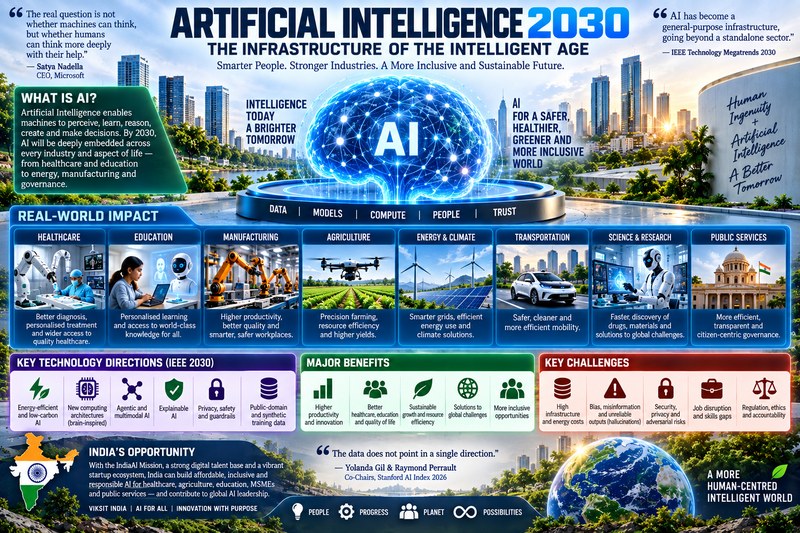
In the present day, artificial intelligence is no longer just another technology branch but a foundational layer through which industries are run, knowledge is generated, and decisions are made. In its 2030 IEEE Technology Megatrends Report prepared by an international team of technology professionals, this technological transition is explicitly recognized: “AI has become a general-purpose infrastructure, going beyond a standalone sector.” This is probably the main technological transition of this decade – AI transitioning from a tool that we occasionally use to an infrastructure embedded in the healthcare industry, energy sector, education, manufacturing, science, finance, space research, and robotics.
Among the technologies related to Artificial Intelligence megatrend identified by IEEE, six areas deserve particular attention: energy-efficient and low-carbon AI, new computing architectures like brain-inspired computing, agentic and multimodal AI beyond transformers, explainable AI, guaranteed privacy with safety and guardrails, and public or synthetic data sets. Such choice of trends is important in that they move the discussion of AI away from the development of increasingly large language models. Instead, the competition for 2030 involves making AI better, autonomous, energy-efficient, explainable, safer, and more reliable.
The transformation is already taking place at the unprecedented pace. According to the 2026 AI Index Report of Stanford University, AI adoption by organizations has increased to 88% in 2025, whereas generative AI has achieved a population-level adoption of approximately 53% in just three years, which was done faster than both the personal computer and the Internet. Moreover, the transition of AI from question-answering technology to agentic systems capable of performing and planning a sequence of actions has begun. However, the findings of Stanford offer an important warning: even the advanced AI demonstrates inconsistent capabilities – while excelling in complex benchmarks, it fails simple tasks.
The potential benefits of AI adoption are immense. AI can accelerate discoveries in science, assist physicians, provide personalized education, optimize electric grids, help forecast weather changes, create software, translate languages, and give people sophisticated knowledge tools. According to Stanford University, there were measurable increases in productivity of structured tasks – 14-15% in customer support and 26% in software development in studies surveyed by the 2026 Index. For developing nations, appropriately designed AI can compensate the shortage of teachers, specialists, and technical expertise instead of automating well-developed organizations.
However, intelligence comes with an infrastructure cost. IEEE specifically draws the connection between energy, computing infrastructure, and AI scalability as a first order of the systems problem, warning that efficiency improvements can be outmatched by Jevons paradox: cheaper or more efficient computation encourages even larger total consumption. Similarly, according to the findings of Stanford University, global AI computing capacity is growing rapidly as well as environmental requirements related to electricity, water consumption, and emissions. Therefore, sustainable AI will require not only more computing power but better chips, smaller specialized models, efficient inference, clean electricity, and radically different computing architectures.
However, there are also major social drawbacks. Hallucinations produce convincing falsehoods, biased data reproduces inequality, synthetic media weakens trust, confidential information gets leaked, cyber criminals exploit AI on a massive scale, and opaque models make decisions that neither user nor regulators can reasonably explain. IEEE’s high-risk/high-reward assessment specifically identifies safety, explainability, and control challenges for autonomous AI, as well as threats from misinformation, cyber warfare, and concentration of power. Additionally, according to Stanford University, in 2025 there were 362 documented AI incidents compared to 233 in 2024, although the responsible-AI evaluation did not keep pace with capability development.
The issue of employment can be considered as the most urgent human challenge. As anticipated by IEEE, AI skills can become increasingly important for employment as some white-collar jobs get automated. Similarly, according to Stanford, the impact of AI on labor market is uneven – while mass unemployment has not occurred yet, the disruption is obvious for young workers in occupations exposed to AI. Thus, the sensible approach is neither automated replacement of humans nor rejection of AI but their augmentation – using machines to increase human capabilities and deliberately retraining people for changed jobs.
For India, this situation opens up unique opportunities. IndiaAI mission is developing subsidized cloud infrastructure aimed at making GPUs and AI platforms available for researchers, students, startups, MSMEs and government organizations while promoting indigenous models and responsible AI development. Additionally, India starts the transition to a new era of AI having relatively high level of workplace engagement: according to the 2025 AI Index Report of Stanford University, in 2025 more than 80% of workers in India and several other emerging economies used AI at work on regular basis. India’s competitive advantage may lie not only in creating large foundation models, but also in developing affordable AI for Indian languages, healthcare, agriculture, education, public services and small businesses.
The task of advocacy is thus evident: India and the world need to accelerate the useful AI but not the unaccountable one. Investment in computing capacity must go hand in hand with the investment in people; innovation with safety measures; scalability with energy efficiency; and automation with human oversight. According to the IEEE report, trust, governance, security, explainability and safe human-machine interaction will be “enablers of scale, not compliance afterthoughts.”
Yolanda Gil and Raymond Perrault, the co-chairs of the Stanford AI Index, have aptly expressed the current state of affairs: “The data does not point in a single direction.” AI can democratize expertise or deepen digital divide; enhance creativity or industrialize misinformation; augment workers or displace them. It depends not on the technology itself but on the choices people make about how to use it. Thus, by 2030, the key metric of artificial intelligence may turn out to be not only how intelligent our machines have become but also how intelligently humanity has learned to use them.
Senior Professor and former Head,
Department of ENT-Head & Neck Surgery, Skull Base Surgery, Cochlear Implant Surgery.
Basaveshwara Medical College & Hospital, Chitradurga, Karnataka, India.
My Vision: I don’t want to be a genius. I want to be a person with a bundle of experience.
My Mission: Help others achieve their life’s objectives in my presence or absence!
My Values: Creating value for others.
Leave a reply




























Leave a reply