
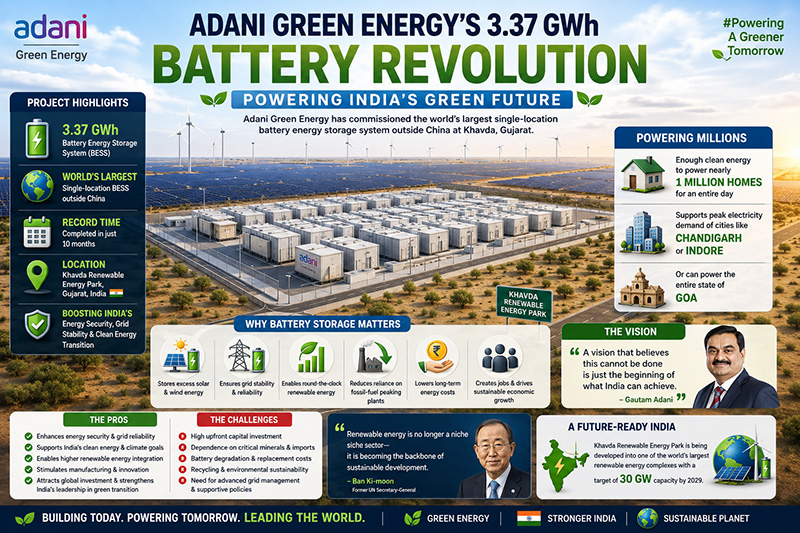
India made another significant step towards clean energy last week. Adani Green Energy Limited (AGEL) completed a battery energy storage system (BESS) consisting of a total capacity of 3.37 GWh at the Khavda Renewable Energy Park in Gujarat. According to AGEL, this facility is the world’s largest BESS project installed outside China and one of the quickest large battery storage projects ever deployed. The project was constructed in less than ten months from the start of its implementation.
Before going into further details, it is important to remember the primary problem of renewable energy. Solar panels generate electricity only during sunlight hours, while the same applies to wind-powered turbines. Therefore, the solution lies in battery technology, which stores excess production in times of abundance and provides energy during peak periods. In essence, batteries form the “brain” of renewable energy projects.
As per its capacity, the Khavda BESS project is capable of storing sufficient amounts of energy to provide for the needs of around a million households within a day and cope with peak consumption demands in Indian cities like Chandigarh, Indore, or entire states such as Goa. From this perspective, batteries contribute significantly to grid reliability, energy security, and transitioning towards 24/7 operation on renewable sources.
Regarding India, this project demonstrates that it is becoming a technology leader rather than a consumer of innovations. The Khavda project demonstrates the thinking pattern associated with the personality of Gautam Adani, which implies constructing large infrastructure facilities and undertaking ambitious projects. Moreover, project managers and the technological team should also be highlighted because they contributed significantly to project success due to their experience and competence.
As a result, India has numerous advantages from such projects. First, they increase the overall resilience of electricity distribution networks and reduce the dependence on fossil fuel power plants. Secondly, they help India achieve climate targets and ensure lower energy costs over the long run. Furthermore, large-scale projects of this kind foster domestic manufacturing, create new highly-qualified jobs, and increase international investments in renewable energy. As UN Secretary-General Ban Ki-moon noted, “Renewable energy is no longer a niche sector—it is the backbone of sustainable development.”
At the same time, there are some problems associated with large battery storage. The cost is very high, although it may be considered an initial barrier to investment. The majority of projects rely on lithium-ion batteries, creating additional concerns related to supply chains, mineral mining, recycling of used products, and environmental impacts. In addition, batteries have a certain lifespan, requiring maintenance or replacement over time. Advanced grid management and proper regulatory frameworks are required as well.
Internationally, India has become part of the club of leaders in energy storage deployment together with China, which is still dominating in the market, and the US, where rapid development took place in regions such as California and Texas. In other words, this project proves that developing countries can sustainably grow their economies while reducing greenhouse gas emissions. Peter Drucker once said, “The best way to predict the future is to create it.” This principle works perfectly for India.
For India itself, the significance of this project goes beyond technological innovations. Until now, this country was regarded primarily as a consumer of technologies. With projects of this kind, it is gradually transforming into the producer or at least the technology deployer. Indeed, the Khavda Renewable Energy Park is expected to evolve into the world’s largest hub of renewable energy, with AGEL planning to reach a 30 GW capacity by 2029. Thus, the battery project demonstrates national ambitions and capabilities.
Businesspeople, government officials, and investors can draw conclusions from this project as well. Namely, they should be prepared that the future belongs to generators of green energy as well as its efficient storers and distributors. India provides an example of such a transition, which means that the time of green transition is not coming soon – we can already witness it now in Gujarat’s desert.
Senior Professor and former Head,
Department of ENT-Head & Neck Surgery, Skull Base Surgery, Cochlear Implant Surgery.
Basaveshwara Medical College & Hospital, Chitradurga, Karnataka, India.
My Vision: I don’t want to be a genius. I want to be a person with a bundle of experience.
My Mission: Help others achieve their life’s objectives in my presence or absence!
My Values: Creating value for others.
References:
- Adani Green Energy Ltd. Adani Green Energy commissions the world’s largest single-location battery energy storage system outside China at Khavda, Gujarat. 2026. (Adani)
- Gupta U. Adani Green Energy commissions 3.37 GWh battery energy storage system in India. ESS News. May 2026. (Energy Storage)
- PV Magazine India. Adani Green Energy commissions 3.37 GWh battery energy storage system at Khavda. May 2026. (pv magazine India)
- Colthorpe A. Adani Green Energy reaches 3.37 GWh of cumulative BESS capacity at India’s Khavda renewable energy park. Energy-Storage.news. May 2026. (Energy-Storage.News)
- Press Trust of India. Adani Green Energy commissions world’s largest battery storage system outside China. NDTV. May 2026. (www.ndtv.com)















*Dear Dr Prahlada N. B Sir,*
Your piece on Adani’s Battery Revolution turns megawatts into meaning. You’ve framed India’s shift from technology consumer to architect — where batteries become the _“brain”_ of renewables, and conviction builds the world’s largest BESS outside China in under ten months.
As you noted, Drucker was right: _“The best way to predict the future is to create it.”_ In Gujarat’s desert, India isn’t waiting for the green transition. It’s writing it.
Thank you for connecting clean energy to clean intent, and for reminding us that infrastructure is also philosophy.
*Pedal for Health. Store for Power. Build for Bharat.* 🔋🇮🇳
With deep respect and admiration,
🙏
Reply