
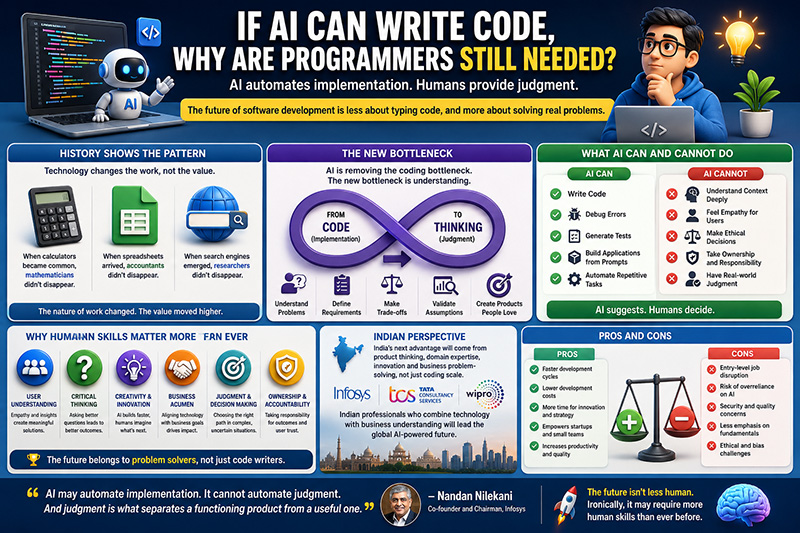
The quick rise of artificial intelligence has everyone in the tech world asking an uncomfortable question: if AI can write code, do we even need programmers anymore? I mean, AI can knock out coding, find bugs, and whip up whole products with just text prompts. So, it’s understandable that developers might worry about being replaced. But here’s the thing – according to Nandan Nilekani, co-founder and chairman of Infosys, this is the wrong question to be worrying about.
Instead, we should be wondering how humans will fit in as coding gets more automated. Think back in history; when big shifts happened in tech, routine jobs often got streamlined by machines. Yet, far from cutting out jobs, it changed roles. Calculators made basic math quicker, but that didn’t end math as a career; spreadsheet software sped up accounting tasks yet kept accountants employed; search engines speed up looking up info, but they didn’t wipe out researchers. These changes moved people to focus more on the bigger picture, strategy, and deep analysis.
Same goes for coding today. We’ve relied heavily on developers actually writing code for years. Nowadays, though, there are these smart AI tools – like GitHub Copilot, Cursor, and other big language models – which bang out lines of code in minutes. Problems that once tied developers down for days are sorted in hours. But hey, code isn’t the hardest part!
The real kicker in any tech project has always been knowing what to develop and why. Lots of initiatives fall flat because teams just misread user wants, give unclear instructions, or make bad calls in planning. Here’s where AI falls flat too – it ain’t got a clue if a problem deserves solving in the first place.
With easy coding tasks becoming super simple due to AI, the actual holdup lies in figuring out which projects to undertake. In this new setup, human judgment – identifying good opportunities, diving deep into customer actions, figuring out the risks, deciding on the vital parts of the plan, and matching all that up with wider company aims – is priceless.
Looking at India specifically, this means a big change for their booming IT scene. They’re famous for their huge coding workforce through giants like Infosys, TCS, and Wipro. If coding itself gets taken over by AI, their next ace in the hole could be leading product design, getting serious domain know-how, sparking fresh ideas, and cracking business issues.
Globally, big shots in tech echo this. Microsoft’s Satya Nadella stresses AI boosting productivity, not crowding out imagination. More execs use “co-pilot” for AI nowadays – hinting machines guide but don’t take charge. Machines spew out options, but humans must check them for rightness, morals, and fitting into the broader plan.
It’s not all sunshine though – entry-level coding gigs might shrink, shifting paths for young coders. And while devs focus more on complex stuff, basic coding duties could get handed mostly to AI. Oversight’s key too; rely on machines entirely, you open doors to risks in security, hidden mistakes, poorly planned coding choices.
Yet, with AI around, tons of benefits come too. Bye-bye boring, menial tasks. Faster innovation, lower costs, leaving teams space for smarter, more valuable efforts. New startups sprinting with products. Companies nailing upgrades quicker. All letting devs dig deeper into customer issues, sorting tricky challenges.
The final takeaway? Code-focused coding jobs are shifting; now more than ever, the best tech pros will need solid human smarts. Wisdom, knowing context, real empathy, foresight, these aren’t automated by algorithms. As Peter Drucker cleverly put, “It’s the unsaid part in a conversation that’s crucial.” In tech’s future, it’ll be spotting these unseen issues that truly count.
So rather than killing programmer jobs, AI might just pump up the demand for human input. Future code whizzes won’t merely type; expect a bigger leap in human understanding, creativity, and discernment than ever seen before.
Senior Professor and former Head,
Department of ENT-Head & Neck Surgery, Skull Base Surgery, Cochlear Implant Surgery.
Basaveshwara Medical College & Hospital, Chitradurga, Karnataka, India.
My Vision: I don’t want to be a genius. I want to be a person with a bundle of experience.
My Mission: Help others achieve their life’s objectives in my presence or absence!
My Values: Creating value for others.
References
- Infosys Official Website
- GitHub Copilot Documentation
- Microsoft AI Strategy and Leadership Insights
- Drucker PF. The Effective Executive. New York: Harper Business; 1967.
- Brynjolfsson E, McAfee A. The Second Machine Age. New York: W.W. Norton; 2014.
- Mollick E. Co-Intelligence: Living and Working with AI. New York: Portfolio; 2024.




























Leave a reply