
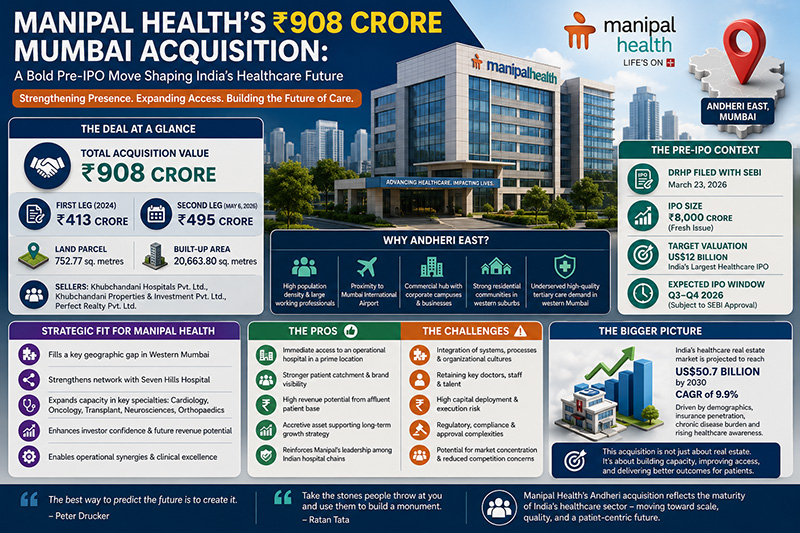
While the purchase of a hospital asset by Manipal Health Enterprises in Andheri East, Mumbai, for around ₹908 crores is certainly an important real estate deal, it can also be seen as much more than this. Firstly, it is indicative of the future of healthcare in India and the gradual institutionalisation of hospital networks. Secondly, it represents one of the latest signs that healthcare infrastructure has emerged as a significant investment opportunity. Thirdly, it shows the confidence with which Manipal Health Enterprises plans to launch its India’s largest ever healthcare IPO.
Contrary to what one might expect, healthcare is a fundamentally local business. Indeed, while patients may choose to cross borders to have highly specialised medical treatments performed, most other forms of healthcare consumption are geographically rooted. Location is thus of key importance to hospitals’ competitive positioning. Mumbai, as one of the most densely populated cities in the world, has all the ingredients for making a lucrative healthcare market. These include a combination of affluent patient base, high levels of diseases, concentration of corporations, medical tourism, and insurance penetration.
The deal in question is an excellent example of a common strategy used by successful healthcare organisations across the globe. Specifically, instead of setting up new hospitals, healthcare enterprises typically prefer to acquire existing operating businesses in order to gain rapid access to markets. In a city like Mumbai, this can sometimes mean that acquiring a hospital makes more sense than building it from scratch. It is, therefore, no surprise to learn that the business model followed by Manipal in India is very similar to the models adopted by some of the biggest players in US and Australian markets, such as HCA Healthcare and Ramsay Health Care.
From a business point of view, there are several benefits offered by the Andheri deal. First of all, the purchase will help Manipal grow its footprint in Western India, thereby supplementing its operations in Seven Hills Hospital. Secondly, the transaction will make Manipal even more attractive for public investors looking to evaluate its upcoming IPO. Indeed, public investors tend to value healthcare companies’ scalability, geographic diversity, and urban penetration. Thirdly, Andheri will give Manipal access to India’s wealthiest patients who can afford the latest treatment types such as oncology, cardiology, transplantation, neurosciences, and robotic surgery.
However, large scale expansions always carry risks. These include, but are not limited to, problems with raising sufficient funds to finance an acquisition, as well as potential integration issues after completing the deal. History abounds with instances when hospital acquisitions have failed to deliver expected synergies due to complications that arise during the process of integrating two entities together.
Another concern is that the consolidation of market leaders may reduce competitiveness and harm consumer choice. Indeed, small independent hospitals are likely to have less bargaining power, worse marketing capabilities, and weaker access to funds compared to larger companies. Consequently, it becomes increasingly difficult for independent hospitals to compete effectively.
More broadly, the acquisition reveals a trend in the evolution of Indian healthcare. Historically, hospitals have been seen primarily as service institutions. Nowadays, however, they are increasingly treated as pieces of infrastructure worth investing in. As such, sovereign wealth funds, private equity, pension funds, and infrastructure investors allocate considerable amounts of money to healthcare. Such allocations are justified by demographic trends that suggest significant demand growth for the foreseeable future.
Indeed, according to renowned management thinker Peter Drucker, “the best way to predict the future is to create it”. Similarly, legendary industrialist Ratan Tata once observed that “you take the stones people throw at you and use them to build a monument”. Applied to healthcare, expansion through acquisitions can be seen as building the infrastructure necessary to provide better care in the future.
Finally, although growth is good, it should not become an end in itself. Whether the above-mentioned Andheri purchase becomes a success for Manipal ultimately depends on patient outcomes, access to services, clinical quality, and efficient delivery.
In summary, viewed in the context of both Indian and global healthcare, Manipal’s latest acquisition represents an important milestone marking the maturing of Indian healthcare. Indeed, it illustrates the shift away from fragmented and entrepreneurial hospitals towards professionally-managed, institutionally-funded healthcare enterprises able to compete globally.
References:
- Shariff M. Manipal Health Has Spent ₹908 Crore to Acquire a Mumbai Hospital in Andheri — Pre-IPO, Pre-SEBI Approval, India’s Most Ambitious Hospital Chain Is Moving Fast. Bengaluru Health Community. June 1, 2026.
- Drucker PF. Management Challenges for the 21st Century. New York: Harper Business; 1999.
- Porter ME, Teisberg EO. Redefining Health Care: Creating Value-Based Competition on Results. Boston: Harvard Business School Press; 2006.
- OECD. Health at a Glance 2025: OECD Indicators. Paris: Organisation for Economic Co-operation and Development.
- Deloitte. Global Healthcare Outlook: Reshaping the Future of Health. Deloitte Insights; recent editions.
- World Health Organization. Global Health Expenditure Database and Universal Health Coverage reports. Geneva: WHO.


























*Dear Dr Prahlada N. B Sir,*
Sharp, timely, and insightful as always.
Your analysis of Manipal’s Andheri acquisition cuts to the core — it’s not just real estate, it’s the future of Indian healthcare taking shape. The shift from fragmented care to institution-led infrastructure is happening in real time, and you’ve mapped it brilliantly.
Loved the Drucker and Tata references — building monuments with the stones thrown at us indeed. Here’s hoping this bet translates to better access, better outcomes, and not just bigger balance sheets.
Thank you for connecting global patterns to *Keralam’s* and Karnataka’s reality. Learning a lot from your posts.
Warm regards,
🙏
Reply