
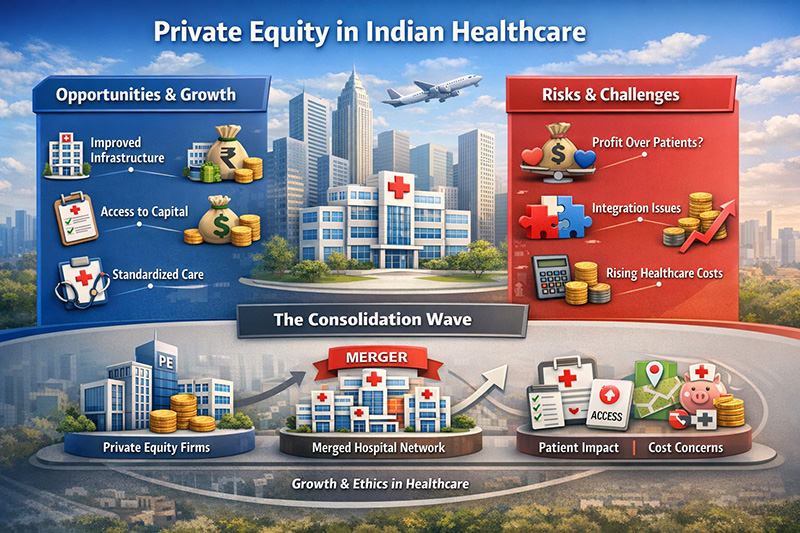
The recent acquisition of Star Hospitals in Hyderabad by KKR-backed Baby Memorial Hospital is more than a financial transaction—it represents a defining moment in the evolving architecture of Indian healthcare delivery. As reported by Mustafa Shariif (April 2026), this ₹1,800 crore deal reflects a broader private equity (PE) strategy of consolidation, scale-building, and eventual value unlocking, a model previously demonstrated in the success story of Max Healthcare under the stewardship of KKR .
At its core, the PE playbook in healthcare revolves around aggregating fragmented assets into integrated platforms, enhancing operational efficiency, standardizing clinical protocols, and ultimately achieving scale that attracts premium valuations. India, with its highly fragmented hospital ecosystem—especially in Tier 2 and Tier 3 cities—offers fertile ground for such consolidation. The acquisition of Star Hospitals, a reputed tertiary care provider founded by Dr. Gopichand Mannam, is a strategic move to strengthen a South India-focused hospital network anchored by Baby Memorial Hospital. The intent is clear: build a multi-city, multi-specialty platform capable of competing with national chains and eventually pursuing public listing or strategic exit .
From a healthcare systems perspective, this model offers several compelling advantages. First, consolidation can drive standardization of care. Fragmented standalone hospitals often struggle with variability in clinical protocols, quality benchmarks, and patient safety practices. A platform approach enables the implementation of unified clinical pathways, centralized procurement, and shared technology infrastructure, which can improve outcomes. As Atul Gawande, renowned surgeon and public health researcher, observed, “Better is possible. It does not take genius. It takes diligence. It takes moral clarity. It takes ingenuity.” This philosophy aligns closely with the operational rigor that PE-backed platforms attempt to instill.
Second, access to capital is a transformative enabler. Many mid-sized hospitals in India face constraints in upgrading infrastructure, adopting advanced technologies such as robotics, or expanding specialty services. PE investment unlocks this capital, allowing institutions to modernize rapidly. The Baby Memorial platform, for instance, is simultaneously pursuing acquisitions and greenfield expansion, including a new hospital in Chennai . Such expansion can improve geographic access to high-quality tertiary care.
However, the model is not without its risks and criticisms. One of the primary concerns is the potential shift from patient-centric care to profit-driven decision-making. Healthcare, unlike other industries, operates within an ethical framework where outcomes and equity must take precedence over margins. The World Health Organization has consistently emphasized that “health is a fundamental human right,” and excessive commercialization risks undermining this principle.
Another critical challenge lies in integration. Merging hospitals with distinct cultures, clinical practices, and management systems is inherently complex. In highly competitive markets like Hyderabad—home to major players such as Apollo, AIG, and Care Hospitals—maintaining clinical quality while driving growth is a delicate balancing act. If integration falters, both patient outcomes and financial returns may suffer. The valuation of Star Hospitals at approximately 5–6 times revenue underscores high investor expectations, which can amplify pressure on management teams .
Internationally, similar consolidation trends have been observed in the United States and Europe, where private equity has played a significant role in healthcare delivery transformation. While these models have improved efficiency and scalability, they have also sparked debates about rising costs and reduced physician autonomy. In India, where out-of-pocket expenditure remains high, such concerns are even more pertinent.
Yet, it would be reductive to view PE involvement purely through a critical lens. When executed responsibly, with strong clinical governance and transparent accountability, platform-based healthcare models can deliver both economic and societal value. They can enable data-driven decision-making, foster innovation, and create integrated care networks that improve patient journeys.
Ultimately, the KKR–Star Hospitals deal is emblematic of a larger shift: healthcare is no longer just a service sector—it is becoming a structured, capital-intensive industry with global investment interest. For clinicians, administrators, and policymakers, the challenge lies in ensuring that this transformation aligns with the foundational ethos of medicine. As Mahatma Gandhi aptly stated, “It is health that is real wealth and not pieces of gold and silver.” The future of Indian healthcare will depend on how well it balances these two imperatives—financial sustainability and ethical responsibility.
Dr. Prahlada N.B
MBBS (JJMMC), MS (PGIMER, Chandigarh).
MBA in Healthcare & Hospital Management (BITS, Pilani),
Postgraduate Certificate in Technology Leadership and Innovation (MIT, USA)
Executive Programme in Strategic Management (IIM, Lucknow)
Senior Management Programme in Healthcare Management (IIM, Kozhikode)
Advanced Certificate in AI for Digital Health and Imaging Program (IISc, Bengaluru).
Senior Professor and former Head,
Department of ENT-Head & Neck Surgery, Skull Base Surgery, Cochlear Implant Surgery.
Basaveshwara Medical College & Hospital, Chitradurga, Karnataka, India.
My Vision: I don’t want to be a genius. I want to be a person with a bundle of experience.
My Mission: Help others achieve their life’s objectives in my presence or absence!
My Values: Creating value for others.
References:
- Shariif M. KKR Just Bought Star Hospitals Hyderabad for ₹1,800 Crore — The PE Playbook That Built Max Healthcare Is Being Replicated in South India. April 16, 2026
- World Health Organization. Constitution of the WHO.
- Gawande A. Better: A Surgeon’s Notes on Performance. Metropolitan Books.
Leave a reply























Leave a reply