
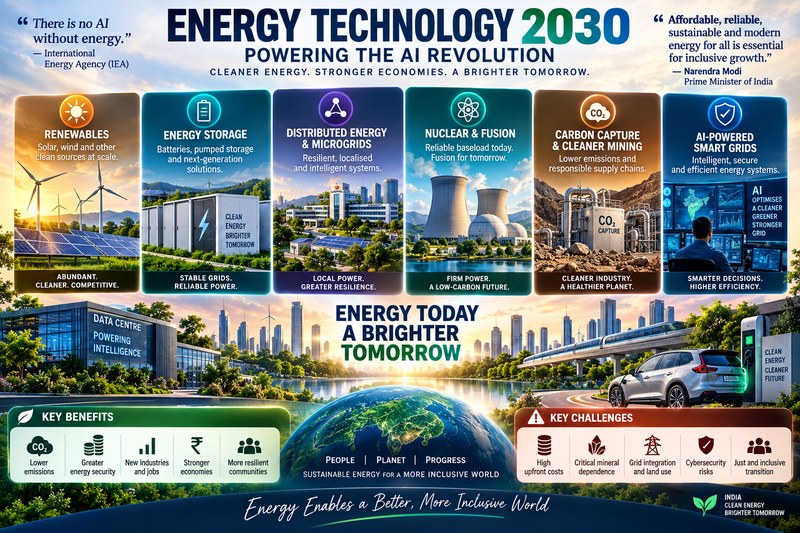
The most important infrastructure of the artificial-intelligence revolution may not be the semiconductor. It may be electricity. In Technology Megatrends 2030, the 166-member IEEE Future Directions/Industry Advisory Board team treats energy as one of five defining technological forces, alongside AI, health, space and physical AI. Its deeper insight is that these forces cannot develop independently: energy, computing infrastructure and AI scalability must increasingly be treated as a single “first order systems problem.”
The IEEE energy vision extends far beyond simply installing more solar panels. It identifies six technology directions: distributed energy resources (DERs) and microgrids, energy storage, carbon capture, fusion, cleaner mining, and safety and guardrails. The report expects microgrids serving IT and urban infrastructure to become pervasive, sees storage becoming an increasingly meaningful source of incremental power, and regards commercial fusion as considerably farther away—meaning conventional nuclear and other established generation will remain necessary during the transition.
This matters because the digital revolution is becoming an electricity revolution. The International Energy Agency puts it succinctly: “There is no AI without energy.” Its Energy and AI analysis estimates that data centres consumed about 415 TWh in 2024 and projects consumption of roughly 945 TWh by 2030 in its base case. AI is the principal driver of that growth. The IEEE report reaches a complementary conclusion: improvements in AI efficiency may be overtaken by the Jevons paradox—when computing becomes more energy-efficient, companies may simply deploy more computing within the available energy budget.
That creates both an extraordinary opportunity and a warning for India. As of 31 August 2026, India had about 295.6 GW of renewable-energy capacity including large hydro, comprising approximately 168.0 GW of solar and 58.5 GW of wind. A country combining abundant renewable resources with batteries, pumped storage, nuclear generation, smart grids and distributed microgrids could turn reliable low-carbon electricity into a strategic advantage for AI, semiconductor manufacturing, electric mobility and advanced industry.
Storage is especially consequential. Solar and wind are variable; hospitals, factories, cities and data centres require electricity continuously. The IEA estimates that, in a pathway consistent with global climate commitments, storage capacity would need to rise sixfold to 1,500 GW by 2030, with batteries providing most of that increase. Microgrids can meanwhile strengthen resilience by allowing campuses, hospitals, factories and communities to combine local generation, storage and intelligent demand management.
The benefits are compelling: lower emissions, greater energy security, reduced exposure to imported fuels, new clean-technology industries, better grid resilience and potentially cheaper electricity over time. AI itself can improve forecasting, predictive maintenance, renewable integration and real-time grid optimisation. The IEEE assessment specifically highlights AI-enabled energy generation for its potential to integrate intermittent renewables and analyse real-time data.
But the transition has costs. Batteries require lithium and other critical minerals; grids require enormous capital investment; transmission projects face land, permitting and community challenges; renewable intermittency requires flexibility; and digitalised grids create new cybersecurity vulnerabilities. The IEEE report also warns that mineral dependence can create geopolitical risk and that transition costs may fall unevenly across society. The IEA similarly notes highly concentrated battery supply chains, with China accounting for almost 85% of global battery-cell production capacity in its cited assessment.
The right response, therefore, is not a simplistic choice between renewables and conventional power. It is to build an intelligent energy ecosystem: renewables where economical, nuclear and other firm generation where necessary, storage at scale, stronger transmission, distributed microgrids, responsible mineral supply chains, carbon-management technologies and AI-controlled grids protected by robust cyber safeguards.
Energy was once regarded mainly as the fuel of industrialisation. By 2030, it may increasingly become the currency of intelligence. Nations able to provide abundant, affordable, resilient and progressively cleaner electricity will have an advantage not merely in energy policy, but in AI, healthcare, manufacturing, mobility and economic sovereignty. For India, the energy transition should therefore be understood not simply as a climate obligation, but as a technological and developmental opportunity.
Senior Professor and former Head,
Department of ENT-Head & Neck Surgery, Skull Base Surgery, Cochlear Implant Surgery.
Basaveshwara Medical College & Hospital, Chitradurga, Karnataka, India.
My Vision: I don’t want to be a genius. I want to be a person with a bundle of experience.
My Mission: Help others achieve their life’s objectives in my presence or absence!
My Values: Creating value for others.
References
- IEEE Future Directions Committee, Industry Advisory Board. Technology Megatrends 2030. The report identifies the interdependence of AI, energy and physical systems and details its energy technology predictions.
- International Energy Agency. Energy and AI. Paris: IEA; 2025.
- International Energy Agency. Batteries and Secure Energy Transitions. Paris: IEA; 2024.
- Ministry of New and Renewable Energy, Government of India. Physical Achievements: Cumulative Physical Progress as on 31 August 2026.
- International Energy Agency. Renewables 2024. The IEA highlights grid infrastructure, flexibility and system integration as increasingly important as wind and solar penetration rises.





























Leave a reply