
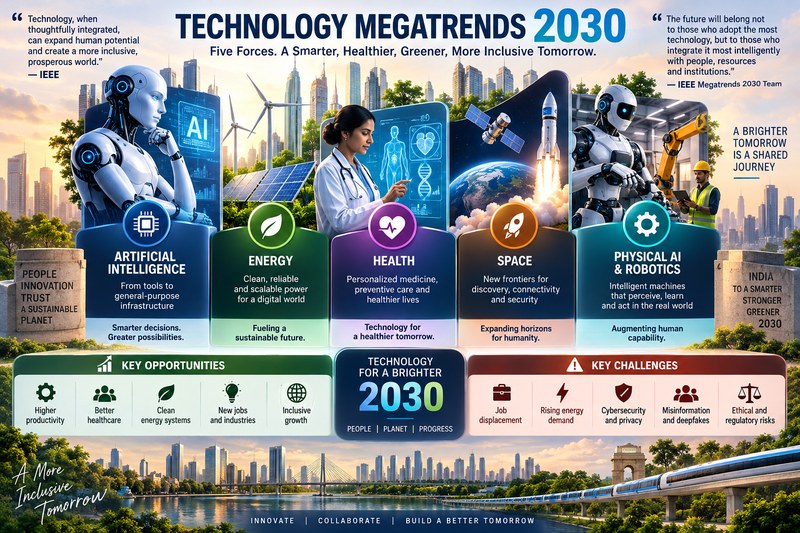
Perhaps the most important takeaway from the just-published IEEE Technology Megatrends 2030 is not the dominance of artificial intelligence in the future. It is the inevitability of increasing convergence between AI, energy, healthcare, robotics and space. Produced by the Megatrends team, comprising 166 experts of the IEEE Future Directions Committee’s Industry Advisory Board, working in collaboration with the IEEE Santa Clara Valley Section, IEEE Computer Society and IEEE Industry Engagement, the report leverages expertise from a remarkable global network of technology professionals. Amongst its key predictions, the report highlights five related forces – AI, energy, health, space and physical AI – which will form a nexus of many upcoming technological transformations around the year 2030.
The key statement that the report makes is that AI is ceasing to be just another technological sector. It is becoming a “general-purpose infrastructure”. Hence, energy availability and efficiency will start acting as limitations to digital progress, while trust, governance and human-AI interaction will have to precede technology scaling instead of being mere regulatory concerns to be addressed later. Consequently, the ways to govern AI are going to change. A country endowed with excellent algorithms and lacking electricity, semiconductor manufacturing, cybersecurity, people or information infrastructure may find itself in a technological bind.
This systemic approach is particularly relevant for India. The country is actively developing digital infrastructure, AI capabilities and electricity production. The Government’s IndiaAI Compute platform has already started providing GPU infrastructure to researchers, academicians, startups, MSMEs, students and government institutions. At the same time, by 31 August 2026, India had reached the level of approximately 295.6 GW of its renewable-energy capacity, with 168 GW coming from solar energy. All these examples showcase exactly the convergence that IEEE predicts – AI race is turning out to be an energy race.
Some of the most socially beneficial results may come from the healthcare domain. According to IEEE, personalized medicine, gene therapy, disease diagnostics, biomarkers, molecular therapeutics and protein synthesis will be among the key healthcare technologies. India may prove itself an especially good place to turn this convergence into socially scalable applications. The Ayushman Bharat Digital Mission has already created infrastructure that would allow citizens to electronically manage, access and share their health records. Combining all this infrastructure (properly protected with respect to privacy), AI-enabled radiology, pathology, genomics, wearables and predictive medicine, one might make healthcare increasingly predictive and preventive, instead of reactive and curative.
The next step, however, is not just generative AI. It is physical AI – intelligence capable of perceiving and performing in the real world. IEEE anticipates autonomous collaborative robotics, energy-efficient edge intelligence, tactile and advanced sensory systems, bio-inspired materials and more natural human-AI interaction. For India, physical AI might revolutionize factories, warehouses, agriculture, hospitals, construction and disaster relief. In nations faced with aging population, it might serve as compensation for labour shortage. However, in India, physical AI could instead serve as augmentation to the huge workforce – provided that automation would be consciously designed around human abilities.
This qualifier is important since the costs of failure are severe. IEEE directly names autonomous weapons and AI cyberwarfare, synthetic media, surveillance, brain-computer interface, gene editing, geoengineering and AGI among the technologies characterized by both high risk and high reward. On one hand, it promises everything from curing genetic illnesses to significant increase in productivity, while, on the other hand, it poses a risk of biosecurity threats, violation of privacy, cascading cyber-physical catastrophes, centralization of power and loss of human control. The report also highlights misinformation, deficit of public trust, skill gap, regulatory fragmentation, geopolitical instabilities and workforce replacement amongst the factors which can limit the progress of technology.
There is another unpleasant limitation: electricity. Greater efficiency of computation does not necessarily lead to lower consumption. Citing the Jevons paradox, IEEE warns that more efficient AI will only encourage greater use of computation till all available energy is consumed. Therefore, higher AI efficiency without expansion of clean energy may turn technological progress into environmental burden.
The right response to the described problem, however, is neither technological pessimism nor uncritical techno-optimism. Recommendations of IEEE are pointing towards “augmentation first” policy: using AI copilots, robotics, simulations and decision support systems as tools to amplify human capabilities, while at the same time working on AI governance, cybersecurity, data protection and continuous re-education of the workforce. For India, this means educating its professionals in AI just like it was done during the previous technological era with respect to digitization.
Thus, the key opportunity of 2030 may consist not in development of the outstanding machine, but in the combination of intelligent machines with abundant clean energy, trustworthy data, personalized healthcare and human judgment. The central idea of the report can be formulated as a rule which should guide us to the new decade: the future will belong not to those societies which would adopt the most technology, but to those who would integrate technology most intelligently with humans, resources and institutions.
Technology is accelerating. Governance and inclusiveness need to keep up with it.
Senior Professor and former Head,
Department of ENT-Head & Neck Surgery, Skull Base Surgery, Cochlear Implant Surgery.
Basaveshwara Medical College & Hospital, Chitradurga, Karnataka, India.
My Vision: I don’t want to be a genius. I want to be a person with a bundle of experience.
My Mission: Help others achieve their life’s objectives in my presence or absence!
My Values: Creating value for others.
References
- IEEE Future Directions Committee Industry Advisory Board. Technology Megatrends 2030. IEEE; 2026. Uploaded report.
- IEEE Megatrends 2030 Team. Executive Summary: five technology megatrends and 30 technology predictions.
- IEEE Megatrends 2030 Team. Technologies Landscape.
- IEEE Megatrends 2030 Team. 2030 Technologies with High Risk-Reward.
- IEEE Megatrends 2030 Team. Survey: Targeted Recommendations.
- Ministry of New and Renewable Energy, Government of India. Physical Achievements: Cumulative Renewable Energy Capacity as on 31 August 2026.
- IndiaAI, Ministry of Electronics and Information Technology, Government of India. IndiaAI Compute Portal.
- National Health Authority, Government of India. Ayushman Bharat Digital Mission—My Health Records.



























Leave a reply