
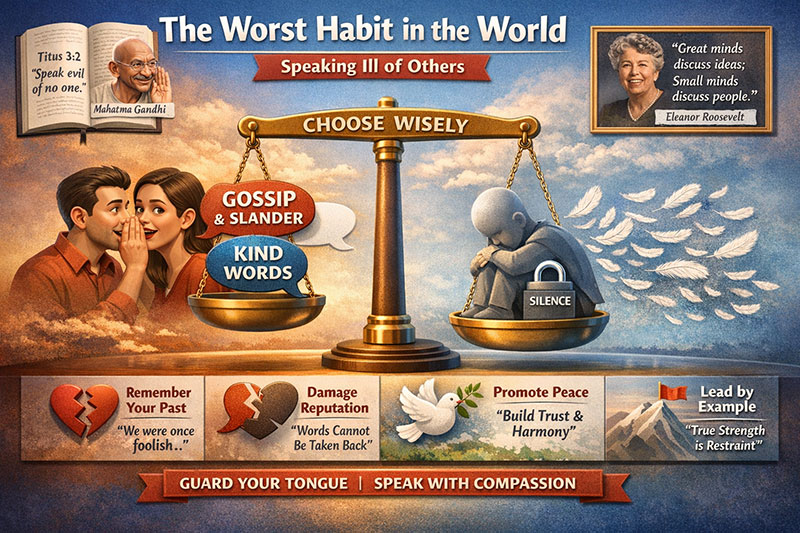
Just the other day, a marketing email arrived in my inbox from one of my favourite author and motivational guru—no less than Robin Sharma—subject lined “The worst habit in the world.”
And, as in every such message, there has been curiosity. There are obviously many damaging practices—greed, dishonesty, laziness, arrogance. But the one he chose stands out among the rest in its subtle destruction: Speaking against those who are not there.
At first glance, it might seem harmless—just words, just talking. But words do have a remarkable ability to shape and mould minds, relationships, and culture. This prompted an uninterrupted trip down memory lane as far back as a Bible verse I memorized long ago.
Such is the scripture in Titus 3:2, where the Bible says, “To speak evil of no one, to be peaceable, gentle, showing all meekness to all men.” Notice that the wisdom in this scripture is profound. Paul, the apostle, does not simply make a moral decree but, rather, finds his reason for this moral decree. He says that believers are, in effect, remembering themselves. They, too, were imperfect. They, too, were foolish, misguided, and unkind. Because of this, he says that showing meekness to all men is not an exhibition of moral superiority.
The Greek word for “speak evil” (blasphēmeō) carries the meaning of slandering or damaging one’s reputation. Gossiping is not simply an idle chatter; rather, it is a character assassination in absentia. Such speech rarely remains localized. Gossip is like smoke; it drifts and chokes.
Indian philosophy has traditionally expressed this truth. The Mahabharata states that uncontrolled speech can be more destructive than uncontrolled action. Mahatma Gandhi expressed this ethic succinctly:
“Speak only if it improves upon the silence.”
Gandhi understood that “tongue control is no weakness, but strength controlled.”
Here’s a parable you might have heard in Indian households many times over. A man goes about speaking slandering words about his neighbour. But when eventually guilt gets the better of him, he goes to the wise elder and asks to be forgiven. The wise elder tells the guilty man to go and burst open a pillow full of feathers on the roof and then report back to him the next day to pick them up. Which, naturally, are blown away by the winds and can never be picked up.
Today’s psychology confirms the validity of this ancient wisdom. Research regarding organizational culture has empirically verified that gossip damages trust, inspires anxiety, and shatters teamwork. Conversely, organizational cultures that value respectful communication exhibit higher collaboration rates.
The Bible has another thought to share. James 1:26 says that without controlling the tongue, one’s Christianity is meaningless. And without kindness, compassion, and forgiving qualities mentioned in Ephesians 4:32 towards fellow human beings, an individual cannot speak ill of them.
In a global perspective, the words of former First Lady Eleanor Roosevelt remain to this date very relevant: “Great minds discuss ideas; average minds discuss events; small minds discuss people.” While it is very quotable, it is still very relevant because it highlights a timeless truth: our words reflect our level of thinking.
In this world of instant messaging, social media, and anonymity, this “worst habit” has found expansive power. But its cure is timeless: think before speaking, gauge your intentions, and wonder if your words will cure or hurt.
At the end of it all, tongue control is not a function of monitoring another person’s conduct; it is a matter of personal control. As Robin Sharma continually quotes, “leaders must lead from within.” The most important hallmark of personal leadership is: “When a person is out of the room, your words protect his/her dignity, rather than detract from it.”
Dr. Prahlada N.B
MBBS (JJMMC), MS (PGIMER, Chandigarh).
MBA in Healthcare & Hospital Management (BITS, Pilani),
Postgraduate Certificate in Technology Leadership and Innovation (MIT, USA)
Executive Programme in Strategic Management (IIM, Lucknow)
Senior Management Programme in Healthcare Management (IIM, Kozhikode)
Advanced Certificate in AI for Digital Health and Imaging Program (IISc, Bengaluru).
Senior Professor and former Head,
Department of ENT-Head & Neck Surgery, Skull Base Surgery, Cochlear Implant Surgery.
Basaveshwara Medical College & Hospital, Chitradurga, Karnataka, India.
My Vision: I don’t want to be a genius. I want to be a person with a bundle of experience.
My Mission: Help others achieve their life’s objectives in my presence or absence!
My Values: Creating value for others.
Leave a reply


























Leave a reply