
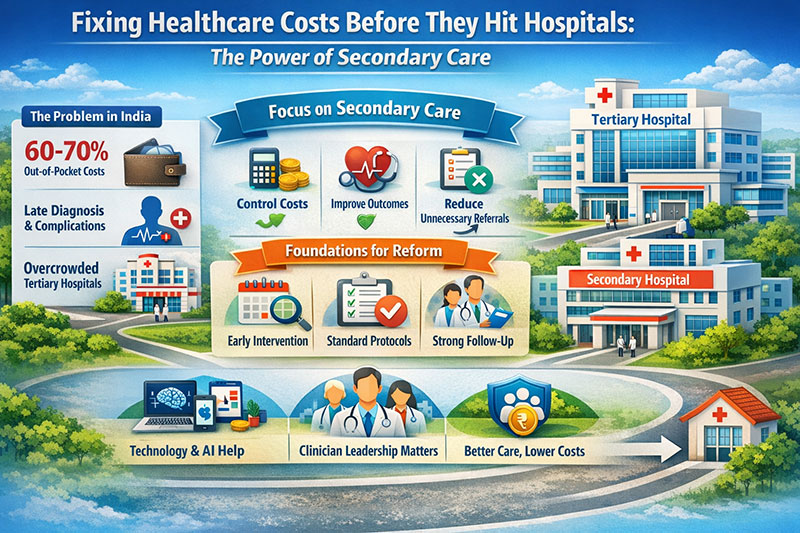
India’s healthcare crisis is often framed around two extremes: underfunded primary care and overcrowded tertiary hospitals. Yet the most decisive battleground for cost control, clinical outcomes, and system efficiency lies quietly in between—secondary care. Ignoring this layer has made healthcare unnecessarily expensive, fragmented, and reactive.
According to India’s National Health Accounts and World Bank estimates, nearly 60–70% of total healthcare expenditure in India is out-of-pocket, one of the highest proportions globally. A large share of this burden does not arise from rare diseases or advanced procedures, but from late diagnosis, avoidable complications, and poorly coordinated care pathways that escalate manageable conditions into financial and clinical crises.
As the World Health Organization has repeatedly emphasized, “Health systems fail not because of lack of technology, but because of weak delivery platforms.”
Late Diagnosis Is a Systems Failure, Not a Patient Failure
In India, patients frequently present late—not because they are indifferent, but because the system does not reliably catch disease early. Hypertension, diabetes, chronic ear disease, early cancers, COPD, and vestibular disorders often circulate between clinics without standardized evaluation or follow-up. By the time they reach tertiary hospitals, they require intensive interventions that are both expensive and risky.
The Lancet Commission on High-Quality Health Systems clearly demonstrated that poor-quality care causes more deaths globally than lack of access to care. In other words, patients are entering the system—but at the wrong level, too late, and without continuity.
An Indian public health economist once summarized this bluntly: “We don’t have a disease burden problem as much as we have a care-pathway problem.”
Why Secondary Care Is the Real Control Point
Secondary care—district hospitals, medical college hospitals, and well-run private hospitals—is where most conditions should be definitively managed. This is where diagnosis can be confirmed, protocols applied, and longitudinal care organized.
When secondary care functions well:
- Costs are controlled because escalation is selective, not reflexive.
- Outcomes improve through early intervention and standardized treatment.
- Unnecessary tertiary referrals and investigations drop sharply.
Countries with strong secondary care frameworks consistently demonstrate lower catastrophic health expenditure. The UK’s NHS, for example, relies heavily on protocol-driven secondary care to absorb disease burden before it overwhelms specialist centers. Similarly, Thailand’s universal health coverage reforms strengthened district-level secondary hospitals first, resulting in dramatic reductions in out-of-pocket spending.
A senior NHS clinician once remarked: “Tertiary hospitals should be places of precision—not congestion.”
Technology Helps—but Systems Decide the Impact
India is rapidly adopting electronic health records, AI-assisted diagnostics, telemedicine, and predictive analytics. These tools undeniably help—but evidence shows that technology without system redesign produces marginal gains.
A 2023 WHO policy brief on digital health warned that digital tools layered onto weak systems often increase fragmentation rather than reduce it. AI can flag abnormalities, but if referral pathways, accountability, and follow-up loops are broken, patients still fall through the cracks.
India offers many examples: AI-enabled radiology reporting that identifies early disease, but no structured mechanism ensures patient recall; screening camps that generate data, but no downstream clinical ownership; teleconsultations that end without documented continuity.
As one global health systems scholar put it: “Digital health scales chaos unless governance scales first.”
Clinician Leadership Is the Missing Multiplier
What consistently distinguishes high-performing secondary care institutions—both in India and abroad—is clinician-led system ownership. When clinicians define protocols, triage rules, and escalation thresholds, care becomes predictable, safer, and more affordable.
The Narayana Health model in India demonstrated that protocolization and clinician-driven process engineering can dramatically reduce costs without compromising outcomes. Internationally, the Mayo Clinic’s integrated care pathways show how specialist expertise can coexist with standardized secondary-level management.
Technology supports these models, but leadership enables them.
Reform Begins Before the Hospital Door
Healthcare reform is often imagined as something that happens inside hospitals—new ICUs, robots, AI dashboards. In reality, reform begins before patients arrive: in early recognition, referral discipline, continuity of care, and reliable follow-up systems anchored in secondary care.
Strengthening secondary care is not a compromise solution—it is the highest-leverage intervention available to India today. It protects households from financial shock, preserves tertiary capacity, and restores medicine to its preventive and problem-solving roots.
As the World Bank succinctly noted in its India Health Financing review: “The fastest way to reduce catastrophic health spending is not more insurance—but better care at the right level.”
India does not need to choose between affordability and excellence. It needs to choose where excellence is applied first.
Dr. Prahlada N.B
MBBS (JJMMC), MS (PGIMER, Chandigarh).
MBA in Healthcare & Hospital Management (BITS, Pilani),
Postgraduate Certificate in Technology Leadership and Innovation (MIT, USA)
Executive Programme in Strategic Management (IIM, Lucknow)
Senior Management Programme in Healthcare Management (IIM, Kozhikode)
Advanced Certificate in AI for Digital Health and Imaging Program (IISc, Bengaluru).
Senior Professor and former Head,
Department of ENT-Head & Neck Surgery, Skull Base Surgery, Cochlear Implant Surgery.
Basaveshwara Medical College & Hospital, Chitradurga, Karnataka, India.
My Vision: I don’t want to be a genius. I want to be a person with a bundle of experience.
My Mission: Help others achieve their life’s objectives in my presence or absence!
My Values: Creating value for others.
Leave a reply




























Leave a reply