
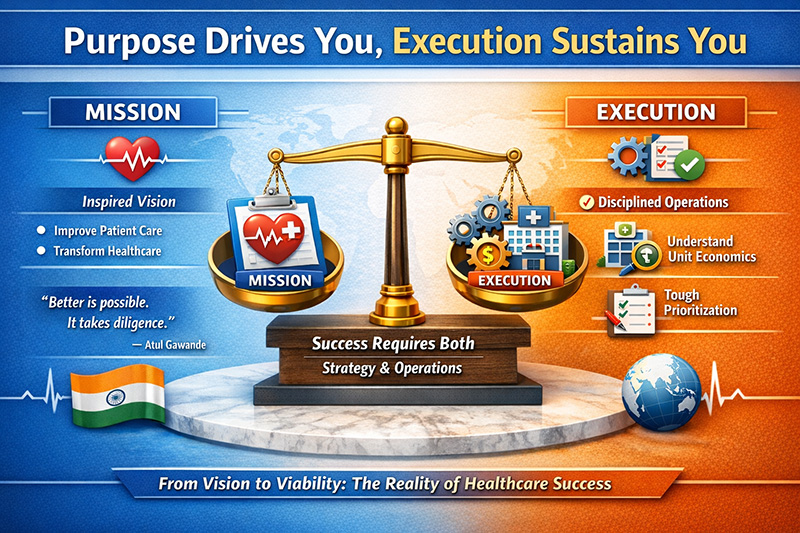
Purpose-driven healthcare entrepreneurship is common. Most founders are committed to addressing the challenges of health inequity, access, and patient well-being. Such a foundational value proposition cannot be undermined; it must be central. However, research on Indian and global healthcare entrepreneurship shows that having a clear mission is not enough. Success and impact require discipline and economic acumen.
Research on healthcare entrepreneurship demonstrates how crucial it is for entrepreneurs to not just articulate their mission but also deliver execution. For example, an integrative framework published in a 2024 study in healthcare innovation literature highlights that successful healthcare entrepreneurship ventures need to produce impact by achieving both health and operational results, necessitating collaboration between different parties involved. This means that one needs both purpose and economic sustainability.
Unlike consumer-facing innovations, healthcare requires rigorous execution. Healthcare innovations cannot rely on iterations since health is a highly regulated sector and any errors or inefficiencies in service provision can lead to negative consequences. Several studies on health tech startups reveal that the major barrier to starting a business and operating efficiently lies in the complex regulatory context and the complexity of healthcare systems. Therefore, developing a rigorous approach to operations is vital in this sector.
Execution starts with the development of operations. Healthcare requires coordinated efforts of medical specialists, administrators, payers, and patients. Any inefficiencies in any step of the process can negatively affect outcomes. For instance, inefficiency in scheduling, paperwork, and procurement is detrimental. Modern healthcare startups demonstrate how execution goes beyond innovation. For example, AI-driven healthcare startups have achieved operational efficiency by reducing workload for doctors and increasing the number of patients seen.
Furthermore, understanding unit economics is critical for success. Health-care entrepreneurs often overlook how complicated it is to deliver high-quality care. Staff costs, the cost of maintaining facilities, the need for compliance, and patient acquisition add up. Moreover, healthcare researchers have long understood the peculiarities of health markets, where asymmetry of information and variability in prices distort conventional principles. Therefore, having a thorough understanding of unit economics in terms of how much a startup earns per patient and its lifetime value is vital.
Some Indian startups in the field of healthcare entrepreneurship use outcome-based models. By linking the price and the results provided, such startups manage to align economics and ethics of health care. Thus, it is possible to see that economic rigor can coexist with the mission of the company.
Another aspect of execution that needs to be highlighted is the skill of prioritizing tasks and goals. Expanding the scope of activities, developing additional features, or pursuing growth are very tempting. However, research shows that companies that are good at focusing on specific activities perform better. Product-market fit, team capabilities, and value creation for the stakeholders should be the focus of healthcare ventures. Difficult but necessary decisions can become the hallmark of great businesses.
The above information highlights how healthcare ventures face the challenge of balancing mission and execution. American physician and innovator Atul Gawande emphasized in his work that better health care is possible. He notes that “better is possible. It does not take genius. It takes diligence. It takes moral clarity.” This quotation perfectly sums up what is essential in entrepreneurship in health care: success in this field depends more on persistence than anything else.
For the Indian context, the task of balancing mission and execution is even more important. Indeed, the iron triangle of health care consists of affordability, accessibility, and quality. Frameworks proposed by health economists show that only integration of all three factors via data and effective management is possible. Execution is not solely about internal processes.
Nevertheless, there are some potential risks associated with this approach. First, focusing on execution may result in over-standardization. It may harm the humanistic component of care. Another issue that emerges in healthcare entrepreneurship is related to cost. If poorly implemented, economic focus might undermine the core of healthcare entrepreneurship. Debates surrounding private equity in health care emphasize the point that health care value might suffer from this approach. Therefore, it is crucial to remember about a mission throughout the execution process.
Conclusively, the healthcare sector requires patience, perseverance, and rigor. Being a long-cycle business, health care needs founders who do not only create visions but who also build systems, optimize resources, and deal with complexities.
Dr. Prahlada N.B
MBBS (JJMMC), MS (PGIMER, Chandigarh).
MBA in Healthcare & Hospital Management (BITS, Pilani),
Postgraduate Certificate in Technology Leadership and Innovation (MIT, USA)
Executive Programme in Strategic Management (IIM, Lucknow)
Senior Management Programme in Healthcare Management (IIM, Kozhikode)
Advanced Certificate in AI for Digital Health and Imaging Program (IISc, Bengaluru).
Senior Professor and former Head,
Department of ENT-Head & Neck Surgery, Skull Base Surgery, Cochlear Implant Surgery.
Basaveshwara Medical College & Hospital, Chitradurga, Karnataka, India.
My Vision: I don’t want to be a genius. I want to be a person with a bundle of experience.
My Mission: Help others achieve their life’s objectives in my presence or absence!
My Values: Creating value for others.
Leave a reply





























Leave a reply